All species › Gamebirds › Partridges, pheasants, grouse and allies › Ruffed Grouse
Ruffed Grouse | Bonasa umbellus
Kraaghoen | Grévol Engolado
The Ruffed Grouse is the gamebird of young deciduous and mixed forest across the east and north, with a chunky body, a short crest, and a long, fan-shaped tail carrying a broad dark band near the tip. Its 'song' is not a sound from the throat but a drumming made with the wings, which thuds through the forest in spring without the bird itself ever coming into view. It occurs in two colour morphs, reddish-brown and grey, which occur side by side in the same woods.

Voice
The male stands on a fallen log and speeds up a series of dull, hollow wingbeats into a rapid drumming — the 'drum' — that starts as separate thumps and within half a minute becomes an unbroken buzzing roll, much like a distant outboard motor starting up. The sound carries hundreds of metres through the forest and is used to mark a territory and attract a female, not as a call in the ordinary sense. The species also gives a low, clucking contact note, and a hissing sound while raising its ruff when disturbed.
Recording: Stanislas Wroza — CC BY-NC-SA 4.0 · Les Dunes (near Tadoussac), Côte-Nord, Quebec, Canada · xeno-canto
Identification
The male has a broad black ruff of feathers on each side of the neck that it raises into a full collar while drumming and when threatened, and a fan-shaped tail with a broad, dark band just short of the edge. The female closely resembles the male but has a smaller ruff and a tail band that is often broken in the middle. Both sexes are otherwise finely patterned in brown and grey, a pattern that barely stands out on the forest floor among dead leaves. When flushed the bird bursts straight up through the trees with a loud, explosive wingbeat, landing again after a short distance to sit motionless.
Confusion species
In the north of its range it overlaps with Spruce Grouse (Canachites canadensis), which is smaller and darker, has a red eye-comb in the male, and keeps to conifer forest rather than the deciduous and mixed forest the Ruffed Grouse favours; Spruce Grouse also lacks the clear neck ruff and the broad dark tail band. In the mountains of the west it occurs alongside Dusky Grouse, which is considerably larger, plainer greyish-brown, and lacks a ruff. Ruffed Grouse is further told from both by its more fully feathered, slightly longer tail with sharply defined banding.
Habitat
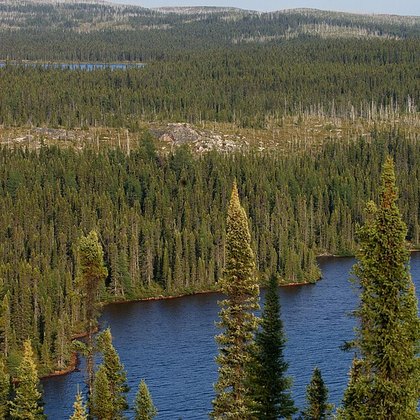
Young to medium-aged deciduous and mixed forest with a dense shrub layer, with a strong preference for regenerating aspen and birch, whose buds form the most important winter food. It avoids both open ground and old, opened-up forest without a shrub layer, and needs cover at ground level to conceal the nest and chicks. In the north of its range it dives into loose snow at night during severe cold to roost, which insulates it from the low temperatures.
Where the bird is most often found, arranged by the USNVC — the vegetation classification of the United States and Canada — and CMECS for sea and coast.


Range and movements
Resident across nearly all of forested Canada and in a broad band of the northeastern and northern United States, with an arm running south through the Appalachians to northern Georgia and Alabama, and west through boreal and montane forest to Alaska, British Columbia and the northern Rocky Mountains. It does not migrate. South of the Great Lakes and across the Midwest it has disappeared from much of its former range during the twentieth century through deforestation and forest maturation, leaving only isolated populations, while the core of the range in Canada and the north has remained stable.
- Resident
- Breeding (summer)
- Winter
- Passage
- dark = core range, pale = thinly spread
Where and when to look
Go to young deciduous forest thick with aspen in the early morning in April and listen for the drumming, which still carries clearly a few hundred metres away; then approach slowly, since a male returns to the same fallen log again and again. In winter the species can be found where aspen buds are being eaten in the crowns of young trees, recognisable by nipped-off twig tips scattered on the snow.
Conservation
Least Concern (LC); widespread and still locally numerous, with numbers that naturally rise and fall on a roughly ten-year cycle, especially in the north of the range. South and west of the Great Lakes region the species has declined substantially compared with a century ago through the loss of young forest and the fragmentation of woodland.
Scientific name
Bonasa umbellus | (Linnaeus, 1766)
Linnaeus described the species in 1766 as Tetrao umbellus, among the capercaillies and grouse; it has since been placed in the genus Bonasa, hence the parentheses around author and year. That genus derives from the Latin bonasus, a wild ox or bison, after the booming drum that recalls the bellow of such an animal. umbellus is Latin for 'small parasol', after the ruff of feathers the male can raise around its neck. The type locality is Pennsylvania.