All species › Gamebirds › Partridges, pheasants, grouse and allies › Greater Sage-Grouse
Greater Sage-Grouse | Centrocercus urophasianus
Waaierhoen | Gallo de las Artemisas Grande
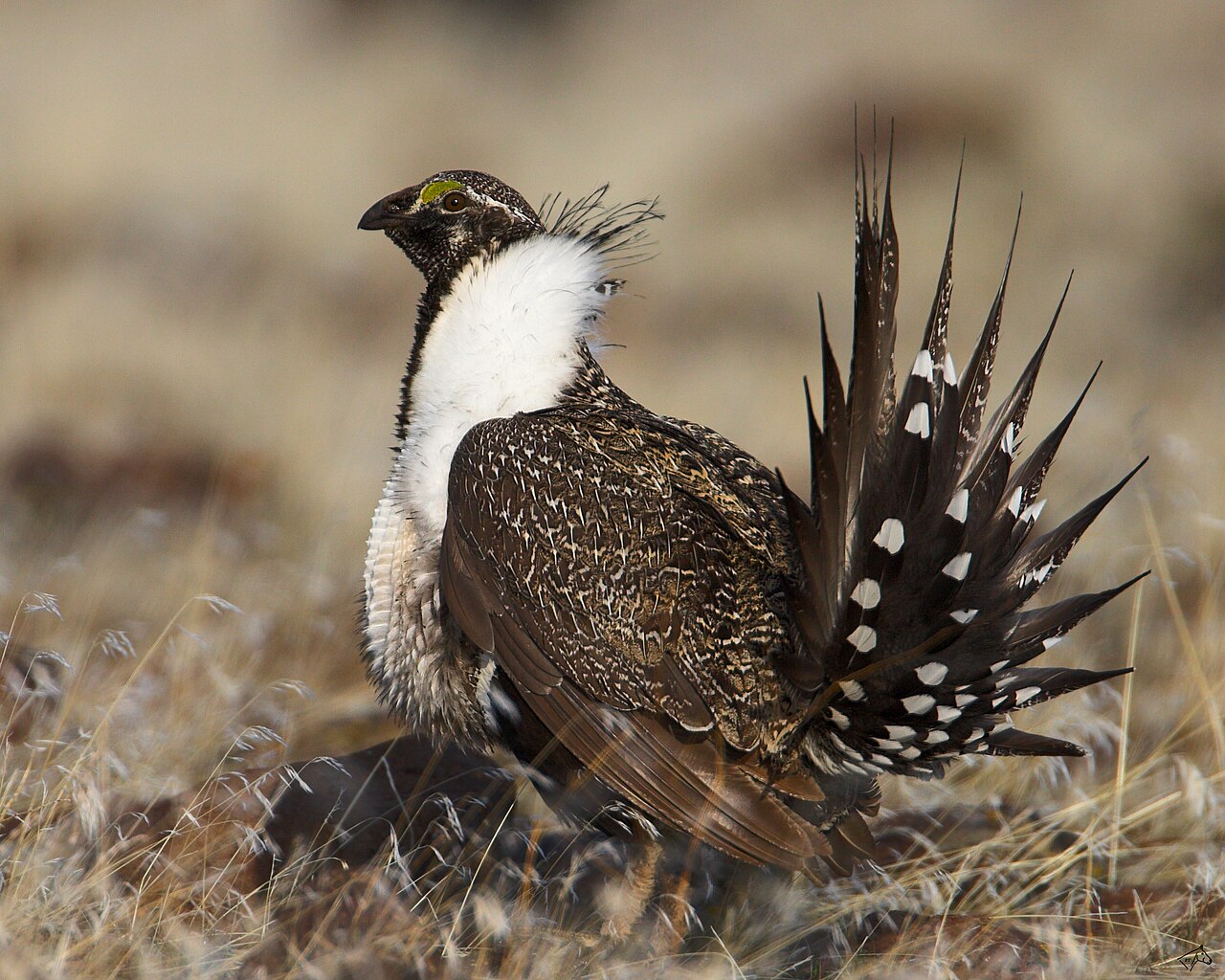
The Greater Sage-Grouse is North America's largest grouse and, at the same time, the bird most tightly bound to a single plant: it feeds, shelters and nests almost entirely in sagebrush (grey-green wormwood scrub of the dry western interior) steppe dominated by Artemisia shrubs. The male is considerably larger than the female and carries two yellow air sacs on the breast during display, inflated like balloons. Without unbroken sagebrush cover the species cannot survive, even in land that otherwise looks suitable.
Voice
At the lek, a traditional open ground amid the sagebrush, the male inflates its two yellow throat sacs in turn and lets them collapse with a deep, plopping plop-plop, accompanied by the swish of stiff breast feathers rubbing together — not a call from the throat, but a combination of air-sac and feather sound. Dozens of males can display at the same lek at once, producing a dull, bubbling chorus that rolls across the steppe and, in still air, still carries hundreds of metres. Away from the lek the species is quiet, giving at most a low, clucking sound when alarmed.
Recording: Nick Komar — CC BY-NC-SA 4.0 · Coalmont, Jackson County, Colorado, United States · xeno-canto
Identification
The male is large and heavy-bodied, with a long, pointed tail of spiky feathers that is fanned upright during display, a white breast ruff, a black belly patch, and two bare yellow air sacs on the otherwise fluffy white breast. The female is considerably smaller and plainly mottled greyish-brown, lacking the male's features, and closely resembles the female Gunnison Sage-Grouse. Both sexes have feathered legs and a small, round head on a thick neck. In flight the bird is heavy and slow to get airborne, flying low and straight over the sagebrush.
Confusion species
Gunnison Sage-Grouse (Centrocercus minimus) is clearly smaller and has finer, more closely spaced white bars on the tail feathers; the displaying male swishes its breast feathers faster and more forcefully and adds an extra, higher-pitched swishing note that Greater Sage-Grouse lacks. The two species occur together almost nowhere — Gunnison Sage-Grouse is confined to the Gunnison Basin of Colorado and adjoining Utah, far from most Greater Sage-Grouse populations. Size alone usually settles the identification: Greater Sage-Grouse is noticeably the larger and heavier of the two.
Habitat
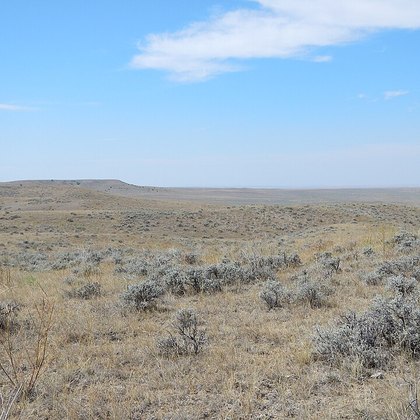
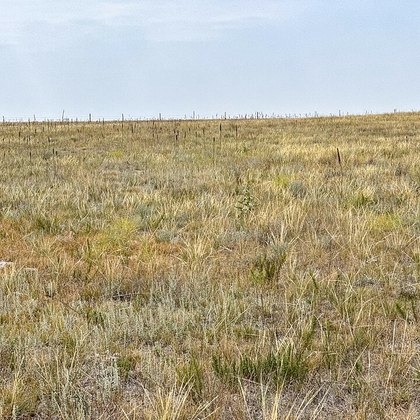
Extensive, unbroken sagebrush steppe with Artemisia as the dominant shrub, across the high plains and valleys of the Great Basin and the northern Rocky Mountains. The bird needs large, undisturbed areas: lek, nest site and winter range can lie tens of kilometres apart, and all three must remain connected by sagebrush. Land where sagebrush has been cleared for cropland, graded after a fire, or replaced by introduced grasses is abandoned even if the rest of the landscape is unchanged.
Where the bird is most often found, arranged by the USNVC — the vegetation classification of the United States and Canada — and CMECS for sea and coast.
Range and movements
Resident in the western United States, from Washington, Oregon and California east through Nevada, Idaho, Utah, Colorado, Wyoming and Montana to western South Dakota, with a small range in southern Alberta and Saskatchewan in Canada. It does not migrate, although birds may shift tens of kilometres between summer and winter habitat within the same sagebrush landscape. The range has roughly halved since the nineteenth century through land clearing, fire and the development of roads and energy infrastructure across the sagebrush steppe, and in North Dakota, where it was formerly more widespread, the species has almost disappeared.
- Resident
- Breeding (summer)
- Winter
- Passage
- dark = core range, pale = thinly spread
Where and when to look
Visit a known lek before sunrise between March and May, stay well back in a vehicle or behind a blind, and use binoculars: the birds are sensitive to disturbance, and a lek that is flushed is often abandoned afterwards. Local wildlife agencies can usually point to the nearest accessible lek.
Conservation
Listed as Vulnerable (VU) by the IUCN, with a population that has declined by tens of per cent over recent decades through the loss and fragmentation of sagebrush steppe to agriculture, energy development, fire and the spread of invasive grasses. The species has for years been a candidate for federal protection in the United States.
Scientific name
Centrocercus urophasianus | (Bonaparte, 1827)
Bonaparte described the species in 1827 as Tetrao urophasianus, among the capercaillies; it has since been placed in the genus Centrocercus, hence the parentheses around author and year. Centrocercus is Greek for 'spike-tailed', after the pointed, stiff tail feathers; urophasianus means 'tailed pheasant', a reference to that same long tail. The type locality covers the country west of the Mississippi, particularly along the Missouri.