All species › Gamebirds › Partridges, pheasants, grouse and allies › Gunnison Sage-Grouse
Gunnison Sage-Grouse | Centrocercus minimus
Gunnisonwaaierhoen | Gallo de las Artemisas Chico
Gunnison Sage-Grouse is the smaller, tightly isolated counterpart of Greater Sage-Grouse, confined to the Gunnison Basin in southwestern Colorado and a small adjoining part of Utah. Outside that one valley the species occurs nowhere. It was only distinguished as a separate species from the far more widespread Greater Sage-Grouse in 2000, on the basis of differences in size, tail pattern and display behaviour.
Voice
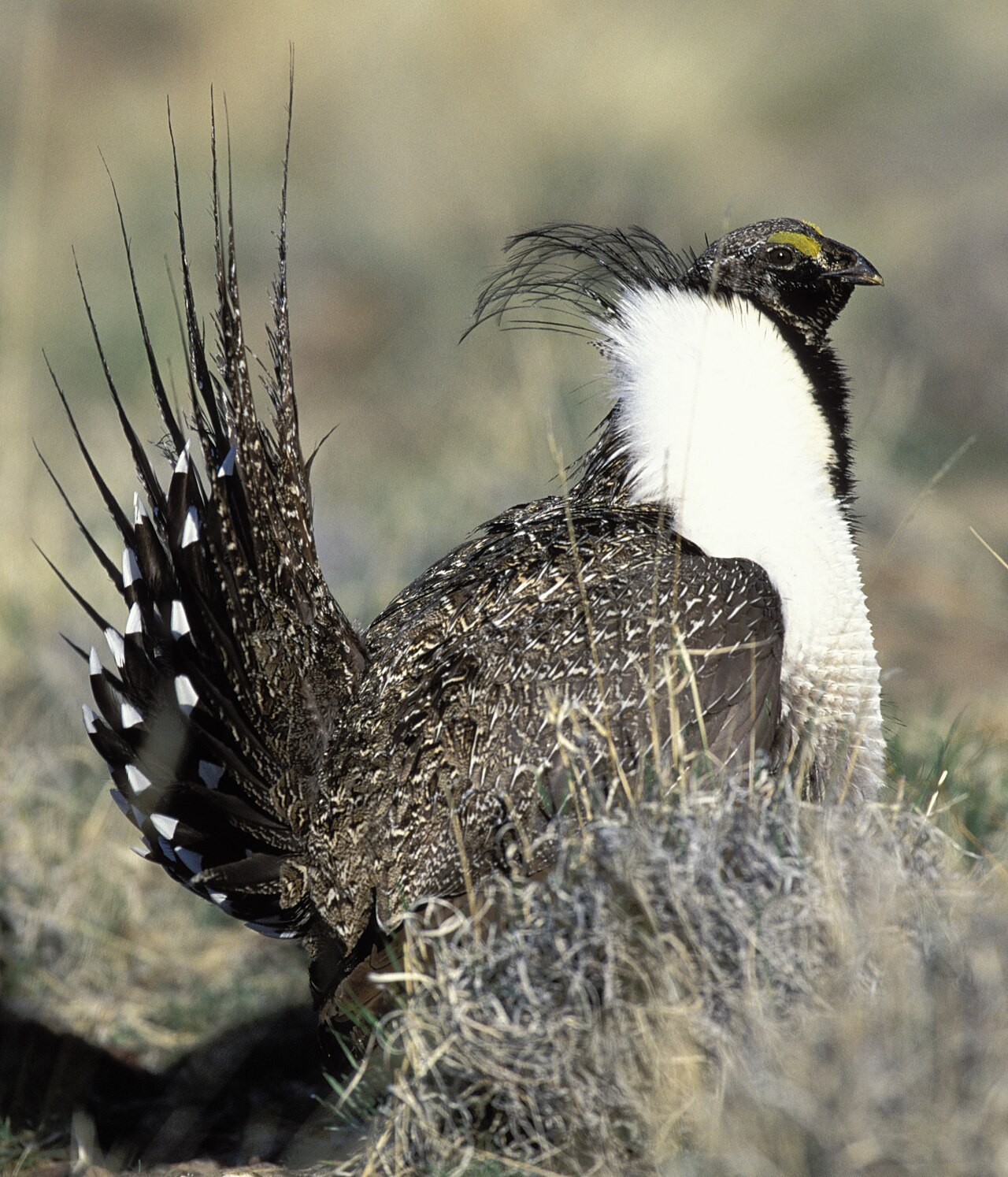
The display runs much as in Greater Sage-Grouse, with two yellow throat sacs inflated and collapsed with a plopping sound, but in Gunnison Sage-Grouse it happens faster and more forcefully, with an extra, higher-pitched swishing note from the breast feathers that the larger species lacks. The tail feathers are also flicked back and forth faster during display, producing a rattling extra sound. Away from the lek the species is quiet, giving at most a low contact note between covey members.
No freely licensed recording has been found for this species yet; what to listen for is described below.
Identification
The male closely resembles that of Greater Sage-Grouse — large, pointed tail feathers fanned upright during display, a white breast ruff, a black belly patch and two yellow air sacs — but is noticeably smaller and lighter, with finer, more closely spaced white bars on the tail feathers. The female is plainly mottled greyish-brown and barely distinguishable from the female Greater Sage-Grouse except by size. Both sexes have feathered legs and a chunky body of smaller size than their sister species. In flight the bird is, like Greater Sage-Grouse, heavy and low-flying, but distinctly lighter-bodied.
Confusion species
Greater Sage-Grouse (Centrocercus urophasianus) is the only species with which confusion is possible, and the difference is mainly one of size: Gunnison Sage-Grouse is noticeably smaller and lighter, with a distinctly finer tail-banding pattern. During display the distinction is even clearer to hear — Gunnison Sage-Grouse swishes its breast feathers faster and adds the extra, higher-pitched swishing note. Because the two species occur together almost nowhere — Greater Sage-Grouse is absent from the Gunnison Basin itself — location alone is already a strong clue.
Habitat
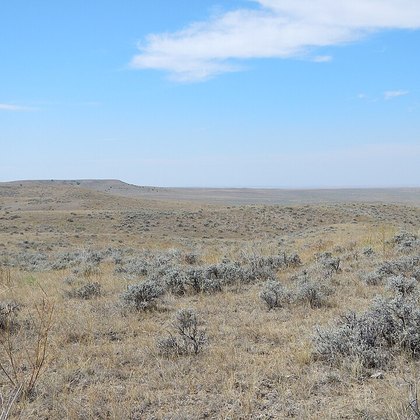
Sagebrush steppe with Artemisia as almost the sole shrub, on the high plain of the Gunnison Basin above 2,000 metres, ringed by mountain ranges that isolate the area from the rest of the sagebrush range further west. The bird, like Greater Sage-Grouse, depends entirely on unbroken sagebrush cover for food, shelter and display, but the small size of its range leaves it no margin at all for habitat loss. Cropland, urban growth around the town of Gunnison, and road building have further fragmented an already small range.
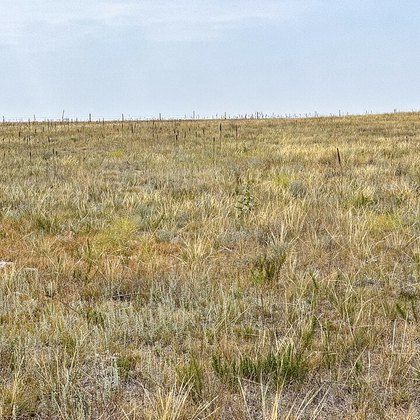
Where the bird is most often found, arranged by the USNVC — the vegetation classification of the United States and Canada — and CMECS for sea and coast.
Range and movements
Resident, confined to the Gunnison Basin in Gunnison and Saguache counties in southwestern Colorado, with a few small, isolated populations elsewhere in western Colorado and the extreme southeast of Utah. It does not migrate and shifts at most a few kilometres between summer and winter range within the same basin. The range has shrunk sharply since the nineteenth century and broken apart into isolated fragments, and the total population is estimated at a few thousand birds.
- Breeding (summer)
- Passage
- dark = core range, pale = thinly spread
Where and when to look
Leks in the Gunnison Basin are sensitive and often accessible only by permit or on a guided early-morning outing; check with the visitor centre in Gunnison for the rules before going. Stay well back from the lek in any case and use binoculars or a scope, since any disturbance can drive the birds from one of the few places they still have left.
Conservation
Listed as Endangered by the IUCN, with a total population of a few thousand birds in a range covering less than a tenth of that of Greater Sage-Grouse. Loss and fragmentation of sagebrush steppe to agriculture, urban growth and road building are the main threats to a species that, given its small and isolated range, has little resilience to spare.
Scientific name
Centrocercus minimus | Young; Braun; Oyler-McCance; Hupp; Quinn, 2000
Young, Braun, Oyler-McCance, Hupp and Quinn described the species in 2000 directly within the genus Centrocercus, so that — unlike most other species in this guide — no parentheses surround author and year: there has never been a change of genus to explain. minimus is Latin for 'smallest', after the clearly smaller size relative to Greater Sage-Grouse, the feature by which the species was first distinguished. No type locality for this species, described only in 2000, is recorded in the source used here.