All species › Gamebirds › Partridges, pheasants, grouse and allies › Sooty Grouse
Sooty Grouse | Dendragapus fuliginosus
Grauw sneeuwhoen | Gallo de las Rocosas Gris
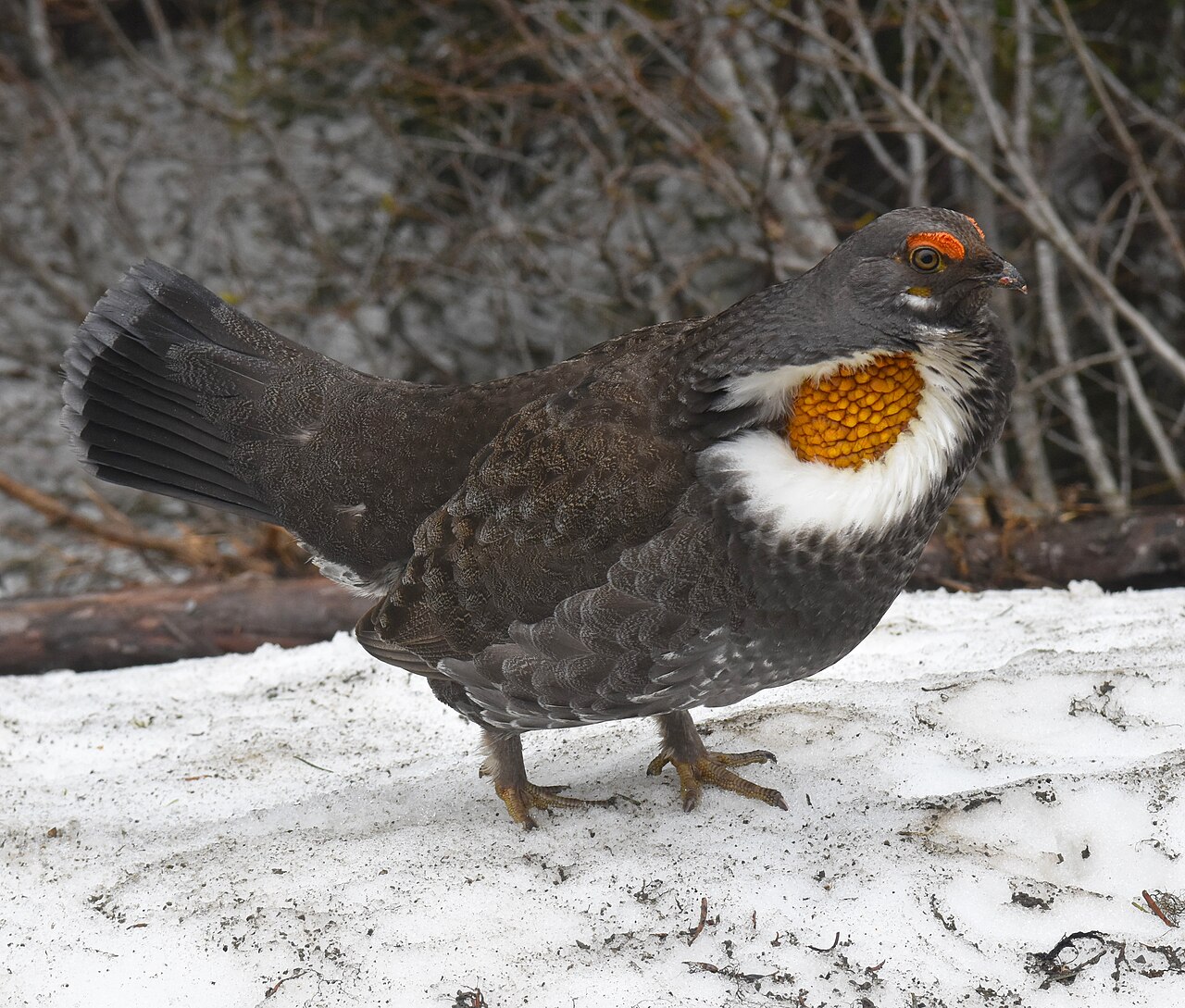
Sooty Grouse is the heavyset grouse of the wet coniferous forests along the Pacific coast, from the coastal ranges of southeastern Alaska to the mountains of California. The male displays high above the ground, hidden deep in the crown of a conifer, with a muffled hoot that carries for kilometres yet is almost impossible to pinpoint. His yellow neck sacs and orange eyebrow combs are then the only bright colour in an otherwise steely blue-grey plumage.
Voice
The display call is a series of five to seven deep, hollow hoots, pitched so low they are felt in the chest as much as heard; from a perch high in a fir or Douglas-fir the series carries up to two kilometres. The male repeats the series hour after hour from the same fixed song post, sometimes from the same tree for weeks on end. In alarm he gives a hoarse, cackling call, and chicks keep contact with soft peeping notes. Outside spring the species is largely silent, and anyone wanting to hear it should find an old coastal conifer edge before sunrise in April or May.
Recording: Greg Irving — CC BY-NC-SA 4.0 · Obstruction Point Road, Olympic NP, Port Angeles, Clallam County, Washington, United States · xeno-canto
Identification
A heavy, short-tailed grouse with a small head and a thick neck; the male is uniformly slate to blue-grey with a faint white wash across the breast and a broad grey terminal band on the tail. During display he inflates white eyelids and yellow neck sacs, fans the tail and raises the neck feathers into a ruff. The female is camouflaged brown with black and white speckling, smaller than the male and lacking the coloured neck sacs. Juveniles resemble the female but are more finely marked and lack the broad tail band. In flight the species is heavy and laboured, with rapid wingbeats followed by a glide, low over the ground.
Confusion species
Dusky Grouse (Dendragapus obscurus) is the near-identical species of the interior Rocky Mountains; the two ranges barely touch, since Sooty Grouse stays close to the coast and Dusky Grouse to the ranges further inland. Where they do meet, in the interior of British Columbia, displaying males are told apart by the colour of the inflated neck sac: yellowish orange in Sooty Grouse, purplish red in Dusky Grouse. The display itself differs too: Sooty Grouse sings high in a tree and carries far, while Dusky Grouse displays on the ground and is barely audible beyond a hundred metres. Females and juveniles of the two species are essentially inseparable in the field.
Habitat
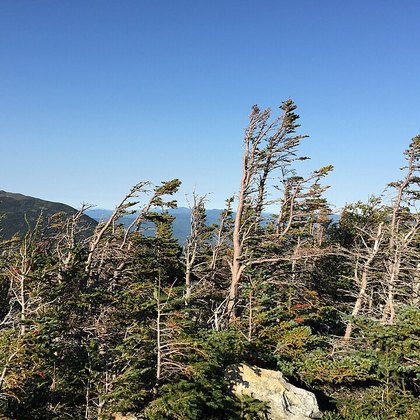
Moist conifer forest of Douglas-fir, western hemlock and silver fir, preferably with openings, regenerating clearcuts or edges where sunlight reaches the forest floor. In summer he uses these open patches for berries, leaves and insects; in winter he moves into the densest, highest stands, where he lives almost entirely on conifer needles. Closed old growth without any opening is as unsuitable as a clearcut without old trees to display from. Numbers peak in winter at the upper edge of the forest, where it grades into krummholz.
Where the bird is most often found, arranged by the USNVC — the vegetation classification of the United States and Canada — and CMECS for sea and coast.

Range and movements
Resident along the entire Pacific coast, from southeastern Alaska and coastal British Columbia through the Cascades and coast ranges of Washington and Oregon to the Sierra Nevada and coastal ranges of California. It does not migrate over long distances but does move vertically: foraging lower among openings and scrub in summer, climbing into the highest, densest conifer stands in winter. The range has stayed largely stable since the nineteenth century, though the species has declined locally where old growth has been logged. Inland, in southern British Columbia, its range meets that of Dusky Grouse, and occasional intermediate birds occur there.
- Breeding (summer)
- Passage
- dark = core range, pale = thinly spread
Where and when to look
Go to an old coastal conifer stand before sunrise in April or May and listen for the low, far-carrying hoot — pinpointing its source is often impossible, since the sound seems to come from every direction at once. Then scan the highest, thickest branches of the nearest firs systematically with binoculars; the male usually sits still and is well camouflaged against the trunk. Outside spring the species is most often seen along a forest road at dawn, where it comes to pick up grit.
Conservation
Least Concern (LC), but numbers fell by more than half between 1968 and 2015, a slow decline that looks unremarkable in any single year. Logging of old-growth conifer forest and its replacement by young, even-aged plantation without the mix of opening and dense cover the species needs is considered the main cause. Partners in Flight nonetheless rates it of low conservation concern.
Scientific name
Dendragapus fuliginosus | (Ridgway, 1873)
Ridgway described the coastal birds in 1873 as a dark colour form of the then single Dusky Grouse, Canace obscura var. fuliginosa; because the form has since been elevated to species and placed in the genus Dendragapus, author and year stand in parentheses. The genus Dendragapus, which also holds Dusky Grouse, was introduced in 1864 by the American zoologist Elliot. fuliginosus is Latin for 'sooty, covered in soot', after the dark plumage of the coastal birds. The type locality covers two places at once: the Cascade Mountains at the foot of Mount Hood, Oregon, and Chiloweyuck Depot in Washington state.