All species › Passerines › Longspurs and snow buntings › Chestnut-collared Longspur
Chestnut-collared Longspur | Calcarius ornatus
Roodhalsgors | Escribano collarejo
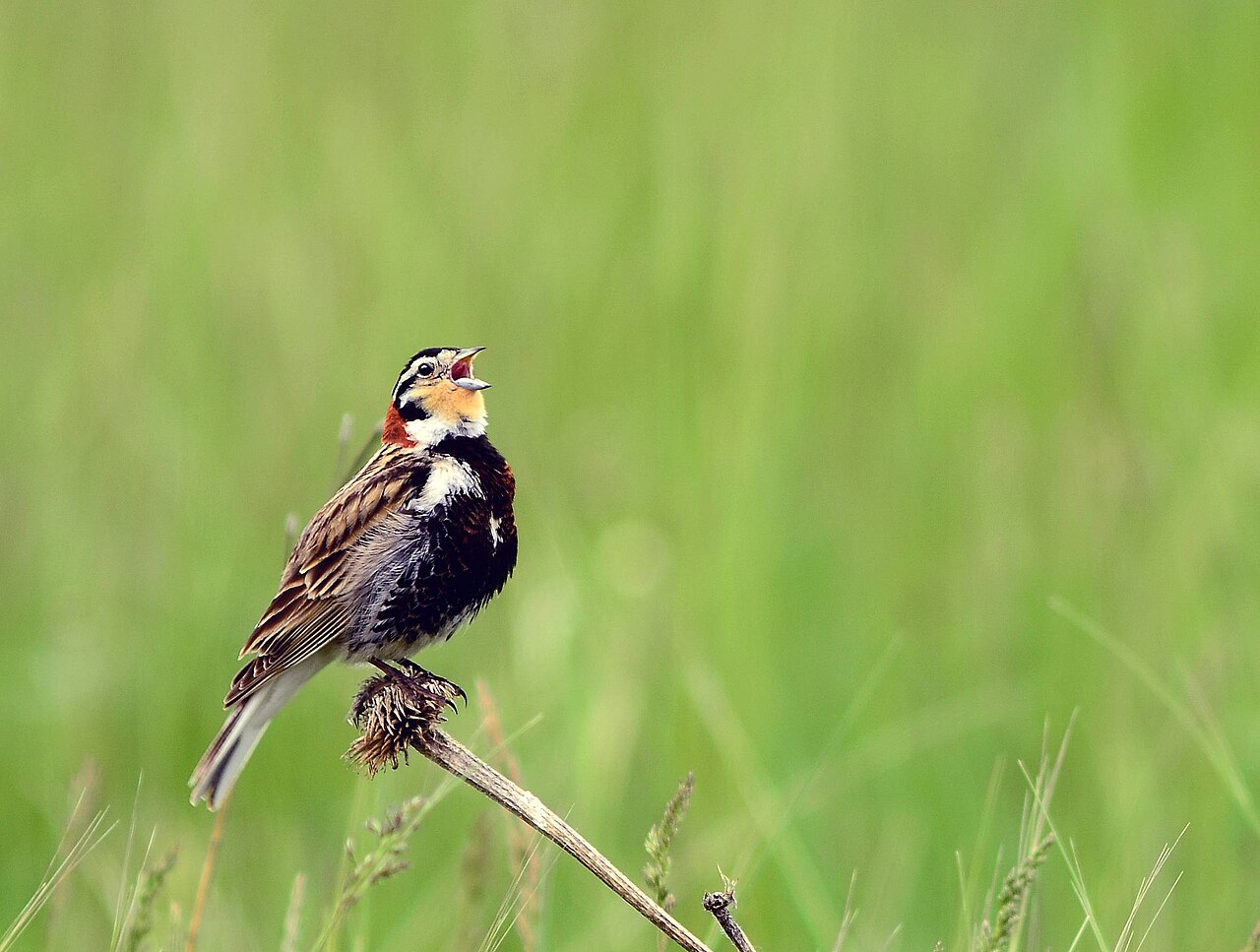
The Chestnut-collared Longspur is the smallest of the four longspurs and the only one breeding entirely within the prairie of the northern Great Plains. The summer male has a black belly, a yellow throat and a chestnut collar. The species has fallen steeply since the 1960s and is listed as Vulnerable on the Red List.
Voice
The male sings in a song flight: he climbs to some fifteen metres, holds the wings up and glides down singing. The song is a short, rapid warble of a couple of seconds, falling at the end, with a scratchy quality. The call is a two-syllable chee-dee or kittle, given constantly over flocks in winter; that call is the best way to pick the species out among other longspurs in a grass field.
No freely licensed recording has been found for this species yet; what to listen for is described below.
Identification
Compact, with a large head and a notably short tail. The breeding male is black on breast and belly, with a yellow throat, a black crown, a white face and a chestnut band across the nape. The tail is largely white with a black central triangle — in flight the most useful mark. The female and the winter bird are pale sandy brown and finely streaked, often with some chestnut still on the nape and the same white tail with a dark tip.
Confusion species
Thick-billed Longspur shows an inverted T in the tail — a black terminal band across the full width — against the central black triangle of Chestnut-collared, and has a heavier, pink bill. Smith's Longspur is warmer buff, longer tailed and has white shoulder spots. Lapland Longspur is larger, with much rufous in the wing and a louder, rattling flight call. Winter flocks are often mixed; call and tail pattern separate them faster than plumage does.
Habitat
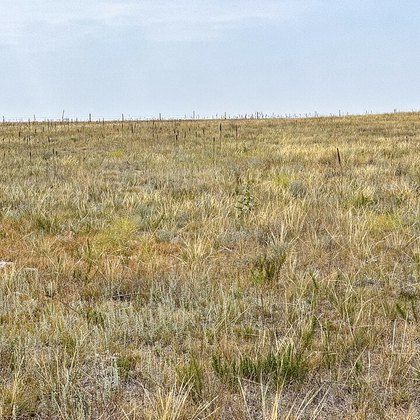
Shortgrass and mixed-grass prairie where the sward stays low, usually under thirty centimetres: grazed pasture, recently burned ground and hay meadow. It leaves tall dense grass, so grazing by cattle or bison and periodic fire keep ground suitable. In winter it uses the same open, short terrain: Chihuahuan desert grassland, grazed plains, stubble fields and field edges.
Where the bird is most often found, arranged by the USNVC — the vegetation classification of the United States and Canada — and CMECS for sea and coast.


Range and movements
Breeds from southern Alberta and southern Saskatchewan to southwestern Manitoba and south through Montana, the Dakotas and northeastern Wyoming; the range has contracted at the edges well inside its historical limits. Migration runs over the southern Great Plains. It winters from southeastern Arizona, New Mexico, west Texas, western Oklahoma and southeastern Colorado into the Mexican desert grasslands of Chihuahua, Coahuila, Durango, Zacatecas, northeastern Sonora and western Nuevo León, where flocks of fifty to a hundred birds are usual.
- Resident
- Breeding (summer)
- Winter
- Passage
- dark = core range, pale = thinly spread
Where and when to look
On the breeding grounds May to July is the time: drive prairie back roads in northeastern Montana or southern Saskatchewan and watch for the singing song flight over grazed grassland. In winter it pays to flush a flock of longspurs in the grasslands of southwestern New Mexico or northern Chihuahua and listen to the call; then go by the tail and not by the colour, because in winter plumage all four longspurs look much alike.
Conservation
Partners in Flight puts the breeding population at about 3.1 million birds. The 2025 State of the Birds report places the species on the red tipping-point list, with a decline of roughly 73 per cent since 1967. The cause is the loss of native prairie: conversion to cropland, fragmentation by oil and gas development, and the removal of grazing and fire, which leaves remaining grassland too tall and too dense. Restoring grazing management and keeping large unbroken blocks of prairie are the measures named in management plans; the wintering range in northern Mexico is also under pressure from conversion to agriculture.
Scientific name
Calcarius ornatus | (Townsend, 1837)
Townsend described the species in 1837 as Plectrophanes ornata, from a bird taken on the prairies of the Platte in western Nebraska; because it later moved to Calcarius, author and year stand in parentheses. Calcarius comes from Latin calcar 'spur', after the greatly lengthened hind claw that all longspurs have. The species name ornatus means 'adorned', after the pattern of throat, crown and nape in the male. The English name longspur refers to that same long hind claw.