All species › Passerines › Munias, parrotfinches, waxbills and allies › Chestnut Munia
Chestnut Munia | Lonchura atricapilla
Kastanjenon | Capuchino castaño
The Chestnut Munia is a small Asian estrildid finch with a black head and a chestnut body that has lived in the Hawaiian Islands since 1959. There it belongs to the damp grassy lowlands: former rice land, wet pasture and rank fields around Pearl Harbor and elsewhere, where flocks cling to the seeding stems.
Voice
The contact note is a thin, high pee-ee or tseet, given by a flock almost without a break and running into a wispy rattle when the birds flush together. The male's song is barely audible: a soft, halting series of clicks and rustling notes ending in a drawn-out high whistle. He sings upright on a stem beside the female, throat feathers raised and tail quivering, often with a grass blade in his bill.
Recording: Sam Hambly — CC BY-NC-SA 4.0 · Thap Yao (near Bangkok), Lat Krabang, Krung Thep Maha Nakhon, Thailand · xeno-canto
Identification
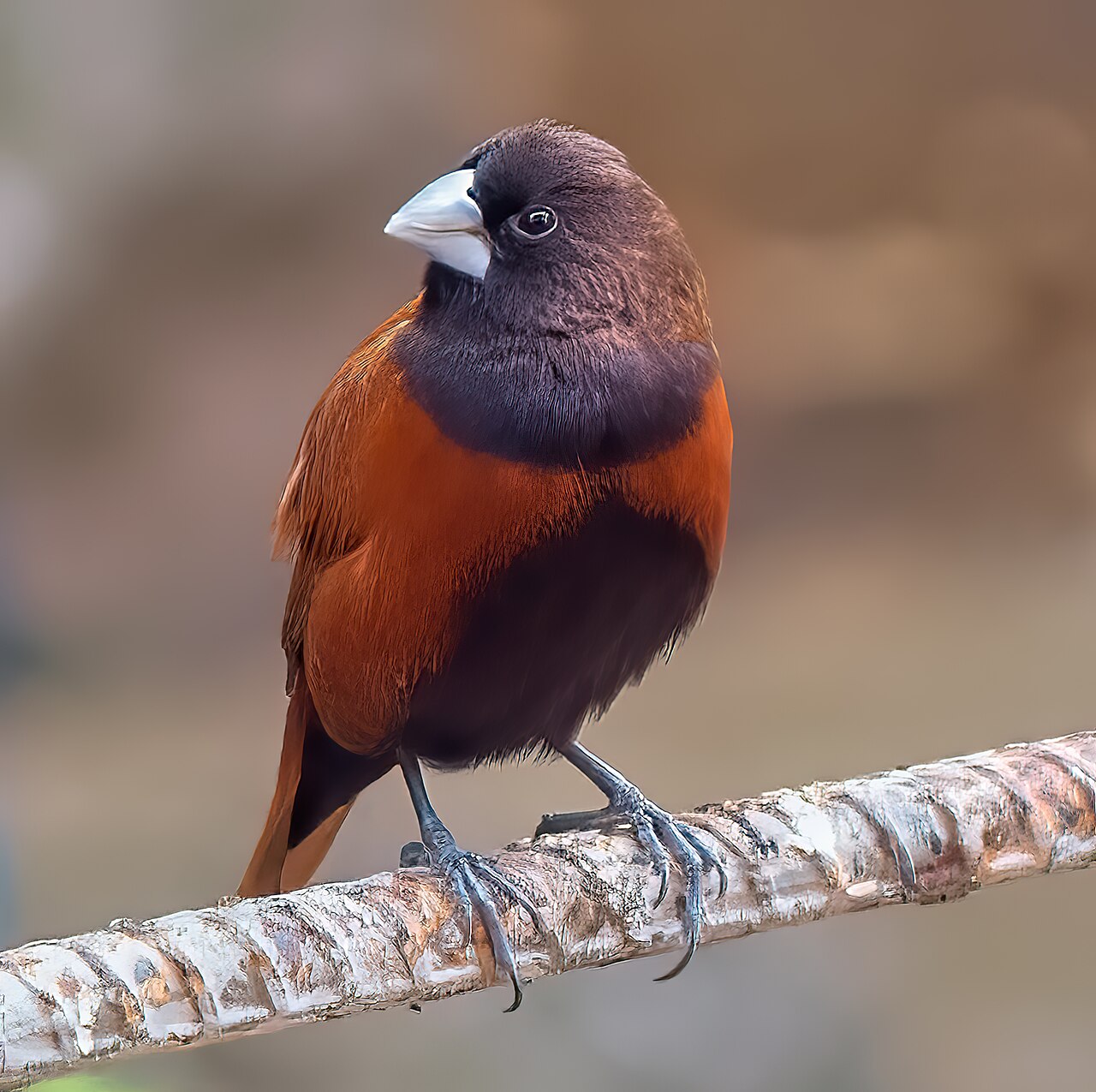
Adults have the head, throat and upper breast wholly black, sharply set off against the plain chestnut body; the underparts are chestnut too, though Philippine races have a black belly. Rump and uppertail coverts are a brighter reddish to golden and show only in flight. The bill is short, deep and pale blue-grey; the legs are grey-blue. The sexes are alike. Juveniles are plain pale brown above and dingy white to buff below, without the black head.
Confusion species
Tricolored Munia, formerly treated as the same species, has the same black head but white flanks and belly; within the guide area it occurs only in the Caribbean and so does not overlap with the Hawaiian birds. In Hawaii the main confusion species is Scaly-breasted Munia, which has a brown head and a finely scaled breast. The real pitfall is the juveniles: plain brown young Chestnut Munias, Scaly-breasted Munias and African Silverbills look much alike — then watch for the black rump and long pointed tail of the silverbill, and check the adults in the same flock.
Habitat
Damp open grassland and farmland with tall seeding grasses: wet meadows, sedge fields, reedy ditch and pond edges, remnant cane and rice land, rank fallow ground, golf-course margins and roadsides. It stays in low vegetation and climbs the stems to feed. In Hawaii mainly in the lowlands up to a few hundred metres; it avoids closed native montane forest.
Where the bird is most often found, arranged by the USNVC — the vegetation classification of the United States and Canada — and CMECS for sea and coast.





Range and movements
Native across South and Southeast Asia, from Bangladesh and northeastern India through Indochina to southern China, Taiwan, the Philippines and the Greater Sunda Islands. In the guide area only an introduced Hawaiian population exists: escaped or released from the cage-bird trade on Oʻahu around 1959, still only 400 to 500 birds around Pearl Harbor and ʻEwa Beach in 1963, and increasing and spreading thereafter. It is now established on Oʻahu, Kauaʻi and Maui, with smaller or more recent numbers on Molokaʻi, Lanaʻi and Hawaii Island.
- Resident
- Winter
- Passage
- dark = core range, pale = thinly spread
Where and when to look
On Oʻahu the wet lowlands give the best chance: the coastal plain at ʻEwa, the margins of the Pearl Harbor ponds, and the marshy grassland of the Hanalei valley on Kauaʻi. Go early in the morning and look for grass stems moving on a windless day; the thin persistent calling betrays the flock before you see it.
Conservation
The species is Least Concern (LC), the lowest Red List category: the Asian range is large and numbers there are stable, despite local control in rice-growing areas and trapping for the cage-bird trade. The Hawaiian birds fall outside that assessment and, as an introduced species, have no protection. They keep to converted damp lowland and do not reach the high native forest where the threatened honeycreepers live, so their effect on native species is regarded as slight.
Scientific name
Lonchura atricapilla | (Vieillot, 1807)
Vieillot described the species in 1807 as Loxia atricapilla; because it was later moved to another genus, author and year stand in parentheses. The species name is from Latin ater 'black' and capillus 'hair of the head', hence 'black-headed'. The genus name Lonchura, introduced in 1832 by William Henry Sykes, is from Greek lonchē 'spearhead' and oura 'tail'. Vieillot gave the origin only as 'Les Grandes-Indes'; that type locality was later restricted to lower Bengal. The Dutch name kastanjenon ('chestnut nun') names the chestnut body; 'non' (nun) is the old cage-bird name for this group, after the black-and-brown plumage.