All species › Passerines › Munias, parrotfinches, waxbills and allies › Tricolored Munia
Tricolored Munia | Lonchura malacca
Driekleurennon | Capuchino tricolor
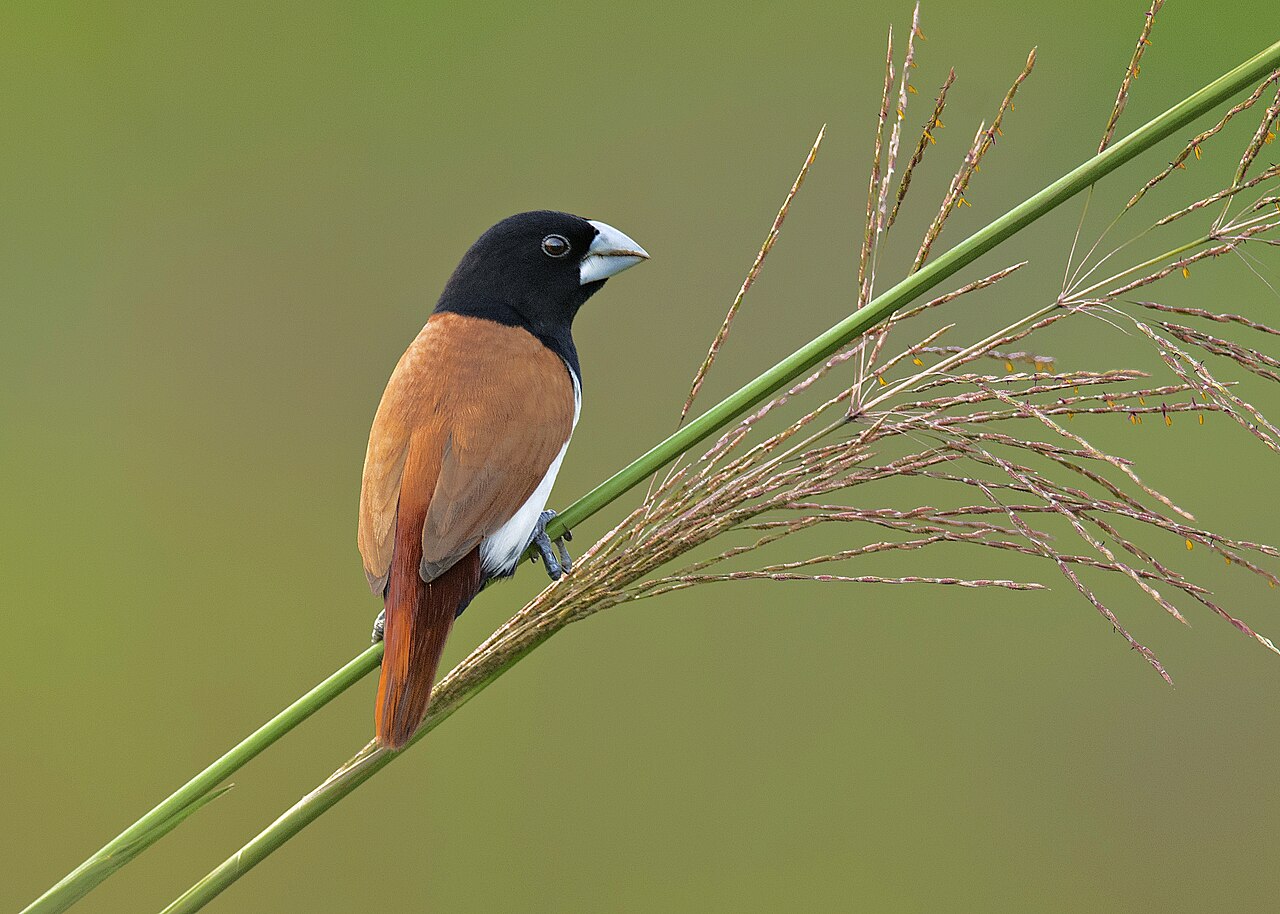
The Tricolored Munia is a small Asian estrildid finch that occurs in the guide area only as an introduced bird, in the Greater Antilles and along the southern rim of the Caribbean. The name refers to the sharp three-way division of the plumage: black head and breast, chestnut back, and white flanks and belly.
Voice
The call is a thin, high pee-pee or tseet, given continuously by flocks in flight; birds flushing from grass produce a rapid series of the same notes. The male's song is so soft that it is barely audible at a few metres: a halting series of clicking and hissing sounds ending in a drawn-out, wispy whistle. It is delivered with the throat feathers raised and the tail quivering, usually from a grass stem beside the female.
Recording: David Ricardo Rodríguez-Villamil — CC BY-NC-SA 4.0 · Villanueva, Casanare, Colombia · xeno-canto
Identification
The adult is divided into three blocks: head, throat and breast deep black; back and wings warm chestnut; flanks and belly white with a black patch on the centre of the belly and black undertail coverts. Rump and uppertail coverts are reddish to golden and catch the light in flight. The bill is heavy, conical and silver-blue; the legs are grey. The sexes are alike. Juveniles are plain warm brown above and pale buff below, without any pattern.
Confusion species
Chestnut Munia is the closest and was long treated as the same species: it also has a black head, but the entire underside is chestnut, without the white block on flanks and belly. Where both occur that white block is the only mark needed. Juveniles of the two cannot be told apart reliably; they also resemble young Scaly-breasted Munias, which have darker legs and a slightly longer, darker bill. African Silverbill is paler, with a black rump and a long pointed tail.
Habitat
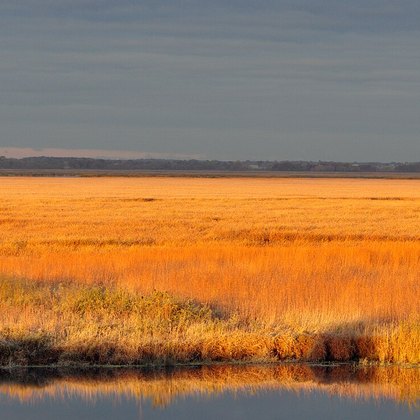
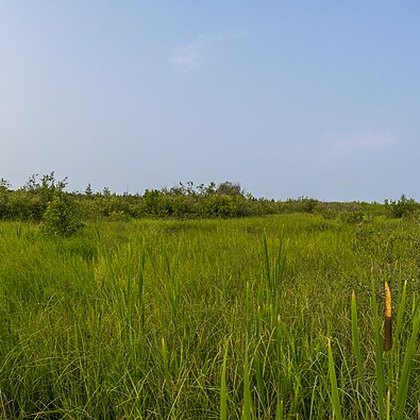
Damp open grassland and cultivation: rice fields, the edges of cane, wet meadows, sedge fields, reed fringes along ditches and pools, and fallow land with seeding grasses. It stays low and feeds by climbing the stems. Water is almost always close by. It avoids closed forest and dry scrub; the domed grass nest hangs low in reeds, grass or a bush.
Where the bird is most often found, arranged by the USNVC — the vegetation classification of the United States and Canada — and CMECS for sea and coast.



Range and movements
Native to peninsular India, Sri Lanka and parts of Bangladesh and southern China. The cage-bird trade has released it in many places outside Asia. In the guide area only introduced populations occur: Cuba, Jamaica, Hispaniola and Puerto Rico in the Greater Antilles, and northern Venezuela and Colombia, where it spread widely after imports in the 1940s and became numerous in the rice-growing districts. It was reported in Hawaii a few times in the 1960s and 1970s but never established itself; some of those old records referred to Chestnut Munia.
- Resident
- Breeding (summer)
- Winter
- Passage
- dark = core range, pale = thinly spread
Where and when to look
In Puerto Rico, search the damp lowlands of the north and south coasts: look along ditches in the morning and over rough fallow land where tall grasses stand in seed. A flock gives itself away by the thin persistent calling and by the jerky movement of the stems. Watch for the white flanks, the one mark that still counts at a distance.
Conservation
The species is listed as Least Concern (LC) on the Red List: the native range is large and numbers there are stable. In Asia it is locally controlled as a rice pest and trapped in quantity for the cage-bird trade, without this producing a range-wide decline. The populations in the guide area are introduced and have no protection; they keep to already converted farmland, and there is no evidence that they displace native seed-eaters.
Scientific name
Lonchura malacca | (Linnaeus, 1766)
Linnaeus described the species in 1766 as Loxia malacca; because it was later moved to another genus, author and year stand in parentheses. The species name refers to Malacca on the Malay Peninsula, but that is an error: the species does not occur there, and the type locality was later moved to Belgaum in India. The genus name Lonchura, introduced in 1832 by William Henry Sykes, is from Greek lonchē 'spearhead' and oura 'tail', after the pointed tail of these finches. The English name counts the three blocks of colour in the plumage.