All species › Passerines › Munias, parrotfinches, waxbills and allies › Scaly-breasted Munia
Scaly-breasted Munia | Lonchura punctulata
Muskaatvink | Capuchino punteado
A small brown bird with a dark head and a breast that looks as though it were covered in scales: every feather has a white centre and a dark rim. It comes from southern Asia and lives here as a feral bird, in California, Texas, Florida, Puerto Rico and above all on Hawaii. In small parties it rustles through the tall grass of a verge or a ditch, clinging to the stems to feed.

Voice
The usual note is a thin, rather plaintive kee-tee or peeh that birds in a party call back and forth without pause and that is often all that betrays a flock in tall grass. On taking off there is a sharp, hard chip, and a flock going up makes a short, dry rattle of dozens of those notes at once. The sound does not carry far and is drowned out by street noise.
Recording: Bo Shunqi 薄顺奇 — CC BY-NC-SA 4.0 · Hengsha Island, Shanghai, Chongming, China · xeno-canto
Identification
Adults have a warm cinnamon-brown back and wings, a dark brown to almost black face and throat, and white underparts closely covered from the breast onto the flanks with dark crescent-shaped rims — the scaling from which the bird takes its English name. Rump and upper tail are yellow-buff and light up in flight. The bill is short, deep and lead-grey to black. Young birds look quite different: plain light brown above and plain buff below, without the dark head and without any scaling, and they are the ones most often misnamed. Male and female cannot be told apart in the field.
Confusion species
Chestnut Munia (Lonchura atricapilla), which lives in the same places on Hawaii, is deep chestnut with an entirely black head and a black belly, without scaling. Young Scaly-breasted Munias are confused with young House Sparrows: those are larger, more coarsely streaked on the back and have a pale brownish bill instead of a heavy lead-grey one. More feral estrildid finches live in the verges and ditches of Hawaii and southern Florida, and the rule of thumb is: look at the breast, for only this species carries scales there. With a flock it pays to wait until the brown birds turn round — young and adult birds fly together.
Habitat
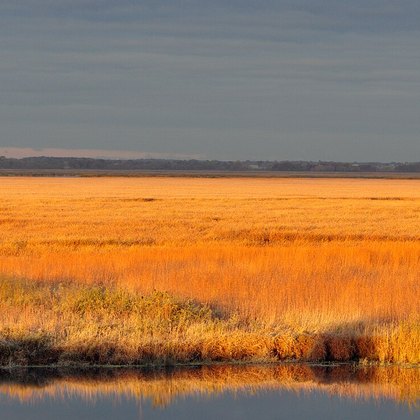
Tall grass and weedy rough ground along roads, ditches, railway lines and vacant lots, reed fringes, rice fields and the edges of cane, and further golf courses, parks, gardens and leafy suburbs. It depends on half-ripe grass seed and therefore keeps to places where the grass is allowed to grow tall; close-mown lawns and closed forest are avoided. For roosting and for the nest a dense tree, a palm or a creeper against a wall is enough. Water is almost always nearby.
Where the bird is most often found, arranged by the USNVC — the vegetation classification of the United States and Canada — and CMECS for sea and coast.




Range and movements
At home it is a bird of India, Sri Lanka and Southeast Asia as far as Indonesia and the Philippines. On Hawaii it has been present since 1883 and is now one of the commonest birds on all the main islands; on the mainland it is a matter of escaped and released cage birds that settled in southern California and have been spreading north through the Central Valley since the 1980s, and further of populations on the Texas Gulf Coast and in southern Florida. In Puerto Rico it has been present since 1971 and is now common in the lowlands and on Vieques and Culebra. The spread is slow and follows building: new places are almost always near a town.
- Resident
- Breeding (summer)
- Winter
- Passage
- dark = core range, pale = thinly spread
Where and when to look
Walk early in the morning along a verge or a ditch where the grass has gone to seed and watch for stems moving on a windless day: a party of munias bends the heads down and feeds from them upside down. They are not shy and allow a view at ten metres, until someone comes too close and the whole flock leaves at once for the nearest tree. On Hawaii every grassy edge beside a car park is a chance.
Conservation
In its own range the species is numerous and listed as Least Concern (LC), with a large range and a stable trend. Here it is a matter of feral birds, which are not counted and for which no conservation policy exists. Where rice or grain is grown a large flock can do damage; that it displaces native birds here has not been shown.
Scientific name
Lonchura punctulata | (Linnaeus, 1758)
Linnaeus described the species in 1758 as Loxia punctulata, among the crossbills; because it was later moved to another genus, author and year stand in parentheses. The genus Lonchura was introduced by Sykes in 1832 and is made from Greek lonchē 'spearhead' and oura 'tail', after the pointed tail of these birds. punctulata is Latin for 'finely spotted'. Linnaeus gave the type locality only as Asia; Baker restricted it to Calcutta in 1926.