All species › Passerines › Munias, parrotfinches, waxbills and allies › Lavender Waxbill
Lavender Waxbill | Glaucestrilda caerulescens
Lavendelastrild | Estrilda azulada
The Lavender Waxbill is a small West African estrildid finch, blue-grey with a crimson rump and tail. In the guide area it lives only in the Hawaiian Islands, where it escaped the cage-bird trade in the 1960s and established itself on the dry western side of Hawaii Island.
Voice
The call is a high, squeaky tseep or cheep, often repeated two or three times and rising at the end; small parties keep contact with it, and it is usually the first sign of the species. The male's song opens with a few short high notes and passes into longer, lower and more drawn-out tones. While feeding the birds also give a short dry tek.
Recording: Romuald Mikusek — CC BY-NC-SA 4.0 · Ginak Kajata, Lower Niumi, Kerewan, Gambia · xeno-canto
Identification
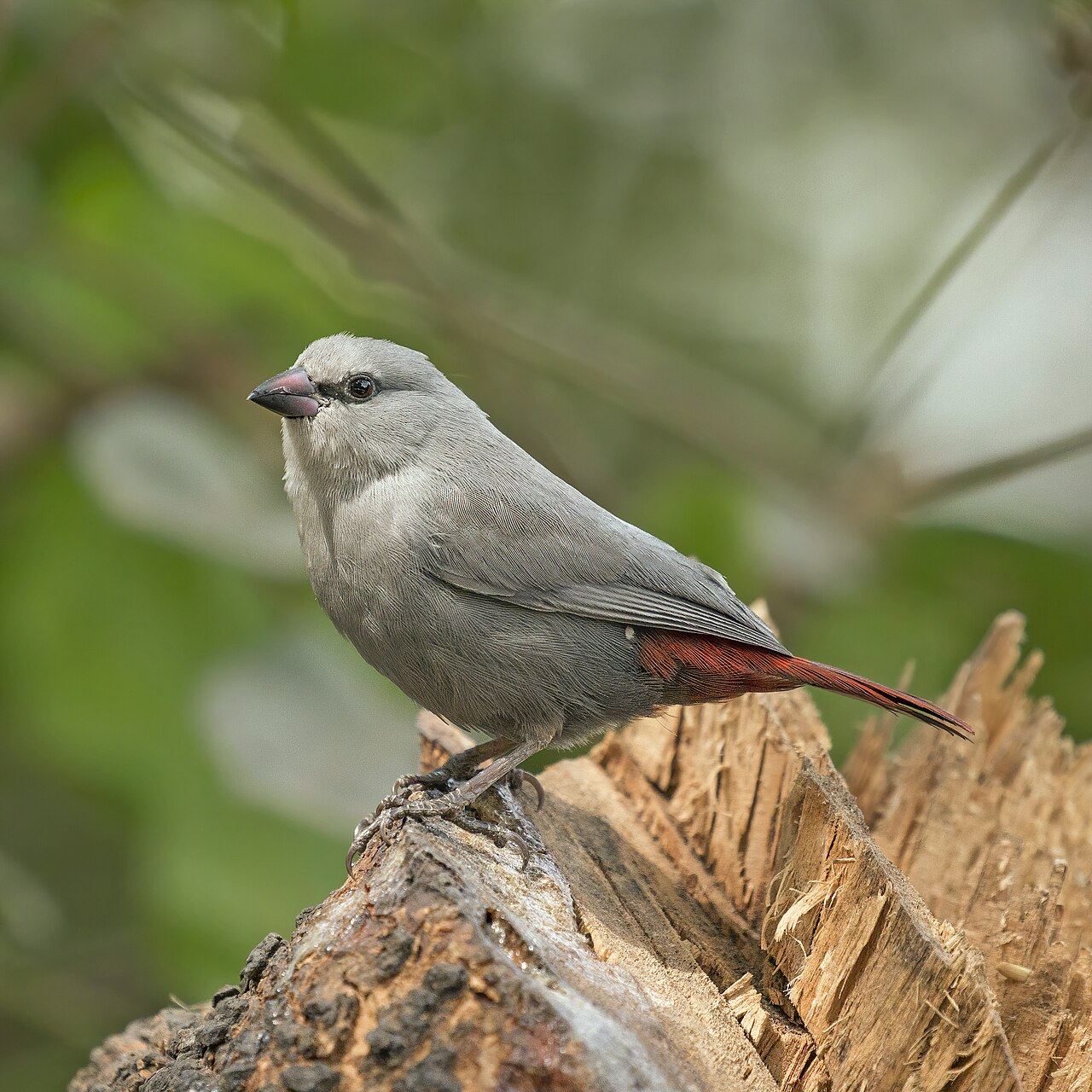
The whole body is soft blue-grey, paler on the head and underparts and darker on wings and back. The rump, uppertail coverts and the fairly long wedge-shaped tail are crimson — the most visible mark in flight. A few small white spots stand on the flanks, and a narrow black line runs through the eye. The bill is short and conical, reddish with a black tip and a black lower mandible; the legs are grey-black. The sexes are alike; juveniles are duller and lack the white flank spots.
Confusion species
Within the guide area no other species combines plain blue-grey plumage with a red rump, and confusion is all but ruled out once the bird is seen well. At a distance or against the light a small party can suggest Scaly-breasted Munias or African Silverbills, but those are brown and sandy with a black rump respectively. On a brief view the red rump may bring another waxbill to mind — such as Common Waxbill, which is finely barred and has a red eye-stripe.
Habitat
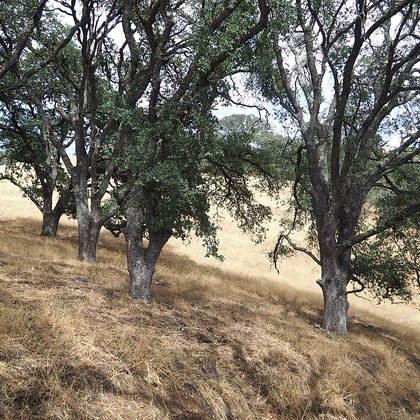
Dry open ground with sandy or stony soil, scattered shrubs and short grasses. In Africa that means thorn scrub and dry savanna; in Hawaii the old lava flows and overgrazed pasture of the Kona coast, along with gardens, parks, hotel grounds and woodland edges. It feeds on the ground and low in bushes and nests in low shrubs, in grass tussocks or among stones. It avoids wet closed forest.
Where the bird is most often found, arranged by the USNVC — the vegetation classification of the United States and Canada — and CMECS for sea and coast.




Range and movements
The native range lies in the Sahel and Sudan zones of West Africa, from Senegambia east to southwestern Chad, northern Cameroon and the Central African Republic. In the guide area only introduced birds occur: released or escaped on Hawaii Island in the 1960s, where the population holds on along the dry western slope of the Kona coast. Reports from Maui and Oʻahu involve small or irregular numbers; the stronghold is Hawaii Island. Outside Hawaii the species is not established in North America.
- Resident
Where and when to look
Look along the Kona coast of Hawaii Island, on the lava fields with kiawe (Prosopis pallida, an introduced South American thorny shrub) and dry grass and in the gardens behind them. Go early in the morning and listen first: the high squeaky calling usually comes from a low bush before the birds show themselves. As soon as one flies the red rump against the grey body is visible at some range.
Conservation
The Red List places the species in the category Least Concern (LC): the African range covers an estimated six hundred thousand square kilometres or more and no decline has been established, although the species is trapped for the cage-bird trade. The Hawaiian population is small and confined to one dry coastal strip; as an introduced species it has no protection. It stays in already altered low ground and does not reach the high native forest.
Scientific name
Glaucestrilda caerulescens | (Vieillot, 1817)
Vieillot described the species in 1817 as Fringilla caerulescens; because it was later moved to another genus, author and year stand in parentheses. The species name caerulescens is Latin for 'bluish', from caeruleus 'sky-blue'. The genus name Glaucestrilda was formed in a recent split of Estrilda, from Greek glaukos 'blue-grey' and the older genus name Estrilda itself, which goes back to the aviculturists' name 'astrild'. Vieillot gave the origin only as the 'Zone Torride'; the type locality was later fixed on Senegal. The English and Dutch names both refer to the lavender tone of the plumage.