All species › Passerines › Munias, parrotfinches, waxbills and allies › Common Waxbill
Common Waxbill | Estrilda astrild
Sint-helenafazantje | Estrilda común
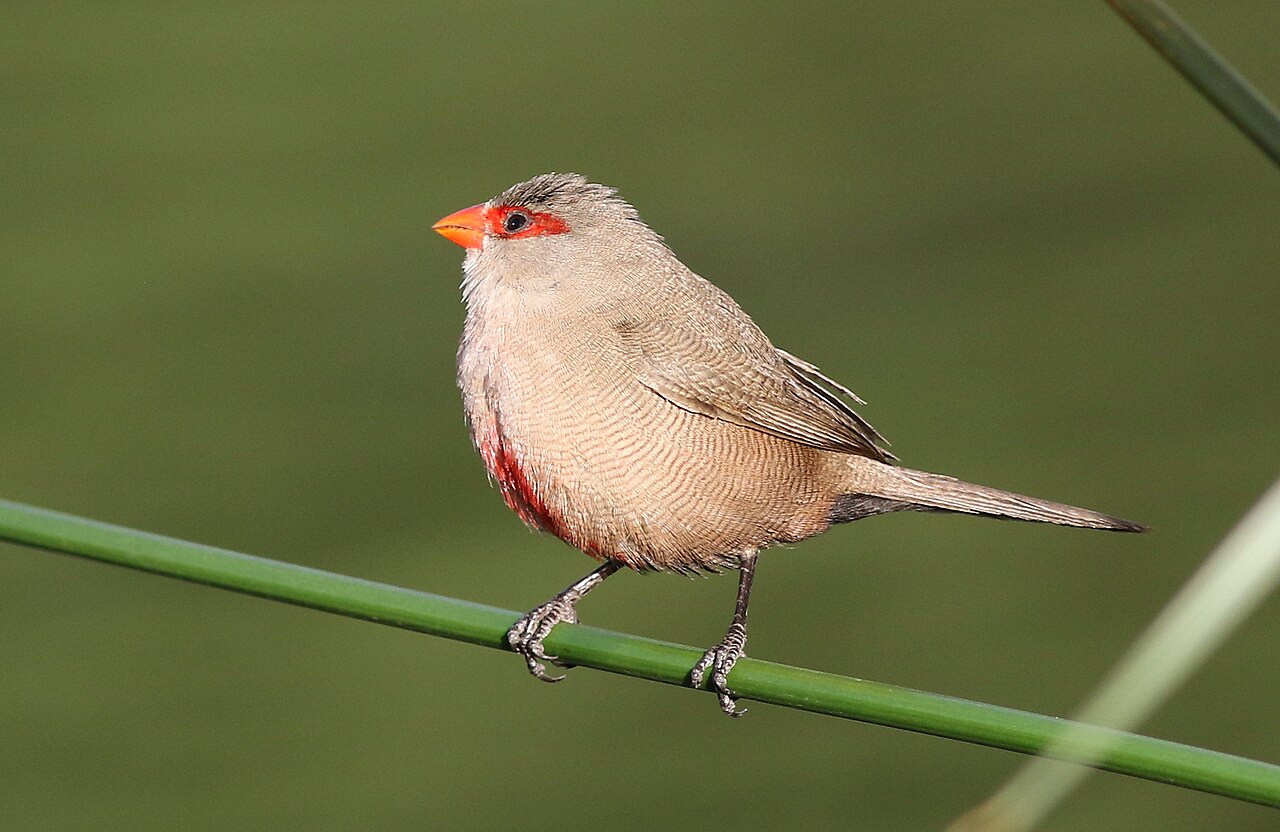
The Common Waxbill is a small African estrildid finch that the cage-bird trade has carried across half the world, and that is established in Hawaii. The fine barring, the red eye-stripe and the sealing-wax bill identify it; on Oʻahu it has become one of the most numerous lowland landbirds.
Voice
The call is a high, nasal cheep or pit, given constantly by moving flocks, so that a group is heard before it is seen. The song is a short, harsh phrase of three or four notes falling on the last one, delivered by the male from a grass stem or a wire with the tail swung sideways. When disturbed the whole party switches to a fast buzzing rattle and drops into tall grass together.
Recording: João Tomás — CC BY-NC-SA 4.0 · União das freguesias de Mazarefes e Vila Fria (near Mazarefes), Viana do Castelo, Viana do Castelo, Portugal · xeno-canto
Identification
Grey-brown above and dingy white to pink below, finely barred dark over the whole body, with a broad crimson stripe through the eye and a sealing-wax red bill. Adults have a red patch in the centre of the belly, larger and deeper in the male than in the female; the undertail coverts are black. The tail is long, dark and graduated, and is swung up and down or sideways almost continuously. Juveniles have a black bill, weaker barring and no red belly patch.
Confusion species
Red Avadavat also has a red bill, but shows white spots rather than bars and a shorter, plain black tail. African Silverbill has a heavy blue-grey bill and an unbarred body. Lavender Waxbill is plain blue-grey with a red rump and tail and lacks the barring. The red eye-mask together with the fine barring and black undertail coverts separates Common Waxbill from every other estrildid in Hawaii.
Habitat
Open country with tall grass and rank growth: the edges of ponds and irrigation ditches, reedbeds, fallow cane fields, road verges, pasture, parks and gardens with seeding grass. Water nearby is a constant. In Hawaii it is mainly a lowland bird, but it has reached mountain pasture and open ground above 1500 metres in Hawaii Volcanoes National Park.
Where the bird is most often found, arranged by the USNVC — the vegetation classification of the United States and Canada — and CMECS for sea and coast.






Range and movements
The native range is Africa south of the Sahara; the cage-bird trade produced populations on Saint Helena and Mauritius, in Portugal and Spain, in Brazil and Trinidad, and on Tahiti. In Hawaii the first flock was seen at Ewa Beach on Oʻahu in November 1973; through the 1980s the species took over the whole lowland of that island. On Hawaii Island it was recorded at Kona in 2002 and spread to Hilo, South Point and Hawaii Volcanoes National Park. A small population persists on Maui around Kealia Pond and Kihei; on Kauaʻi and Molokaʻi there are only scattered records.
- Resident
- dark = core range, pale = thinly spread
Where and when to look
Work the margins of ponds and ditches in the Oʻahu lowlands, where flocks of tens to hundreds strip the seed heads of tall grass. The high cheep gives them away before the eye does; then look for the red eye-stripe and belly patch, since the barring does not carry at a distance.
Conservation
The species is listed as Least Concern (LC), is widespread and numerous in Africa, and is expanding in almost every region where it has been released. In Hawaii it is not a conservation problem but a management one: it eats and spreads the seed of introduced grasses and occupies lowland that the native forest birds have already left. No control is carried out and numbers are still rising on Oʻahu and Hawaii Island.
Scientific name
Estrilda astrild | (Linnaeus, 1758)
Linnaeus described the species in 1758 as Loxia Astrild; because it was later moved to another genus, author and year stand in parentheses. The genus Estrilda was introduced in 1827 by William Swainson, taken from that same species name. The origin of astrild is uncertain: it is probably an old German or Dutch trade name for these finches, or a misprint. The English name waxbill refers to the bill, which has the colour of sealing wax; the Dutch name points to Saint Helena, where trading ships took these cage birds on board. The type locality was later fixed on Cape Town.