All species › Waterfowl › Ducks, swans and geese › Cinnamon Teal
Cinnamon Teal | Spatula cyanoptera
Kaneeltaling | Cerceta Colorada
Cinnamon Teal is an intensely rust-red duck of western wetlands, whose only real look-alike is its eastern cousin Blue-winged Teal — together they form one of North America's trickiest identification puzzles. Far to the south, in the Andes and the lowlands of South America, entirely separate, non-migratory populations of the same species live on.
Voice
The male gives a soft rattling note and a series of thin whistles, similar to Blue-winged Teal but slightly harsher. The female quacks low and soft, barely distinguishable from that of her close relative. Groups on the water keep in contact with short, muffled notes, especially while feeding.
Recording: Bernabe Lopez-Lanus — CC BY-NC-SA 3.0 · Bajos Submeridionales (La Costa), rio Saladillo, San Cristobal, Santa Fe, Argentina · xeno-canto
Identification
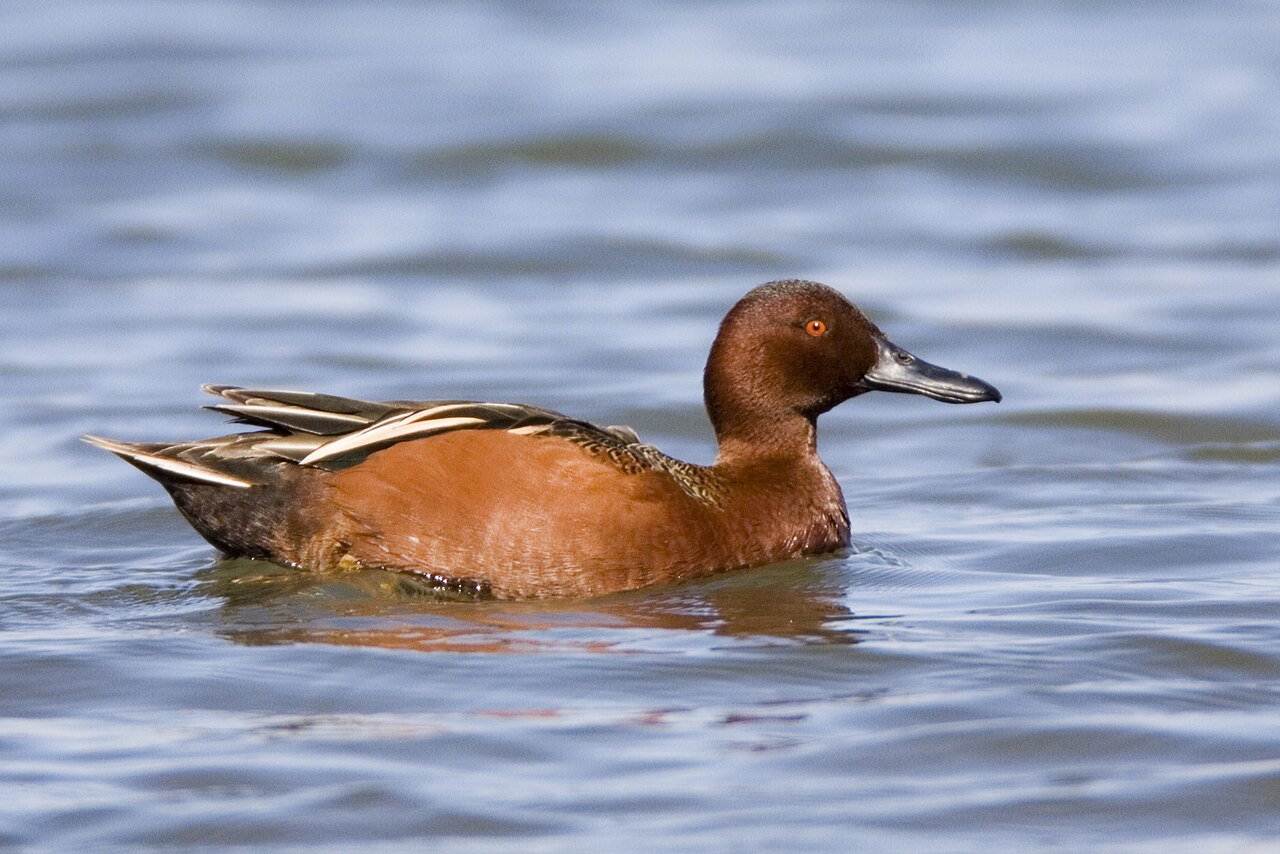
The breeding male is uniform cinnamon-red from head to breast and flanks, with a red eye and a long, broad bill that droops slightly at the tip. In flight, like Blue-winged Teal, it shows a pale-blue shoulder patch with a green speculum. The female is streaky light brown and virtually indistinguishable from a female Blue-winged Teal apart from the longer, broader bill. Males transitioning into breeding plumage sometimes already show a red eye while the body is still largely brown.
Confusion species
Blue-winged Teal (Spatula discors) is the inseparable look-alike: females of the two species are barely told apart in the field, and the best mark is the bill — longer and broader in Cinnamon Teal, shorter and narrower in Blue-winged Teal. The breeding male differs clearly: Cinnamon Teal has a uniformly red head with no pattern, Blue-winged Teal a white facial crescent. Where their ranges overlap, in the western United States, hybrids also occur.
Habitat
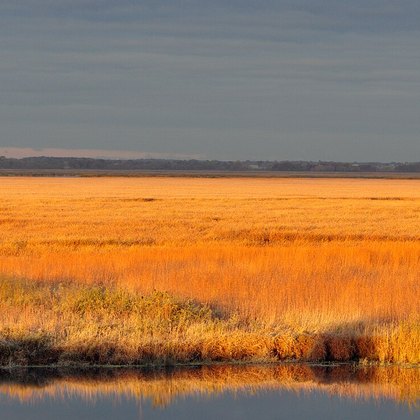
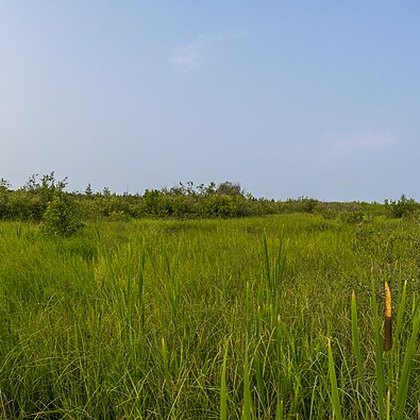
Shallow, densely vegetated marshes, brackish and slightly saline ponds, irrigation ditches and man-made reservoirs of the arid and semi-arid West make up its breeding habitat. Outside the breeding season it also uses brackish coastal marshes. Like Blue-winged Teal, it avoids fast-flowing water and dense forest, preferring to breed where thick shoreline vegetation offers cover close to open, food-rich water.
Where the bird is most often found, arranged by the USNVC — the vegetation classification of the United States and Canada — and CMECS for sea and coast.



Range and movements
Breeds in the western United States and the extreme southwest of Canada, roughly from British Columbia south through the Great Basin to New Mexico. Most of this population winters from California and Arizona south through Mexico to Central America, with some continuing to northern South America; in the marshes of the Mexican highlands part of the population also remains year-round. The entirely separate South American populations, in the Andes and the lowlands from Peru to Argentina, lie outside the guide area.
- Resident
- Breeding (summer)
- Winter
- Passage
- dark = core range, pale = thinly spread
Where and when to look
Check every group of teal on a western marsh in spring for red males — they stand out immediately. For females and young birds, a direct comparison with a Blue-winged Teal alongside is the only sure way to judge the bill.
Conservation
Least Concern (LC). The North American population is stable to slightly increasing, despite facing the same pressure from wetland drainage as Blue-winged Teal. It is hunted and monitored less intensively than its more numerous relative, so its numbers are known with somewhat less precision.
Scientific name
Spatula cyanoptera | (Vieillot, 1816)
Vieillot described the species in 1816 as Anas cyanoptera, based on a specimen from the Río de la Plata and Buenos Aires — the type locality therefore lies in Argentina, within the range of the southern subspecies, not in North America. Boie established the genus Spatula in 1822, Latin for 'spoon'; only DNA research in 2009 placed this species firmly within it, hence the parentheses around author and year. cyanoptera is Greek for 'blue-winged', after the blue shoulder patch it shares with Blue-winged Teal.