All species › Passerines › Finches, euphonias and allies › Common Rosefinch
Common Rosefinch | Carpodacus erythrinus
Roodmus | Camachuelo carminoso
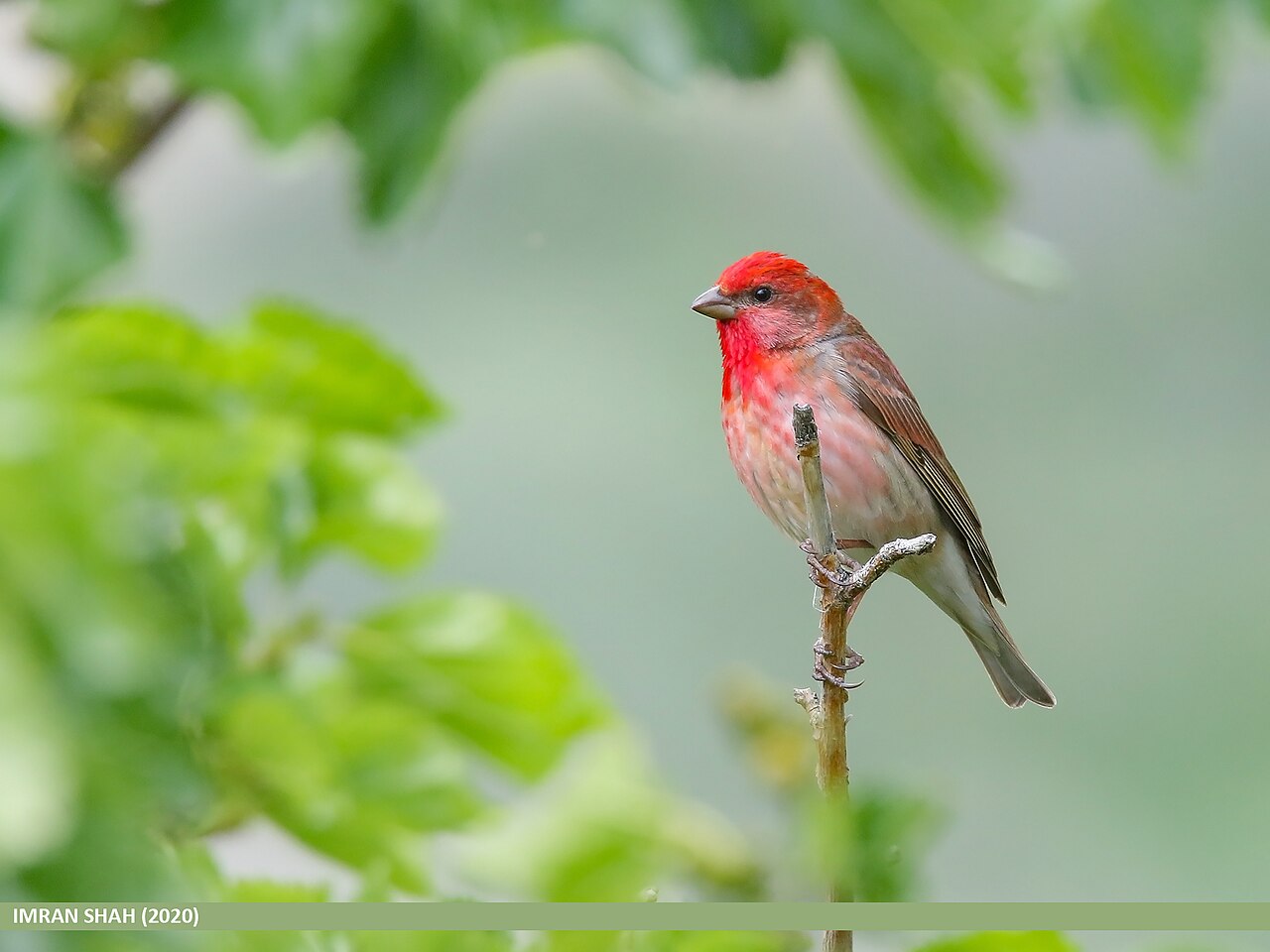
The Common Rosefinch is a Eurasian finch in which only the old male is carmine red; the great majority of birds are grey-brown and unmarked. In North America it is a vagrant, recorded almost entirely on the islands of western Alaska.
Voice
The song is a short clear whistled phrase of four or five notes rising and falling, often rendered wee-chee-wee-choo, repeated in the same form from an open branch or a bush top. The call is a soft upward oo-eet, two-syllabled with a rising end, and a shorter chik when disturbed. Singing birds on the Alaskan islands are rare; most vagrants stay silent.
Recording: Kevin Guille — CC0 · Birky, Lyubeshivs'kyi district, Volyn Oblast, Ukraine · xeno-canto
Identification
A stocky finch with a short, strongly curved upper mandible, a round head without any head pattern and a large dark eye that stands out for that reason. The old male is carmine on head, breast and rump, with brown wings and a white belly; he gains that colour only in his second or third year. Females and young males are olive- to grey-brown, dull below with vague diffuse streaking, and show two narrow pale wingbars. The tail is slightly forked.
Confusion species
The American rosefinches — Purple, House and Cassin's Finch — all have a clear head pattern with a pale supercilium or a streaked crown, and a straighter bill; Common Rosefinch has a plain unmarked head and a smaller, rounder shape. Brown birds are the hard part: note the plain pale base of the lower mandible, the weak blotchy breast streaking and the conspicuously dark eye in an otherwise blank face. Pallas's Rosefinch of Asia is coarser in build and more heavily streaked.
Habitat
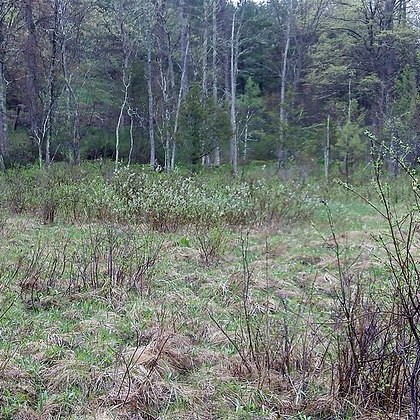
Scrub and woodland edge, damp ground above all: willow growth along rivers, birch scrub, tall gardens and neglected field margins. It sings from mid-height exposed branches and forages on seeds, buds and berries in dense shrub layer. In the Asian winter quarters it uses gardens, orchards and farmland. The Alaskan records involve the sparse bushes, herb vegetation and village gardens of treeless islands.
Where the bird is most often found, arranged by the USNVC — the vegetation classification of the United States and Canada — and CMECS for sea and coast.




Range and movements
The breeding range runs from the Danube valley and Sweden across Siberia to the Bering Sea and Japan, with wintering from southern Iran through India, Burma and southern China. The range has been shifting westward for decades, as far as Portugal and with breeding records in the British Isles. It crosses to North America only rarely: records lie almost entirely on St Lawrence, the Pribilofs and the western Aleutians, with a handful elsewhere along the west coast. They fall mainly in late spring and in September.
Where and when to look
Look for it in June at Gambell or St Paul after days of westerly wind: check every brown finch in the herb vegetation and around the villages. The best character is what it lacks — no supercilium, no streaked crown, no sharp breast streaks — together with the short blunt bill and the large dark eye.
Conservation
The species is listed as of least concern, with a very large range and a stable to increasing trend; in northern and western Europe the westward expansion is well documented. In parts of southern Asia rosefinches are trapped for the cagebird trade, but not at a level that shows in the population. Its North American occurrence is too small and too irregular for management to attach to it.
Scientific name
Carpodacus erythrinus | (Pallas, 1770)
Pallas described the species in 1770 as Loxia erythrina, from material on the Volga and the Samara; because it was later placed in Carpodacus, author and year stand in parentheses. That genus was introduced in 1829 by Johann Jakob Kaup, from Greek karpos 'fruit' and dakos 'biter', so 'fruit-biter'. The species name erythrinus goes back to Greek erythros 'red', after the plumage of the old male.