All species › Passerines › Finches, euphonias and allies › Hawfinch
Hawfinch | Coccothraustes coccothraustes
Appelvink | Picogordo común
The Hawfinch is the most heavily built finch of Eurasia, with a conical bill that cracks cherry and plum stones. In North America it is a vagrant: a handful of records, almost all on the Aleutians and the Bering Sea islands.
Voice
The voice is sparing. The call is a hard short tick, sharp and metallic in tone, often given from the canopy and sometimes the only sign that the bird is there. In flight a thinner high tzree is heard. The song is quiet, mumbled and disjointed, a series of squeaking and clicking notes that carries only a few metres and is seldom noticed.
Recording: Lars Edenius — CC BY-NC-SA 4.0 · Umeå, Umeå Municipality, Västerbottens län, Sweden · xeno-canto
Identification
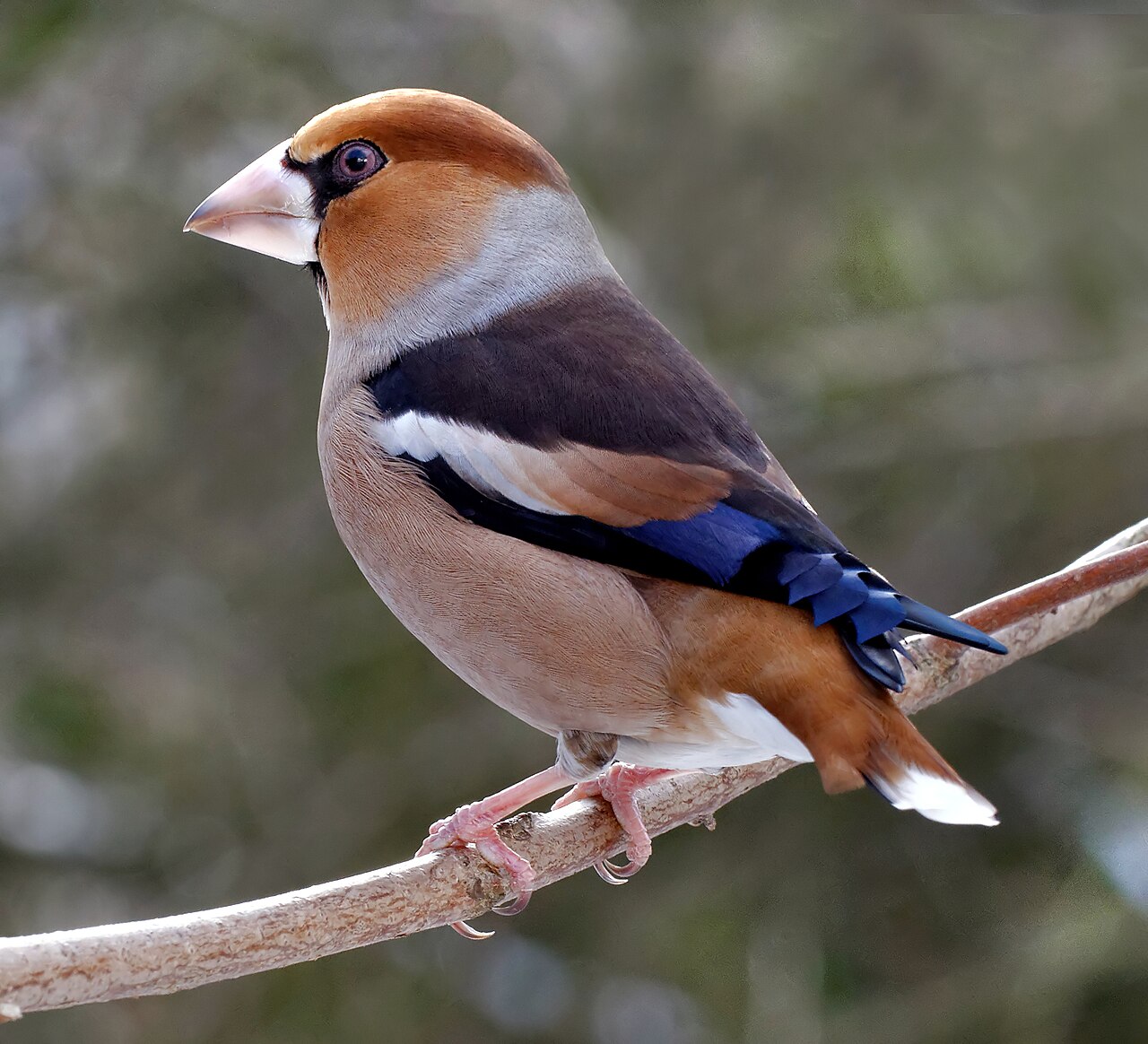
A short-tailed, bull-headed finch that looks almost tailless in flight. The bill is large and conical, steel-blue to black in summer and bone-white in winter. Head and breast are orange-brown, the nape grey, the mantle dark brown, and a black mask surrounds the base of the bill and the throat. The primaries and secondaries are glossy blue-black with white tips, producing a broad white wing panel that shows in flight; the tail is brown with a white terminal band. The jaw muscles deliver a force that has been compared to roughly 30 to 48 kilograms.
Confusion species
Within North America confusion is most likely with Evening Grosbeak, which also has a massive pale bill but is yellow on belly, rump and forehead and shows a large plain white wing panel rather than white feather tips. Pine Grosbeak is long-tailed and has a hooked bill. Black-headed and Rose-breasted Grosbeaks are slimmer and longer-tailed, with a streaked or strongly black-and-white head lacking the brown-to-grey gradation of a Hawfinch.
Habitat
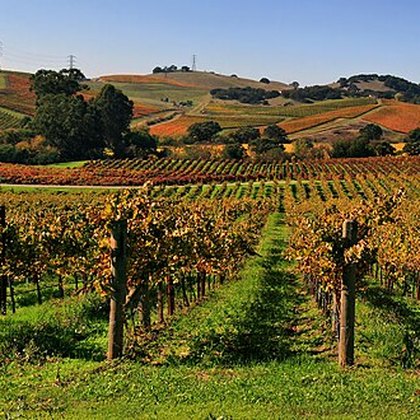
Deciduous and mixed woodland with tall trees, in Europe especially hornbeam, beech, elm and cherry, and also parks, old orchards and estate grounds. It forages high in the canopy and comes to the ground only for fallen seed and stones. In winter it concentrates in woods with cherry, plum or hornbeam seed. The Alaskan records involve low bushes and village gardens on treeless islands, where none of that cover exists.
Where the bird is most often found, arranged by the USNVC — the vegetation classification of the United States and Canada — and CMECS for sea and coast.



Range and movements
The range covers Europe, northwestern Africa and temperate Asia to Japan; northern populations move south, southern ones are resident. It reaches North America as a vagrant across the Bering Sea: accepted records lie almost entirely on the western Aleutians, St. Lawrence Island and the Pribilofs, concentrated in late spring. Records on the North American mainland are exceptional and are routinely weighed against the possibility of escaped cagebirds.
Where and when to look
Look for it in May and early June on Attu, Shemya or St Paul, after days of persistent westerly wind. A Hawfinch sits still in cover for long spells and usually gives itself away first with the short tick call; scan low bushes and garden edges for a bird with a short tail and a white wingbar.
Conservation
The world population is put at roughly 15 to 50 million birds and is regarded as stable, so the species is listed as Least Concern (LC). In the United Kingdom numbers have fallen sharply, probably through changes in woodland management and through grey squirrel and deer taking seedlings and seed. No conservation question attaches to the North American records.
Scientific name
Coccothraustes coccothraustes | (Linnaeus, 1758)
Linnaeus described the species in 1758 as Loxia coccothraustes; because it was later placed in Coccothraustes, author and year stand in parentheses. That genus name comes from Greek kokkos 'kernel or seed' and thrauo 'to break, to shatter', and so describes what the bill does; it is repeated as both genus and species name. The English name Hawfinch refers to the hawthorn. The type material was restricted to Italy.