All species › Birds of prey › Kites, Old World vultures, eagles and hawks › Cooper's Hawk
Cooper's Hawk | Astur cooperii
Coopers sperwer | Gavilán de Cooper
Cooper's Hawk is the middle-sized of the three North American accipiters and the only one that has settled in towns in numbers. It hunts birds in short dashes through the trees, and in many places it is now a more familiar sight at a feeder than in the woods. The female is roughly a third heavier than the male.
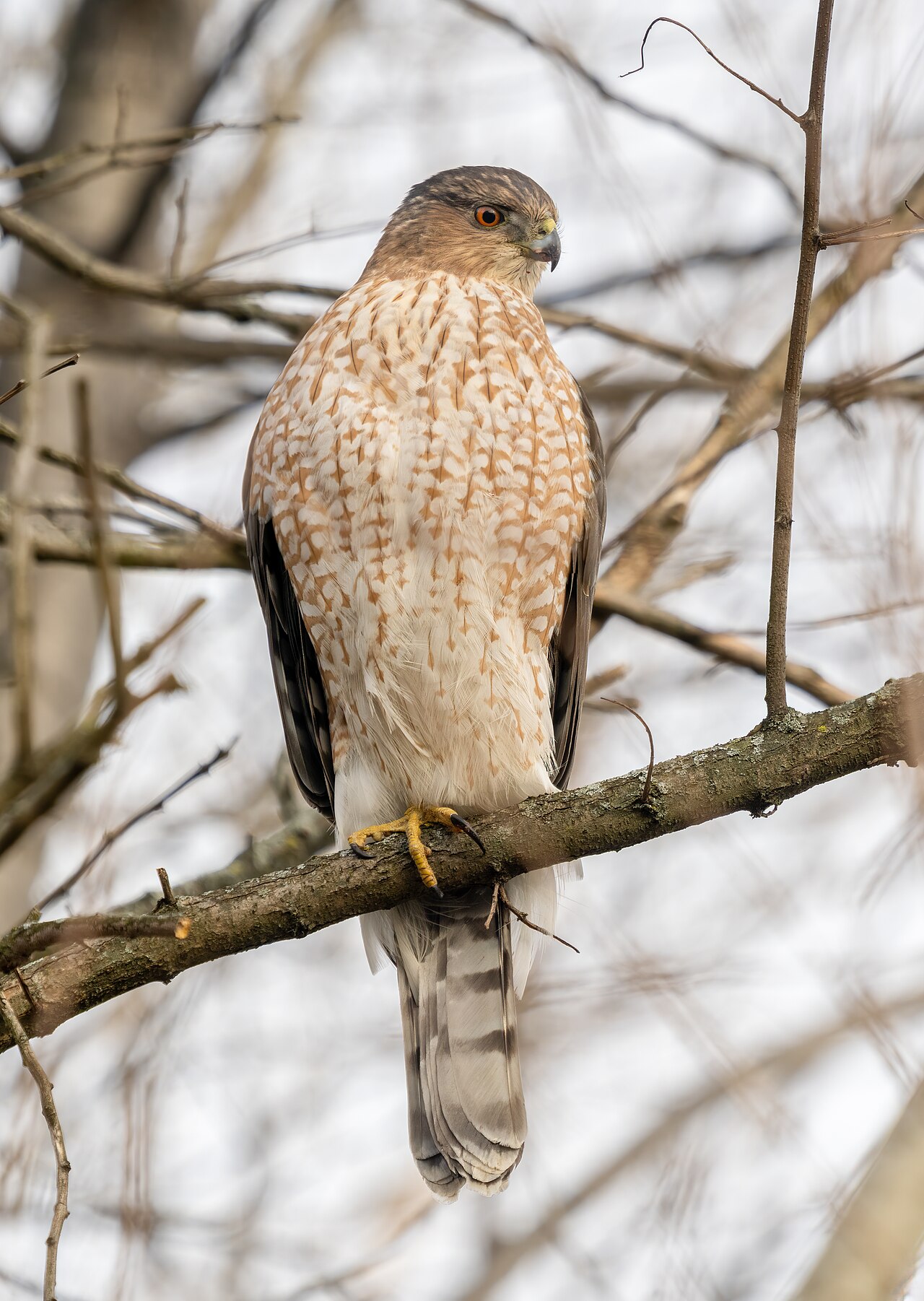
Click a thumbnail to switch the photo above.
Voice
Outside the breeding season it is almost silent. At the nest and in courtship both birds give a hard, grating cak-cak-cak, two to five seconds long. The male adds a short kik to announce his position, and the female a hoarse, complaining whaa when she takes food from him. Fledged young beg with a thin, piercing whistle that can go on for hours.
No freely licensed recording has been found for this species yet; what to listen for is described below.
Identification
The adult is steely blue-grey above, with fine reddish bars across breast and belly and a red iris. A black cap set off against a grey nape is the best mark on a perched bird. Juveniles are brown above and white below with crisp brown streaks that stop on the upper breast, giving a hooded look, and their eye is yellow. The silhouette is short rounded wings and a long tail with a rounded tip and a broad white terminal band. Flight is three or four quick beats and then a glide. The female is clearly bigger than the male, a difference that shows at once when a pair is together.
Confusion species
Sharp-shinned Hawk is smaller and slighter, with a small head that barely projects beyond the wrist in flight, a square-cut tail, and on juveniles a blurrier streaking that runs down onto the flanks. Cooper's Hawk pushes its head well forward, has a rounded tail tip with a broader white edge, and clean white underparts on juveniles. American Goshawk is larger and heavier again, with a white eyebrow, wavy tail bands and a uniformly dark underside on juveniles. A large female Cooper's and a small male goshawk overlap in size; head, eyebrow and tail pattern decide it then, not bulk.
Habitat
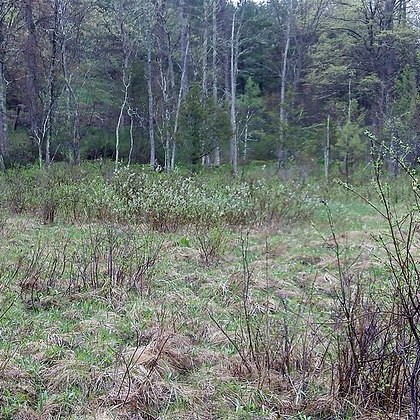
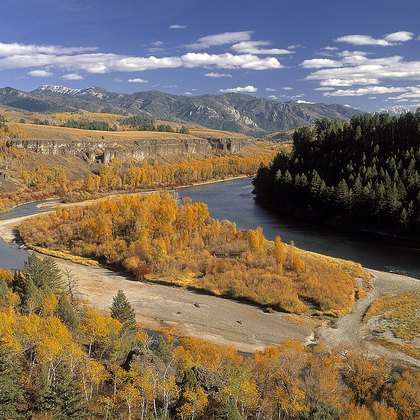
Deciduous and mixed woodland with openings, woodland edges, hedgerows and streamside timber. Since the 1980s it has established itself in suburbs and city parks, locally at higher densities than in the surrounding forest, where Rock Pigeons, Mourning Doves and feeder birds make up the prey. What it needs is a stand of tall trees to nest in and cover to hunt along; it avoids bare farmland and unbroken dark conifer forest. In the southwest it breeds in dry pine and oak woodland along creeks.
Where the bird is most often found, arranged by the USNVC — the vegetation classification of the United States and Canada — and CMECS for sea and coast.



Range and movements
Breeds from British Columbia and southern Canada south through nearly all of the United States into the mountains of Mexico. Over most of that area it stays all year; northern birds leave and winter as far as Central America. In September and October it is a fixture at hawk watches along ridges and coastlines, riding the same thermals as the buteos. After a deep trough in the middle of the twentieth century it has increased again and has greatly extended its range into built-up land.
- Resident
- Breeding (summer)
- Winter
- Passage
- dark = core range, pale = thinly spread
Where and when to look
Look for it in winter at a busy feeder: it comes in low and fast around the corner of a house or hedge, and it is the sudden silence of the garden birds that gives it away. With any passing accipiter, check the tail tip and how far the head projects in front of the wings first — those two are more useful than an impression of size, which without a direct comparison is almost always misleading.
Conservation
Partners in Flight puts the breeding population at about one million birds, and the Breeding Bird Survey shows an increase between 1966 and 2019. Numbers fell in the middle of the twentieth century through DDT and shooting; the species recovered after the ban. In cities about seventy percent of the birds found dead have struck a window or a car.
Scientific name
Astur cooperii | (Bonaparte, 1828)
Bonaparte described the species in 1828 as Falco cooperii, among the falcons; the specimen came from near Bordentown, New Jersey. It was later moved to Accipiter and since 2024 has been placed in Astur, a genus introduced by Lacépède in 1799 whose name is Late Latin astur, 'hawk'; because the species changed genus, author and year stand in parentheses. The epithet cooperii honours William Cooper, a New York naturalist in Bonaparte's circle. The English name goes back to the same man.