All species › Birds of prey › Kites, Old World vultures, eagles and hawks › American Goshawk
American Goshawk | Astur atricapillus
Amerikaanse havik | Azor norteamericano
American Goshawk is the largest of the continent's three accipiters and a bird of extensive old forest. It is rarely seen until it chooses to be seen, and at the nest it attacks people and other raptors head on. Since 2023 it has been treated as a species separate from the Eurasian Goshawk.
Click a thumbnail to switch the photo above.
Voice
The familiar sound is the alarm at the nest: a fast, hard ki-ki-ki-ki repeated ten to twenty times, sometimes led in by a drawn-out kreey-a. Faced with an intruder the female runs the notes together into a continuous scream that carries through the whole wood. Both birds also use a wailing kree-ah in several versions: the male on entering the territory, the female more clipped as she takes prey. If you hear this, keep your distance — it means you are inside the defended zone.
No recording with a suitable Creative Commons licence has been found for this species yet; what to listen for is described below.
Identification
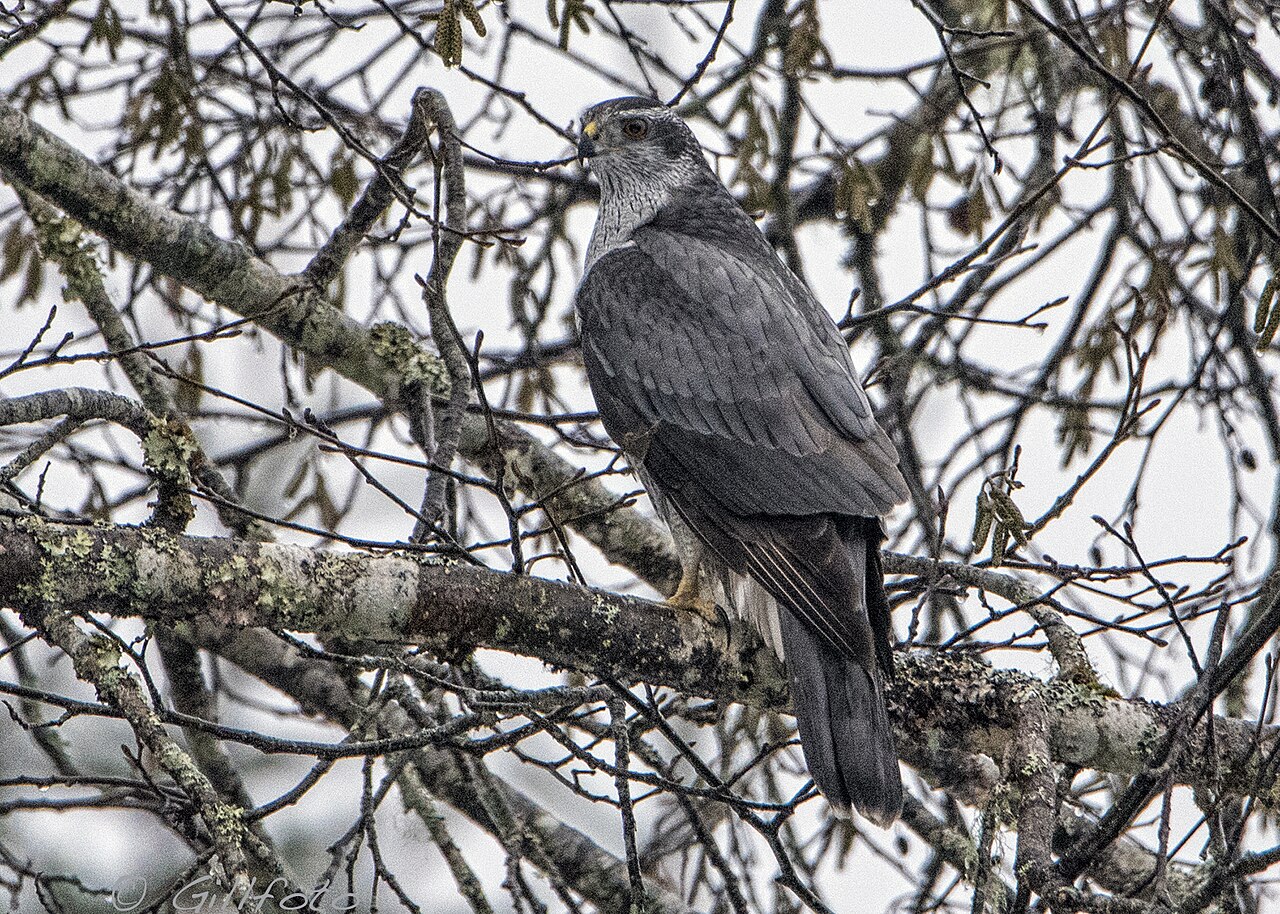
The adult is dark slate grey above and pale grey below with fine grey vermiculation, and the iris is orange to red. A dark hood with a broad white eyebrow above it is the most useful head mark. Juveniles are brown with heavy teardrop streaking that continues over the whole underside on a warm buff ground, an indistinct eyebrow and a yellow eye; the tail carries narrow, wavy dark bands. The silhouette is heavy: broad wings full at the base, a long broad tail with a wedge-shaped tip, and a slow, rowing wingbeat. The female approaches Red-tailed Hawk in size, while the male is barely larger than a female Cooper's Hawk.
Confusion species
Cooper's Hawk is the main pitfall: smaller, with reddish barring instead of fine grey on the adult, no white eyebrow, and on juveniles whiter, finer streaking and a clean white belly. Sharp-shinned Hawk is so much smaller that it only comes into question with a lone bird and nothing to measure against. Juvenile goshawks are also confused with Red-shouldered Hawk, which has a shorter tail with sharper bands and narrower, more translucent wings in flight. When in doubt, the wavy rather than straight tail bands and the broad white eyebrow are the most reliable marks.
Habitat
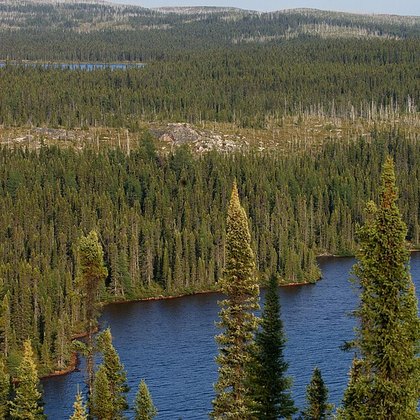
Mature and old-growth forest with more than sixty per cent canopy closure — in the east hardwood stands of beech, birch, maple and hemlock, in the west Douglas-fir and pine, aspen groves and paper birch. It hunts along riparian corridors and over the more open ground at the forest edge, out into the sagebrush (grey-green wormwood scrub of the dry western interior) steppe of Nevada. It avoids settled country; what it asks for is area and quiet. A territory holds up to eight alternate nests, of which one is used in any given year.
Where the bird is most often found, arranged by the USNVC — the vegetation classification of the United States and Canada — and CMECS for sea and coast.



Range and movements
Resident from Alaska and the boreal forest of Canada south through the Rocky Mountains, the Sierra Nevada, the Cascades, the Great Lakes region, New England and the Appalachians. It has no fixed migration, but in winters when snowshoe hares and forest birds are scarce, chiefly young birds move far south — an irruption rather than a migration, and one winter differs sharply from the next. In such years goshawks turn up at northeastern hawk watches and in states where they are otherwise absent. In the south of the range the breeding area has contracted locally where old forest has been logged.
- Resident
- Breeding (summer)
- Winter
- Passage
- dark = core range, pale = thinly spread
Where and when to look
The best chance is in February and March, when pairs display over the canopy with the white undertail coverts flared out. Otherwise listening is the method: a persistent ki-ki-ki in old forest in May or June almost certainly means a nest within two hundred metres. Walk away rather than towards it — the strike comes from behind.
Conservation
Before the 2023 split Partners in Flight estimated the world population at 420,000 birds; there is as yet no separate estimate for American Goshawk, and for the same reason it has not yet been separately evaluated. The Breeding Bird Survey found no clear change between 1966 and 2021, but the bird is so retiring that trends are hard to measure. Logging is the main threat: it needs large trees and a closed canopy, and nesting birds are sensitive to road building and to the skidding of felled timber. The US Forest Service lists it as a sensitive species, so management plans must take it into account.
Scientific name
Astur atricapillus | (Wilson, 1812)
Alexander Wilson described the species in 1812 as Falco atricapillus, from a bird taken at Philadelphia, Pennsylvania. It was afterwards placed in Accipiter and since 2024 in Astur, the genus Lacépède introduced in 1799 from the Late Latin word for 'hawk'; because of that move author and year stand in parentheses. atricapillus is Latin for 'black-haired', after the dark cap. Until 2023 it was counted with the Eurasian bird as Accipiter gentilis; the Dutch name (Amerikaanse havik, 'American Goshawk') has set it apart as the American one ever since.