All species › Passerines › Mockingbirds and thrashers › Crissal Thrasher
Crissal Thrasher | Toxostoma crissale
Roodbuikspotlijster | Cuitlacoche culirrojo
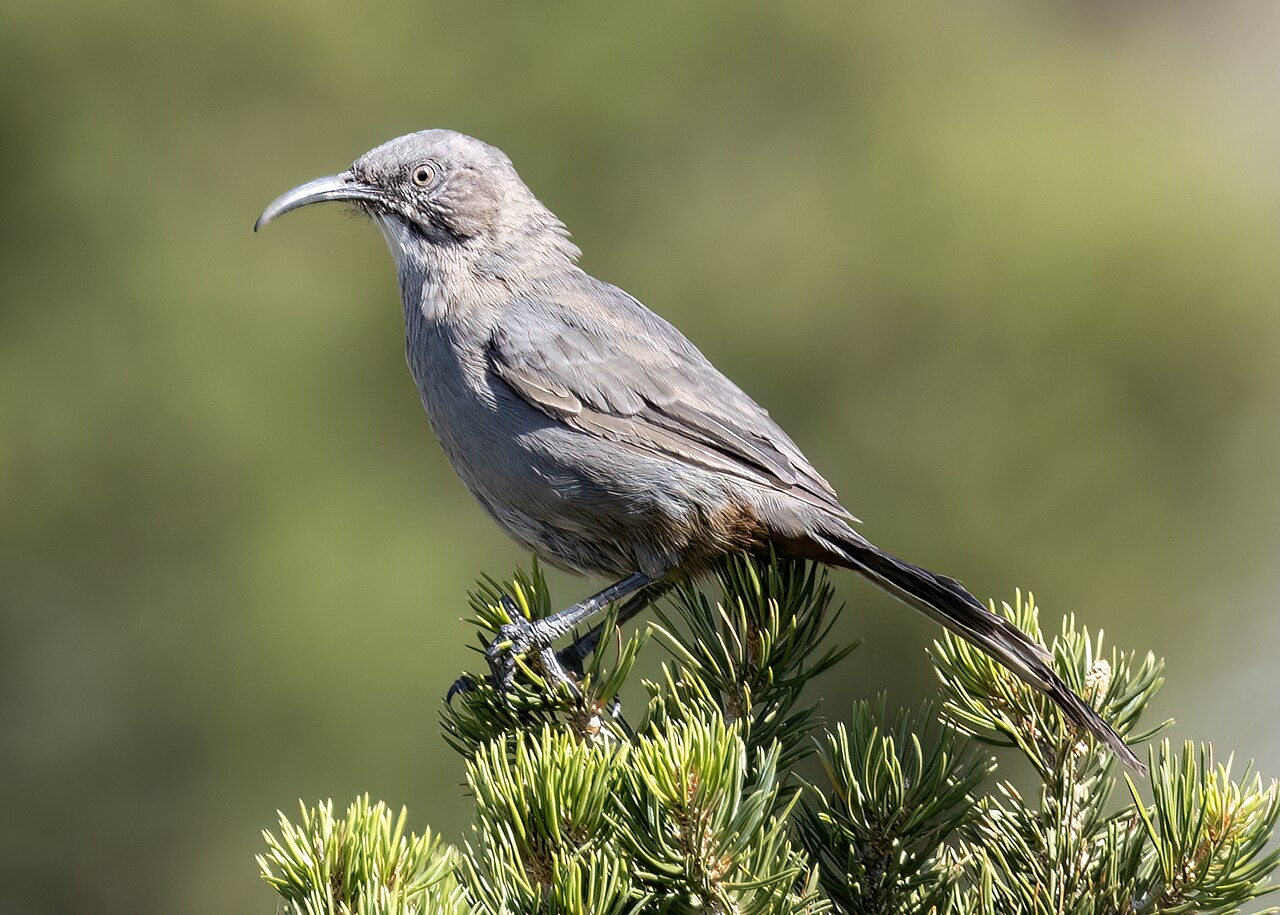
The Crissal Thrasher is the darkest and longest-billed thrasher of the American Southwest, and at the same time the member of the genus least often seen. It lives in dense mesquite thickets along dry washes, walks more than it flies, and usually gives itself away only by voice.
Voice
The song is a series of short, flowing phrases, each repeated two or three times, lower and more even in tempo than in the other desert thrashers. The contact call is a rolling, descending chudry-oo, usually given from cover. Males sing not only in spring but also in winter and late summer, then from a higher perch than the bird uses for the rest of the day.
Recording: Scott Olmstead — CC BY-NC-SA 4.0 · Rock Corral Canyon, Santa Cruz County, Arizona, United States · xeno-canto
Identification
A large, plain grey-brown songbird with a long tail, long legs and a long, strongly decurved black bill. The underparts are unstreaked grey; under the tail lies a sharply defined chestnut patch, the crissum, which gives the species its name. A white malar stripe runs across the cheek between two dark lines. The eye is dull yellow to brown, not orange-red.
Confusion species
Curve-billed Thrasher has a shorter, less strongly curved bill, an orange eye, faint spotting on the breast and no chestnut under the tail. Long-billed Thrasher shows clear streaking on the breast and a rustier back. LeConte's Thrasher is far paler sandy and lives in open, flat desert with scattered shrubs. In extreme southeastern California the range meets that of California Thrasher, which is warmer brown and has a vaguer, more gradually blending rusty area under the tail.
Habitat
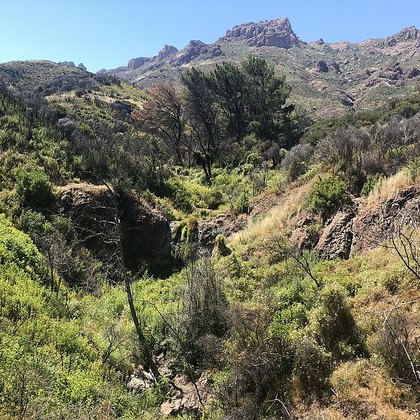
Dense, tall scrub in desert country: mesquite thickets along dry washes, willow and shrub belts along arroyos (steep-sided dry gullies that carry water only after rain), and at higher elevations scrub oak, manzanita and the lower edge of pinyon (a low-growing pine of the dry southwestern foothills) and juniper woodland. It needs cover at least head-high and avoids open, bare flats. Food — beetles, grasshoppers, ants, spiders and the occasional small lizard — comes almost entirely from the ground, dug from the litter layer with the bill and swept aside with sideways strokes; in winter juniper and other berries are added.
Where the bird is most often found, arranged by the USNVC — the vegetation classification of the United States and Canada — and CMECS for sea and coast.




Range and movements
Resident in southeastern California, extreme southern Nevada and southwestern Utah, through Arizona and southern New Mexico to West Texas, and south across the Mexican plateau to about Durango and Zacatecas. There is no migration, though birds shift locally between higher and lower scrub. In Texas the range is confined to the Trans-Pecos, with the Big Bend region as its core.
- Resident
- Breeding (summer)
- Winter
- Passage
- dark = core range, pale = thinly spread
Where and when to look
Work along a dry wash with mesquite (a thorny leguminous shrub of the Southwest that forms dense thickets), shortly after sunrise in February or March, when males sing from an open branch. Stand still and listen for the rolling call: the bird often walks through the scrub ten metres away without showing itself. On a brief view, check the curve of the bill first and the chestnut under the tail second.
Conservation
The world population is put at about 110,000 birds, centred on Mexico, and the species is listed as Least Concern (LC). The scrub along dry washes has nonetheless shrunk sharply in the Southwest: groundwater extraction, grazing and the conversion of mesquite thickets to farmland and housing have reduced the suitable area. Climate models point to a further shift in that area.
Scientific name
Toxostoma crissale | Henry, 1858
Thomas Charles Henry described the species in 1858 as Toxostoma crissalis; because Toxostoma is neuter, the epithet now reads crissale. Author and year stand without parentheses, since the genus has not changed. Toxostoma comes from Greek toxon 'bow' and stoma 'mouth', after the curved bill; crissale refers to the crissum, the feathers around the vent and under the tail. The Dutch and Spanish names point to that same rusty patch; cuitlacoche is the Nahuatl word used in Mexico for the thrashers.