All species › Gannets and cormorants › Cormorants and shags › Double-crested Cormorant
Double-crested Cormorant | Nannopterum auritum
Geoorde aalscholver | Cormorán orejudo
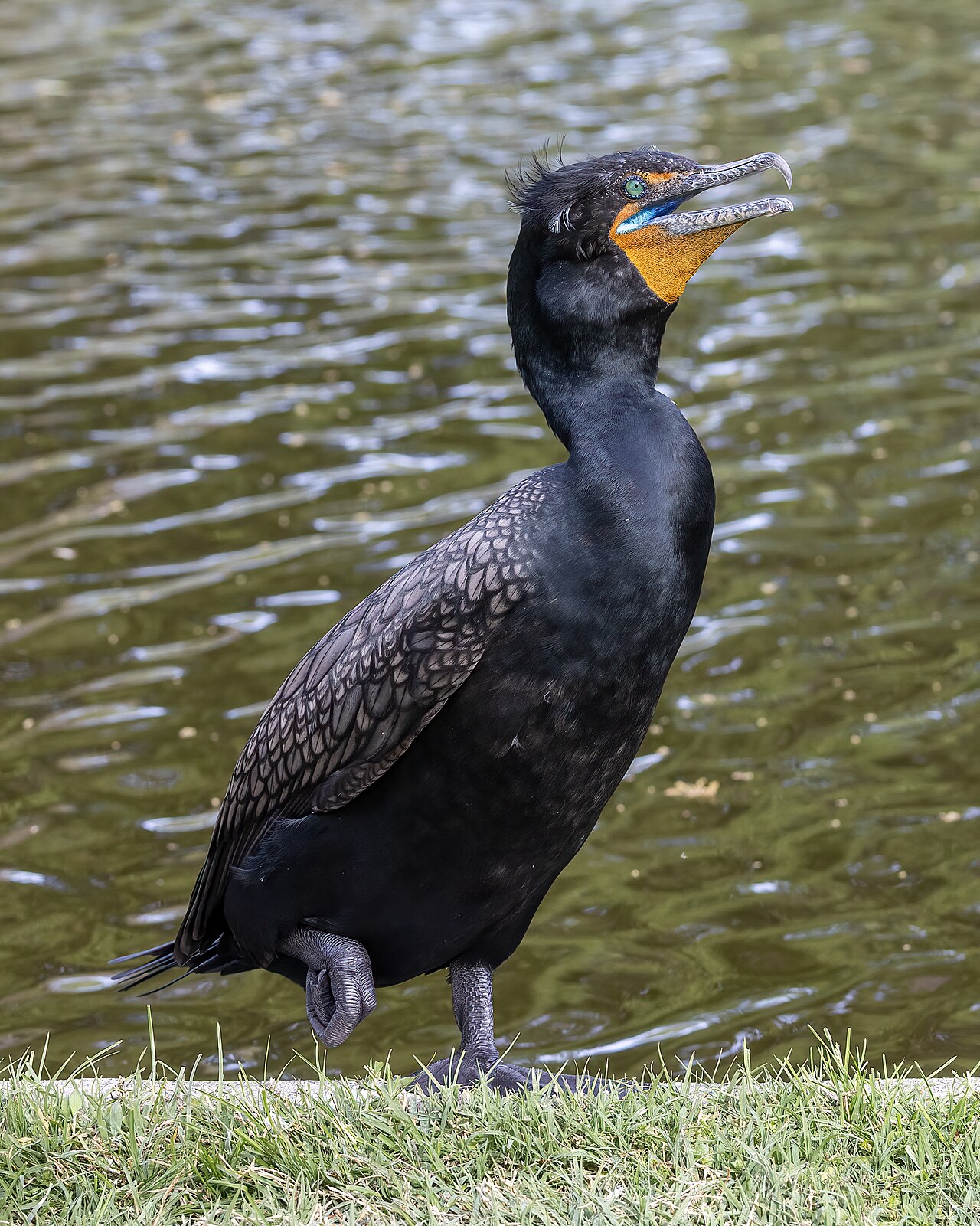
Double-crested Cormorant is the black waterbird found drying its outstretched wings in the sun on almost every lake, river and coastline in North America. Bright orange throat skin and an emerald eye-ring give the mostly black plumage unexpected colour up close. It is the continent's most numerous and widespread cormorant, and has rebounded strongly across its range since the crash caused by DDT.
Voice
Away from the colony a Double-crested Cormorant is almost silent; it lacks the vocal organ most birds have and produces only low, grunting sounds. At the nest a series of dull, pig-like grunts — orrk-orrk-orrk — greets returning partners and drives off intruders. Chicks beg with a persistent, hoarse squealing that carries far across the water. The slap of wings against branches at a busy colony is often louder than the calls themselves.
Recording: Bruce Lagerquist — CC BY-NC-SA 4.0 · Cassimer Bar, Okanogan County, Washington, United States · xeno-canto
Identification
A large, slender waterbird with a long S-shaped neck, a thin hooked bill and mostly black plumage with a greenish or bronze sheen. Bright yellow-orange throat skin and an emerald eye-ring stand out at any distance. In breeding condition it grows two tufts of feathers on the crown — black in eastern birds, white in western populations — which give the species its name but are rarely visible in the field. Young birds are dull brown with a pale breast shading into a dark belly. In flight the slightly kinked neck is diagnostic, along with the heavy, somewhat laboured wingbeat.
Confusion species
Neotropic Cormorant (Nannopterum brasilianum) of the south and Gulf coast is noticeably smaller, with a longer tail and a narrower, white-bordered throat patch that comes to a point toward the eye. In flight the species is confused with Anhinga, which has a straight, spear-like bill rather than a hook and swims with its neck outstretched above the water instead of riding low like a duck. At a distance on the water the silhouette resembles a loon, but loons have a straight, dagger-shaped bill and lack the orange throat patch.
Habitat
Lakes, rivers, reservoirs, marshes and sheltered coastal waters such as bays and estuaries — almost any permanent water body will do as long as fish are plentiful. It nests colonially on rocky islets, in dead trees over water or on low vegetated islands, and prefers to roost and dry its wings on posts, snags or bare rock just above the surface. It avoids fast-flowing water and dense closed forest; the great expansion of inland reservoirs during the twentieth century actually pushed its range far into the interior.
Where the bird is most often found, arranged by the USNVC — the vegetation classification of the United States and Canada — and CMECS for sea and coast.




Range and movements
Breeds from Alaska and southern Canada to Mexico and the Caribbean, and is largely resident across the southern United States and along both coasts. Birds from the interior and the northern part of the range move south in winter to the southern states and northern Mexico. After a sharp decline caused by DDT and persecution in the mid-twentieth century, the species has increased strongly since the pesticide ban and has spread far into the interior, to the considerable frustration of aquaculture operators who see the birds as competitors.
- Resident
- Breeding (summer)
- Winter
- Passage
- dark = core range, pale = thinly spread
Where and when to look
Look along the edge of any lake or river for a black bird perched with its wings held wide open — no other North American waterbird does this so conspicuously. From the water it dives with a short forward hop and stays submerged fishing for a minute or more, surfacing suddenly with a fish held crosswise in its bill.
Conservation
Rated Least Concern (LC) and, numerous, strongly recovered since the DDT crash; the species is now among the most common waterbirds in North America. That recovery has, in many places, produced conflict with the aquaculture industry and managers of fish-stocked lakes, leading in some states to permitted culling and dispersal programmes.
Scientific name
Nannopterum auritum | (Lesson, 1831)
Lesson described the species in 1831 as Carbo auritus; it has since been moved to another genus, so author and year stand in parentheses. It now stands in the genus Nannopterum, introduced by Sharpe in 1899; most other reference works still use the older Phalacrocorax auritus — a difference between checklists, not a disagreement about the bird itself. auritus is Latin for 'eared', after the feather tufts on the crown in breeding plumage. The type locality was originally given, in error, as New Zealand; the species occurs only in North America.