All species › Gannets and cormorants › Cormorants and shags › Neotropic Cormorant
Neotropic Cormorant | Nannopterum brasilianum
Bigua-aalscholver | Cormorán neotropical
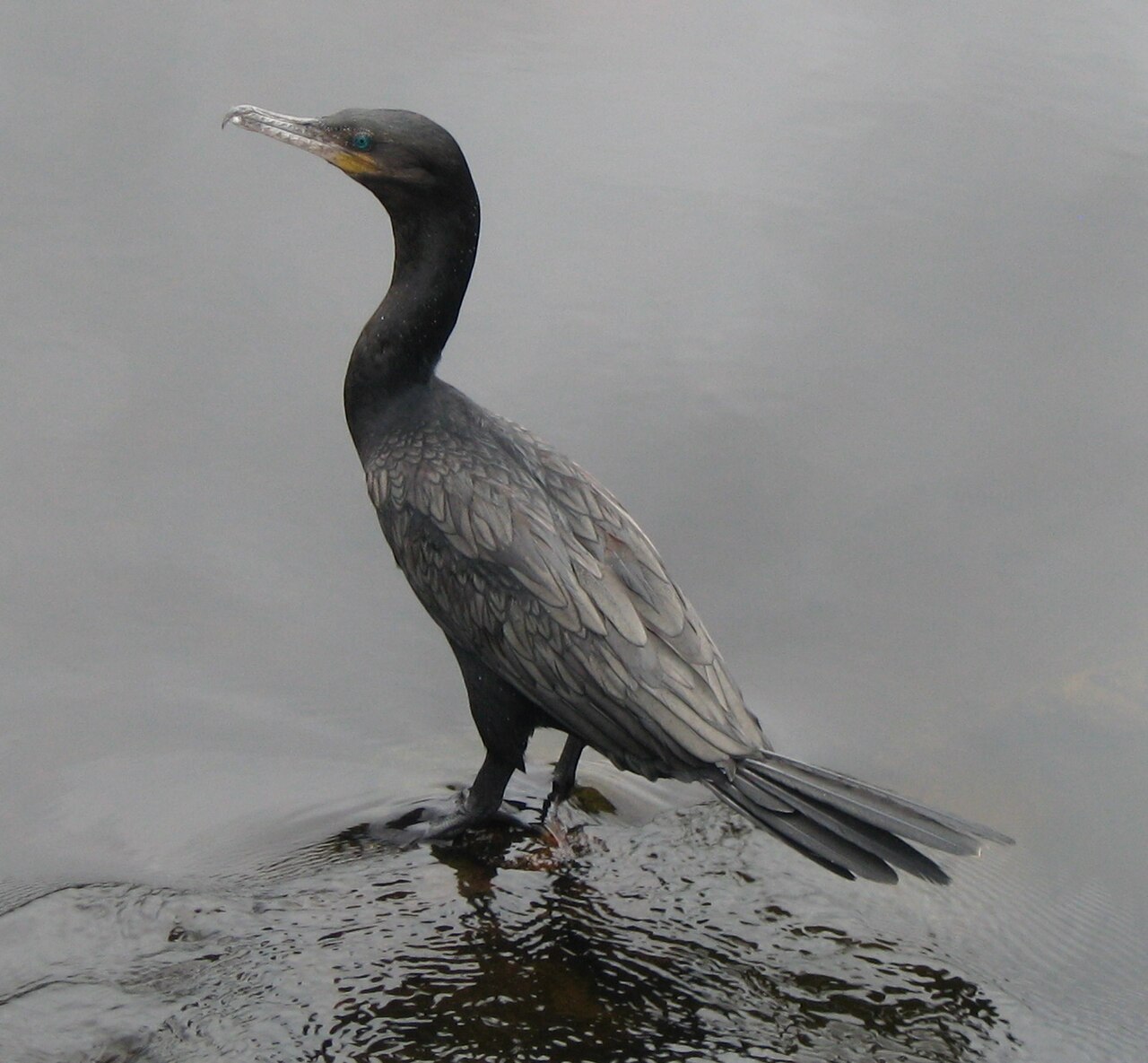
Neotropic Cormorant is the smallest cormorant in North America and the only one that also drops into the water from the air to fish. It is known by its long tail and by the dull yellow throat skin that ends in a point behind the bill, edged with a narrow white border in the breeding season. From Texas to Tierra del Fuego this is the cormorant of every piece of water, from a cattle pond to a mangrove lagoon.
Voice
Away from the colony it is hardly ever heard. At the nest a series of low grunting notes — gorr-gorr — greets a returning partner and keeps neighbours at a distance. Chicks beg with a hoarse, persistent squealing that rises above the general noise of the colony. A disturbed bird sometimes gives a single short grunt as it takes off, and beyond that there is only the slap of wings on water.
No freely licensed recording has been found for this species yet; what to listen for is described below.
Identification
A slim, long-bodied waterbird with a thin hooked bill, an S-shaped neck and a tail that seems to take up almost half the bird. Adult plumage is black with a dull green sheen; the throat skin is dull yellow to brownish yellow, narrow, and runs back behind the bill to a sharp point toward the eye. In breeding condition that throat patch is edged by a white border shaped like an inverted V, and a few white filoplumes appear on the sides of the head. Young birds are dull brown, palest on throat and breast. Swimming, it rides low with the tail often angled upward; in flight the neck is held straight and the wingbeat is faster and looser than that of the larger cormorant.
Confusion species
Double-crested Cormorant is clearly larger and heavier, with a shorter tail and a broad orange throat patch with a rounded rear edge rather than a narrow point, and it holds a slight kink in the neck in flight. Anhinga has a straight, pointed bill with no hook, a much longer and broadly fanned tail and large silver-grey patches on the upperwing; it swims with only the neck above water and soars a great deal, which Neotropic Cormorant seldom does. At a distance the proportions decide it: on Neotropic Cormorant the tail is about as long as the neck, on Double-crested Cormorant clearly shorter.
Habitat
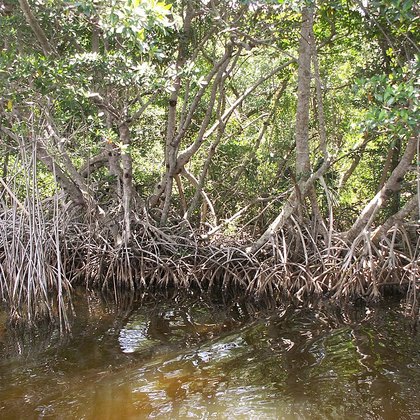
It uses almost any water that holds fish: reservoirs, rivers, canals, irrigation ditches, fish ponds, cattle tanks, mangrove lagoons, estuaries and sheltered coastal bays. It nests colonially in trees or bushes over or beside the water, often alongside herons and ibises. Unlike the larger cormorant it is content with very small waters — a pool a few tens of metres across is enough. It avoids the open sea and fast-flowing mountain rivers.
Where the bird is most often found, arranged by the USNVC — the vegetation classification of the United States and Canada — and CMECS for sea and coast.




Range and movements
The range runs from the southern United States through the whole of Central and South America to Tierra del Fuego, making it the most widely distributed cormorant of the Americas. In the United States it is resident in Texas, Louisiana, New Mexico and Arizona; over recent decades it has moved north along the river systems and now also breeds in Oklahoma, Kansas, Colorado and Arkansas. That expansion follows the building of reservoirs and fish ponds. Northern breeders move south for the winter, while birds in Mexico and further south stay all year.
- Resident
- Breeding (summer)
- Winter
- Passage
- dark = core range, pale = thinly spread
Where and when to look
On any reservoir or river in Texas or the southwest, check the cormorants sitting on a post, a buoy or a fence and compare tail and throat: a long tail with a narrow, pointed throat patch means Neotropic Cormorant. If you see one hanging above the water and then entering it with a short forward plunge, the matter is settled — no other cormorant on the continent hunts that way. In mixed groups on a sandbar it is the smallest bird present, and it usually stands a little apart from the rest.
Conservation
Numerous, with a population in the millions, and increasing; the species is listed as not threatened. The northern edge of the range keeps moving, helped along by reservoirs, fish ponds and canals. Where it feeds at aquaculture ponds it is chased off and locally shot under permit, and birds drown in fishing nets every year.
Scientific name
Nannopterum brasilianum | (Gmelin, 1789)
Gmelin described the species in 1789 as Procellaria brasiliana — in the petrel genus, since he worked from an account of a seabird from Brazil. Because it has since been moved to another genus, author and year stand in parentheses. brasiliana refers to that country of origin; AviList records no type locality for the species. The genus Nannopterum was introduced by Sharpe in 1899, from Greek nannos ('dwarf') and pteron ('wing'), after the short wings of the Galápagos cormorant; most reference works still place this species in Phalacrocorax brasilianus, a difference between checklists rather than about the bird itself.