All species › Gannets and cormorants › Anhinga and darters › Anhinga
Anhinga | Anhinga anhinga
Amerikaanse slangenhalsvogel | Anhinga americana
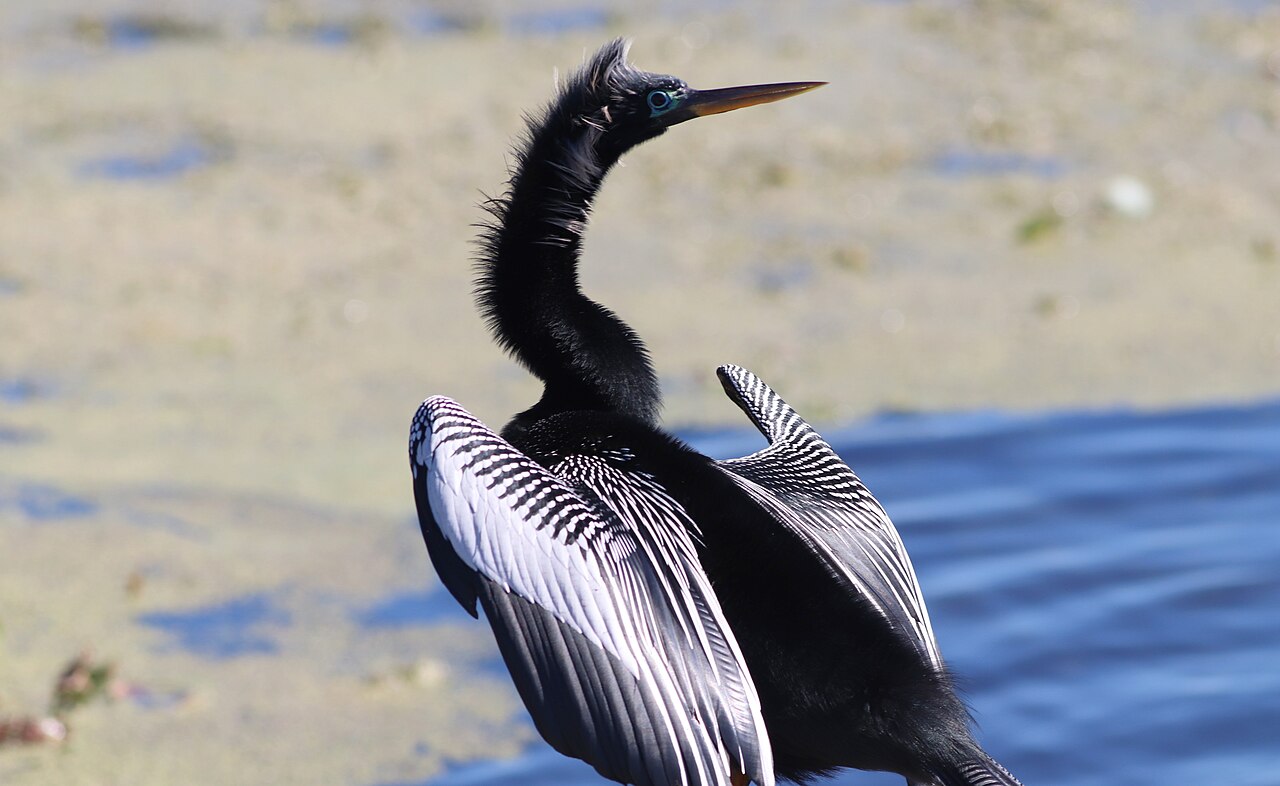
The Anhinga is the bird that sits drying on a dead branch in the swamps of the south-east, wings spread wide, motionless, like a black cross cut out against the sky. When it swims, often nothing of the whole animal shows but a thin, winding neck — which is why it is called the snakebird. It is the only member of its family in the Americas, and the only one that comes this far north.
Voice
Away from the colony it is seldom heard; a flushed bird gives at most a short, hoarse groan before it slips off the branch. At the nest, by contrast, it is noisy, above all when the partner returns: then comes a fast, hard rattle that recalls a wooden ratchet or a fishing reel running out, first accelerating and then breaking off abruptly. Between the rattles come low, grunting agh-agh-agh notes, given with the bill wide open and the neck stretched. The young beg with a shrill, squealing rasp that carries above the herons and ibises in the same trees.
No freely licensed recording has been found for this species yet; what to listen for is described below.
Identification
A long, lean waterbird with a slender neck, a straight yellow dagger of a bill, a small head and a strikingly long, broad tail. The male is glossy black with a green sheen, and across the shoulders and upperwing coverts lie silvery white streaks and spots that look at a distance like embroidery; in the breeding season he carries loose pale plumes on head and neck and the skin around the eye turns green. The female has the same black body but a pale, warm sandy head, neck and breast, sharply cut off against the black — the most useful character of the species. Young birds resemble the female but are browner and lack the silver on the wing. In the air the shape is unmistakable: a cross of outstretched neck, broad wings and a tail just as long.
Confusion species
Double-crested Cormorant (Nannopterum auritum) is the species it is constantly confused with: it has a thicker bill with a hook at the tip, an orange throat pouch, a shorter tail, and it swims with the bill tilted up rather than with a taut neck above the water. In flight the cormorant carries a kink in the neck and nearly always keeps beating; this species holds the neck straight and glides long stretches. Brown, pale-breasted young cormorants are easily taken for females; then watch the bill and the length of the tail. High up, circling on a thermal, it also resembles Turkey Vulture and Wood Stork — both of which have a short tail and a much broader wing.
Habitat
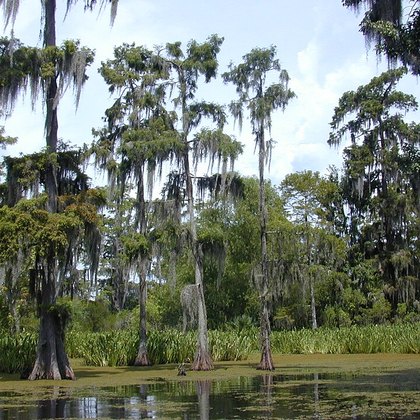
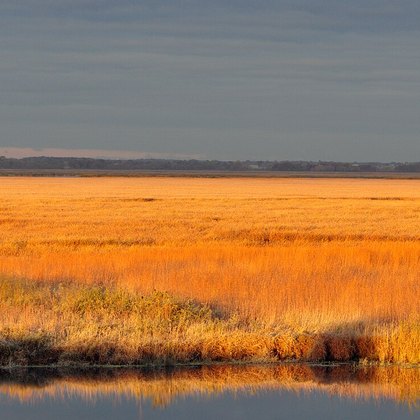
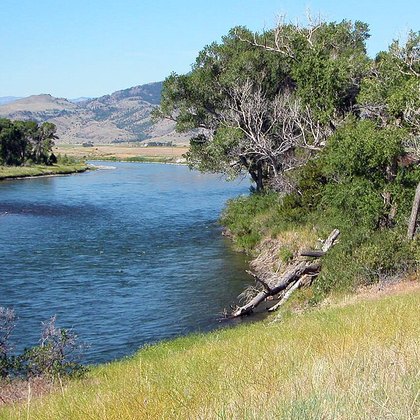
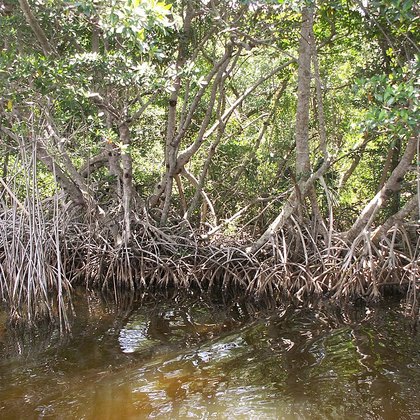
Still or slow-moving fresh water with trees along it: cypress swamp, old river bends, marsh lakes with floating vegetation, and the quiet parts of canals, reservoirs and fish ponds. It needs two things, and they decide where it is: water clear enough to hunt by sight underwater, and dead branches or low-hanging trees over the water to dry and rest on. On the coast it uses lagoons and mangrove creeks as long as the water is brackish or fresh; on the open sea it is not to be found. Fast-flowing rivers, bare banks and cold water it avoids.
Where the bird is most often found, arranged by the USNVC — the vegetation classification of the United States and Canada — and CMECS for sea and coast.

Range and movements
Resident in Florida and the states along the Gulf of Mexico to southern Texas, with breeding sites north to Arkansas, Tennessee, Oklahoma and the coast of North Carolina; further south along both coasts of Mexico, through Central America and in Cuba, and beyond this map window on to Argentina. Birds from the northern edge of the range leave their breeding places in October and winter on the Gulf coast and in Florida; they travel by day, circling on thermals in loose parties, and are then taken for raptors. Where the winter freezes it cannot stay: its spread to the north stops where the water closes over. During the twentieth century it has increased in places with the building of reservoirs, canals and fish farms.
- Resident
- Breeding (summer)
- Winter
- Passage
- dark = core range, pale = thinly spread
Where and when to look
Walk a swamp boardwalk in the middle of the day — the Anhinga Trail in the Everglades is named after this bird — and look down as well as up: below it swims half submerged among the water lilies, above there are often several circling high on a thermal. In the first hour of sun it sits with open wings on a bare branch, and then it can be watched close up and at length. If all you see is a neck above the water, wait a moment: it dives without a splash and surfaces tens of metres away.
Conservation
The species counts as not threatened; the world population is estimated at two million birds and the North American Breeding Bird Survey shows an increase of nearly two per cent a year between 1966 and 2019. Loss of swamp forest is the main threat: drainage, canalisation and the felling of cypress remove the feeding ground and the nest tree at once. Birds also become entangled in discarded fishing line, which happens regularly on heavily fished waters. In the south of the range it is persecuted locally for eating fish, although its share of the catch at fish farms is small.
Scientific name
Anhinga anhinga | (Linnaeus, 1766)
Linnaeus described the species in 1766 as Plotus anhinga; because it was later moved to another genus, author and year stand in parentheses. The genus Anhinga had by then already been introduced, by Brisson in 1760, so that generic and specific name are now identical — a form that occurs only rarely among bird names. The word anhinga comes from Tupí in Brazil, where it denoted a spirit of the forest and passed to this bird. As its origin Linnaeus gave only 'in America australi', the southern part of America; Griscom and Greenway restricted that place in 1941 to the Rio Tapajós in Pará, Brazil.