All species › Woodpeckers and allies › Woodpeckers › Downy Woodpecker
Downy Woodpecker | Dryobates pubescens
Donsspecht | Pico pubescente
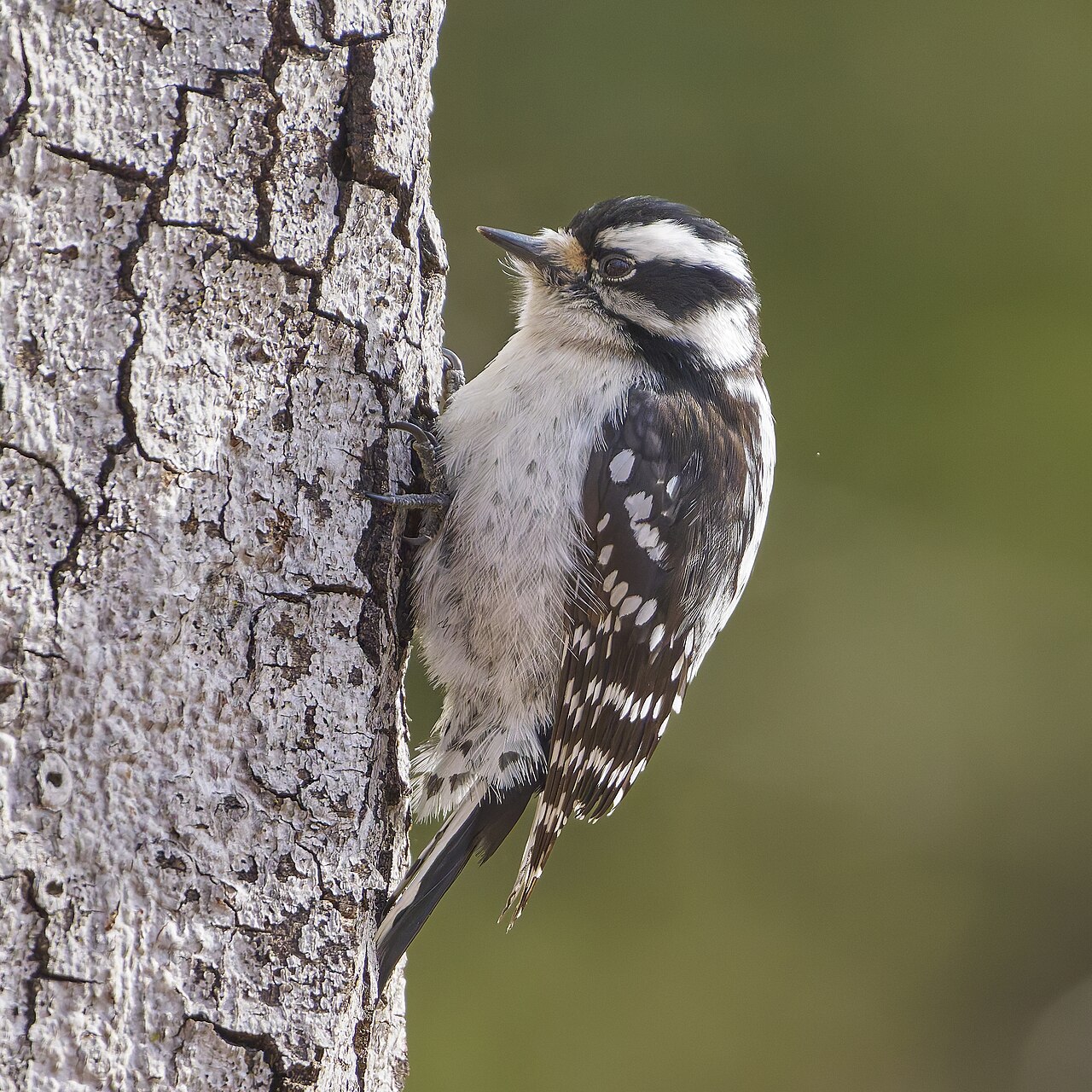
The Downy Woodpecker is the smallest woodpecker in North America, scarcely larger than a sparrow, and the woodpecker most people get to know first. Black and white with a white back stripe and a short bill, it occurs from Alaska to Florida in woodland, parks and gardens, and is a regular visitor to feeders with suet or peanuts. The male has a red patch on the nape; the female lacks it. It looks almost exactly like the much larger Hairy Woodpecker, but is not closely related to it.
Voice
The call is a short, soft, flat pik, lower and less sharp than the peek of Hairy Woodpecker. The most characteristic sound is a fast, high rattle that falls in pitch, a whinnying kee-kee-kee-kee-kee that slows towards the end, like a bouncing ball. The drum is fairly short and even, and clearly slower than that of Hairy Woodpecker. Both sexes drum, mainly from late winter into spring.
Recording: Don Profota — CC BY-NC-SA 4.0 · South Bozeman, Gallatin County, Montana, United States · xeno-canto
Identification
A small black-and-white woodpecker with a white stripe down the middle of the black back, black wings with rows of white spots, a black-and-white striped head and plain white underparts. The outer tail feathers are white with a few small black spots or bars. The bill is short, clearly shorter than the head, and the tuft of feathers at the base of the bill is relatively large. The male has a small red nape patch; young birds often show red on the crown. Birds of the Pacific north-west have duskier, greyish-brown underparts, and those of the Rocky Mountains fewer white spots on the wings.
Confusion species
Hairy Woodpecker is the real problem: almost the same plumage, but a third larger, with a bill as long as the head and plain white outer tail feathers without black spots. Proportions tell more than size: in Downy the head looks large and the bill tiny, in Hairy the bill is a sturdy tool. Voice helps too: the sharp peek and even rattle of Hairy against the soft pik and descending rattle of Downy. In California Nuttall's Woodpecker resembles it, but has a black-and-white barred back without a white stripe; Ladder-backed Woodpecker in the south-west has a similar barred back.
Habitat
Open deciduous and mixed woodland, especially along rivers, and also forest edges, orchards, parks, cemeteries and gardens, from the lowlands into mountain forest. It also forages on thin twigs and even on the stems of herbs and reeds, which a larger woodpecker cannot use; in winter it picks larvae out of goldenrod galls. Males search thin branches more often, females trunks and thicker limbs. It excavates its nest cavity in a dead trunk or branch.
Where the bird is most often found, arranged by the USNVC — the vegetation classification of the United States and Canada — and CMECS for sea and coast.


Range and movements
Resident from central Alaska and the forested part of Canada to Newfoundland, south through almost the entire United States to Florida, Texas and California. It is absent from the south-western deserts, the treeless plains of the Great Plains and the tundra; it does not reach Mexico. In winter some northern birds move a little south or to lower ground. Seven subspecies are recognised, differing mainly in size, the amount of white in the wings and the tone of the underparts.
- Resident
- Breeding (summer)
- Winter
- Passage
- dark = core range, pale = thinly spread
Where and when to look
The Downy Woodpecker is the woodpecker to start with: put out a block of suet in winter and it is almost certain to come. In woodland, watch for mixed flocks of chickadees and nuthatches, such as Black-capped Chickadee and White-breasted Nuthatch: a Downy often travels with them. To separate it from Hairy Woodpecker, look first at the ratio between bill and head and only then at size, which is deceptive at a distance.
Conservation
The IUCN rates the species as Least Concern (LC). Partners in Flight puts the global breeding population at about 13 million birds, and according to the Breeding Bird Survey numbers were stable between 1966 and 2015. It benefits from gardens with food and from standing dead trees, and does not shy away from people. As a predator of, among other things, the larvae of the European corn borer, which it extracts from maize stalks in winter, it is a useful ally of farmers.
Scientific name
Dryobates pubescens | (Linnaeus, 1766)
Linnaeus described the species in 1766 as Picus pubescens, based on the description and illustration that Mark Catesby had published from Carolina around 1730; the type locality is South Carolina. Following a molecular study from 2015 the species was moved to the revived genus Dryobates, so author and year stand in parentheses. Dryobates, introduced by Boie in 1826 with this species as its type, comes from Greek drus 'tree, oak' and batēs 'walker'. pubescens is Latin for 'downy', after the soft, downy feathers of the back.