All species › Woodpeckers and allies › Woodpeckers › Nuttall's Woodpecker
Nuttall's Woodpecker | Dryobates nuttallii
Nuttalls specht | Carpintero de Nuttall
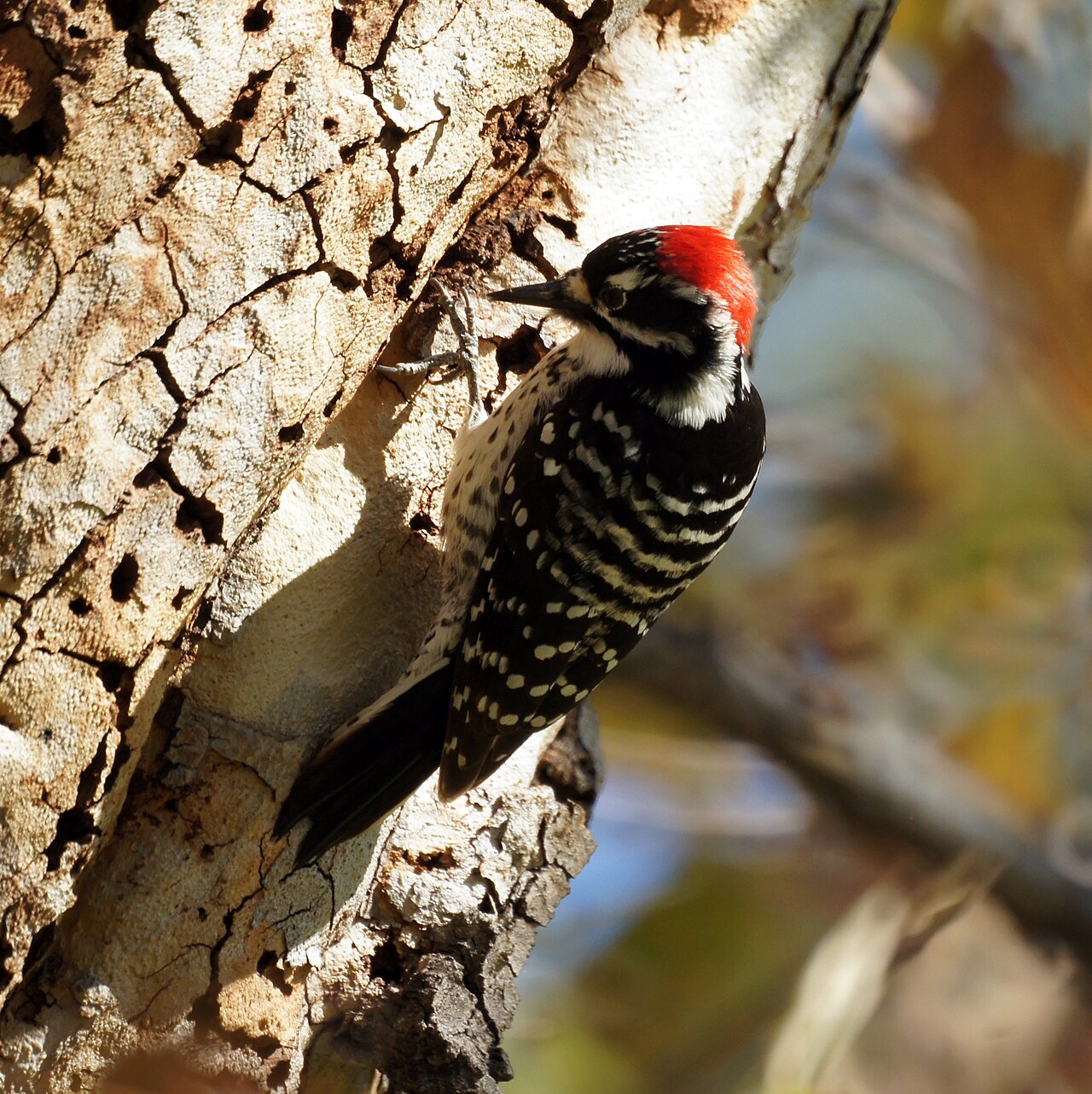
Nuttall's Woodpecker is the small black-and-white woodpecker of California's oak woodlands: a bird with a finely white-laddered back, a black face with white stripes and, in the male, a red hindcrown. Outside California it occurs only in north-western Baja California, so almost the entire world population lives within a single US state. Pairs hold the same territory all year round and give themselves away by their calls sooner than by their looks.
Voice
The most frequently heard sound is a short, dry pitik or pit-it, often repeated as the bird works through an oak, together with a metallic, rolling rattle, a prrrrrt that lasts longer and is given mainly when neighbours meet. When excited it adds a higher, plaintive kweek. Both sexes drum; the rolls are long for such a small woodpecker, averaging over a second, and are heard mainly from late winter into spring. In dense oak foliage sound is often the first sign that the species is present.
Recording: Paul Marvin — CC BY-NC-SA 4.0 · Corral Canyon Trail, Campo, San Diego County, California, United States · xeno-canto
Identification
A small woodpecker with a black back narrowly barred white over its lower part, creating a ladder pattern, while the upper part of the back remains solid black. The head is mostly black with a white supercilium and a white moustache stripe, separated by a broad black cheek stripe. The underparts are white to off-white, with black spots on the breast sides and black bars on the flanks. The male has a red hindcrown and nape, with a black, white-spotted forehead; the female has an entirely black crown. The outer tail feathers are white with a few black bars.
Confusion species
Ladder-backed Woodpecker looks similar, but its back is barred white right to the top, its head is whiter with narrower black stripes and its underparts are more sandy-coloured; in the male the red of the crown extends further forward. The two meet only along the desert edges of southern California and Baja California, where rare hybrids are known. Downy Woodpecker and Hairy Woodpecker have a broad white stripe down the centre of the back instead of bars, and Acorn Woodpecker has a solid black back and a black, white and red clown face.
Habitat
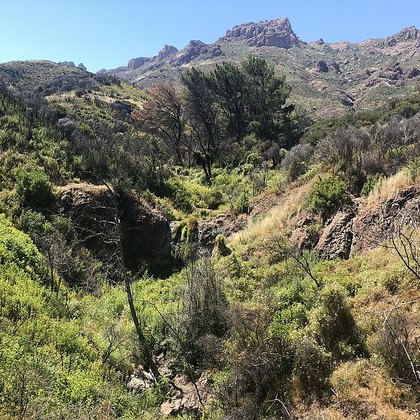
Oak woodland and open oak savanna form its core habitat, from the hills around the Central Valley to the Coast Ranges. In the south of its range, where oaks are scarcer, it lives more in riparian woodland with willows, cottonwoods and sycamores and locally in chaparral, as well as in leafy suburbs, parks and orchards. It occurs from sea level to about 1,250 metres, rarely to 2,000 metres. Although it lives in oak woodland, it does not eat acorns: its food consists of beetles and their larvae, ants and other insects taken from bark and twigs, supplemented with elderberries and blackberries.
Where the bird is most often found, arranged by the USNVC — the vegetation classification of the United States and Canada — and CMECS for sea and coast.


Range and movements
It is almost endemic to California, breeding from the north of the state southwards, west of the Sierra Nevada divide and of the deserts, into north-western Baja California in Mexico, where it reaches roughly the area around Ensenada. Its range thus largely coincides with California's Mediterranean-climate region. It is a strictly resident bird that stays on its territory in winter as well; outside the breeding range it is seldom seen. No subspecies are recognised.
- Resident
- Breeding (summer)
- Winter
- dark = core range, pale = thinly spread
Where and when to look
Look for it in oak woodland or along a willow-lined creek in the Californian hills and listen for the dry pitik and the rattle: these can be heard long before the bird is seen. It likes to forage on the outside of the canopy, often hanging sideways or upside down from twigs and working around branches, which is unusual for a woodpecker. On a perched bird, check the upper part of the back: solid black points to Nuttall's Woodpecker, continuous barring to Ladder-backed Woodpecker.
Conservation
The IUCN rates the species as Least Concern (LC). Partners in Flight estimates the breeding population at about 850,000 birds, and according to the Breeding Bird Survey numbers increased by almost 0.8 per cent a year between 1966 and 2019. Because of its small range and its dependence on oak and riparian woodland it nevertheless remains vulnerable: logging and development of oak woodland, the loss of streamside vegetation and sudden oak death — a disease caused by the water mould Phytophthora ramorum that kills large numbers of oaks in the coastal forests — are considered the main threats.
Scientific name
Dryobates nuttallii | (Gambel, 1843)
William Gambel described the species in 1843 as Picus nuttalii, from birds he had collected 'near the Pueblo de los Angeles'; the type locality therefore lies in Los Angeles County, California. Because the species has since been moved to another genus, author and year stand in parentheses; the original spelling with a single l was later corrected to nuttallii. The epithet honours Thomas Nuttall (1786–1859), the English botanist and ornithologist under whom Gambel had trained. Dryobates comes from the Greek drus 'tree, oak' and batēs 'walker': a tree-walker.