All species › Passerines › Tyrant flycatchers and allies › Eastern Phoebe
Eastern Phoebe | Sayornis phoebe
Oosterse phoebe | Mosquero fibí
The Eastern Phoebe is the flycatcher that nests closest to the house: under a bridge, a roof overhang or a porch, on a ledge of mud and moss. It sits upright on a low branch, dips its tail down and up at every pause, and repeats all morning the two syllables it is named after. It returns earlier than any other flycatcher — in March, while the nights still freeze.
Voice
The song is a hoarse, two-syllable fee-bee, stressed on the first syllable with a rough, pinched second; it is repeated every few seconds from a low perch. Two versions alternate: one ends on a rising note, the other drops and frays out. Unlike most songbirds it goes on singing in midsummer, and from the first days after arrival, before sunrise. The call is a sharp chip, usually followed by a downward flick of the tail.
Recording: Jim Berry — CC BY-NC-SA 4.0 · Jamestown, Chautauqua County, New York, United States · xeno-canto
Identification
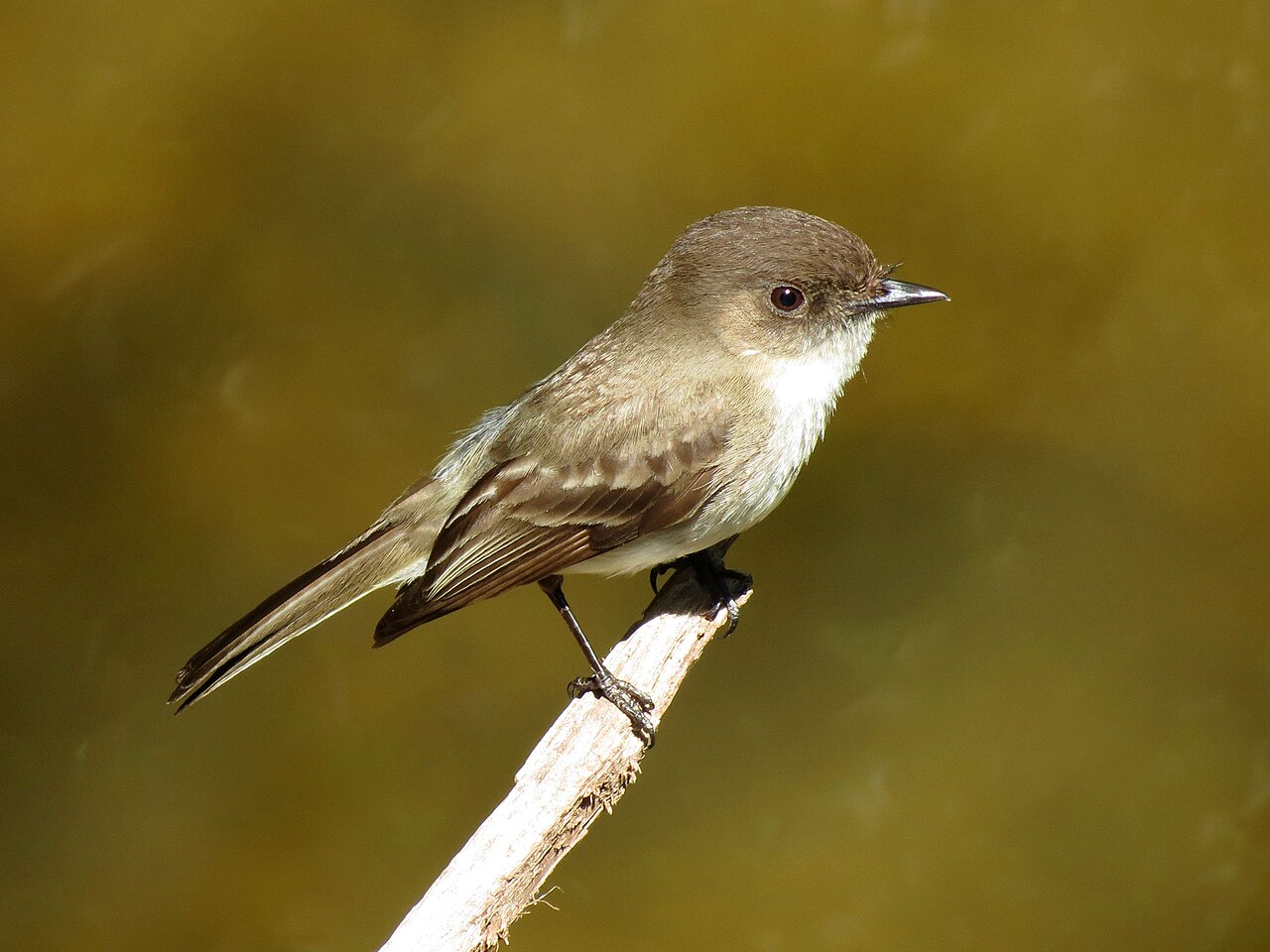
A medium-sized flycatcher without strong markings: dark brown-grey above, darkest on the crown and ear coverts, dirty white below with a grey wash across the breast. The bill is entirely black, thin and broad at the base. Wing bars are absent or faint and brownish, and there is no eye-ring; that absence of marks is itself the mark. Male and female are alike; fresh autumn birds and juveniles show a yellow wash on the belly and two clearer rusty wing bars. In flight the long tail stands out, the same tail it lowers and raises without pause when perched.
Confusion species
Eastern Kingbird is larger and divided sharply into black and white, carries a white band across the tail tip and does not wag its tail. Eastern Wood-Pewee (Contopus virens) is the same grey-brown and the same size, but has two pale wing bars, an orange-yellow lower mandible and sits still and upright. The small flycatchers of the genus Empidonax have a distinct eye-ring, sharp wing bars and a pale lower mandible; Eastern Phoebe lacks all three. Two western relatives share the tail movement: Say's Phoebe (Sayornis saya), with an orange belly, and Black Phoebe (Sayornis nigricans), whose black breast cuts sharply against a white belly.
Habitat
Open woodland and woodland edge beside running water: a stream with steep banks, a rock face, a bridge or culvert over a ditch. The nest needs a sheltered ledge with water or bare ground beneath it, and bridges, barns and porch beams have supplied far more of those over two centuries. It hunts from a low perch one to three metres up, in short sallies after flying insects. Closed high forest and treeless prairie are avoided; a single line of trees along a stream is enough.
Where the bird is most often found, arranged by the USNVC — the vegetation classification of the United States and Canada — and CMECS for sea and coast.





Range and movements
Breeds from northeastern British Columbia and the southern edge of the Northwest Territories east through the boreal south of Canada to Nova Scotia, and south in the United States to Oklahoma, Arkansas and northern Georgia. Winters from the southeastern states and the Gulf Coast through Texas into eastern Mexico, reaching Oaxaca and Chiapas. Migration is short and early: it appears in the north in March and does not leave until October, so it is present longer than any other flycatcher. The range grew through the nineteenth and twentieth centuries along with bridges and farms; in logged country without structures it is correspondingly scarce.
- Resident
- Breeding (summer)
- Winter
- Passage
- dark = core range, pale = thinly spread
Where and when to look
In March or April walk a country lane to the first small bridge over a stream and stand there: if there is a phoebe in the neighbourhood it will be on the railing or flying under the span. Watch the tail rather than the colour — the slow dip and lift carries at a distance where the plumage no longer does. Under a bridge the moss nests of earlier years often remain, sometimes three or four stacked above one another.
Conservation
Least Concern (LC) and numerous, with a breeding population on the order of thirty million birds, and slightly increasing over the past half-century. Hard winters in the wintering range hold the numbers down for a few years, after which they recover. Removal of nests from bridges and eaves is the main local disturbance, and rebuilding bridges without a ledge takes nest sites away.
Scientific name
Sayornis phoebe | (Latham, 1790)
John Latham described the species in 1790 as Muscicapa phoebe, among the Old World flycatchers; because it was later moved to another genus, author and year stand in parentheses. The genus Sayornis was introduced by Bonaparte in 1854: the name of the American naturalist Thomas Say joined to Greek ornis, 'bird'. Latham took the epithet from the English name the bird already carried; that name sounds like its call, fee-bee, and coincides with Phoibe, in Greek the name of a Titaness. The described specimen came from North America, with New York as the type locality.