All species › Owls › Owls › Elf Owl
Elf Owl | Micrathene whitneyi
Cactusuil | Mochuelo de los Saguaros
The Elf Owl is the smallest owl in the world: about thirteen centimetres long and around forty grams in weight. It nests in old woodpecker holes in saguaro cactus and in trees along desert streams, and lives almost entirely on insects, scorpions and other arthropods — an unusual menu for an owl. North of the Mexican border it is strictly a summer bird.
Voice
It is heard far more often than seen, and in practice the voice is the only field mark. The male's song is a series of five to seven nasal, yapping notes that fall in pitch towards the end and recall a young puppy; it starts shortly after sunset and carries for hundreds of metres on a still night. Around the nest there is also a soft, slurred whistled peeu, and a sharp high cheeur in alarm. In a canyon neighbouring males answer one another, so that a single evening walk maps out the whole network of territories.
Recording: Paul Marvin — CC BY-NC-SA 4.0 · Box Canyon Rd, Pima County, Arizona, United States · xeno-canto
Identification
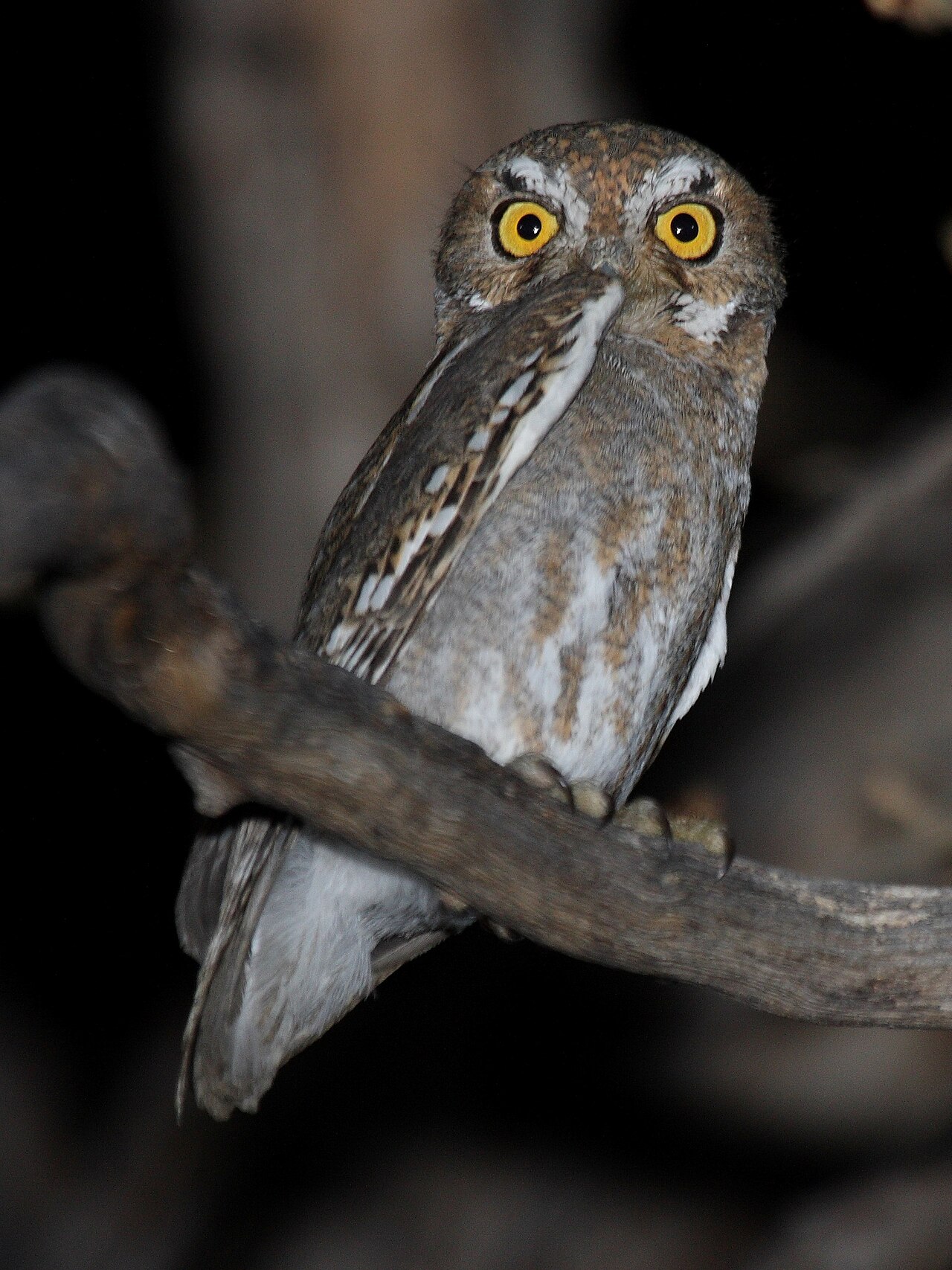
A small, compact owl without ear tufts, with a proportionately large round head, a short tail and long wings. The plumage is greyish brown with vague rusty and white spotting and indistinctly streaked underparts; a thin white eyebrow line runs above the eye and sets off the pale yellow iris. The bill is grey with a horn-coloured tip. Male and female look alike, although the female is slightly larger. In flight it looks light and fluttering, more like a large moth than an owl; it often takes prey in the air or plucks it from a branch.
Confusion species
The screech-owls (Megascops) that share its country are two to three times as heavy and carry ear tufts, which this species lacks entirely. The pygmy-owls Glaucidium gnoma and Glaucidium brasilianum are as small, but have a much longer tail, often cocked at an angle, a streaked crown, and two black marks on the nape that look like eyes. Those two also call in daylight, whereas the Elf Owl does not begin until after sunset. In the dark, size tells you little and the voice decides: the yapping, descending series cannot be confused with either.
Habitat
Desert and semi-desert with large columnar cactus, above all the saguaro country of the Sonoran Desert, and beyond that dry canyons with sycamore, cottonwood and oak along streams, thorn woodland and open pine-oak woodland up to about sixteen hundred metres. What it needs is not the cactus itself but an old woodpecker hole in it: no Gila Woodpecker or flicker cavities, no Elf Owl. It does not use bare sand plains without cavities, nor closed tall forest. It takes to nest boxes and locally nests in telephone poles on the edge of towns.
Where the bird is most often found, arranged by the USNVC — the vegetation classification of the United States and Canada — and CMECS for sea and coast.




Range and movements
Breeds in the southwestern United States and in northern and central Mexico: from the lower Colorado River in southeastern California across Arizona and southwestern New Mexico to the Big Bend country of Texas, and south into interior Mexico. North of the border it is strictly a summer bird, arriving in mid-April, leaving as early as August and September, and wintering in southern Mexico. In southern Baja California and in part of central Mexico it stays all year. Along the lower Colorado and in the lower Rio Grande valley of Texas it declined sharply during the twentieth century.
- Resident
- Breeding (summer)
- Winter
- Passage
- dark = core range, pale = thinly spread
Where and when to look
Go to a canyon or a saguaro flat in the second half of April or in May, an hour after sunset, and stand still and listen: this is when it calls most, and it gives itself away long before it can be seen. Use a lamp only once you are sure of the direction, and look for the head in the opening of a woodpecker hole two to seven metres up. By day it sits deep in the cavity and cannot be found.
Conservation
Worldwide the species is listed as not threatened; Partners in Flight puts the breeding population at about 72,000 birds. In California it is listed as endangered: the riverside woodland and thorn scrub of the lower Colorado has largely gone to water abstraction, housing and the spread of tamarisk. In southern Texas it has likewise become rare as the thorn woodland there was turned into farmland.
Scientific name
Micrathene whitneyi | (Cooper, 1861)
James Graham Cooper described the species in 1861 as Athene whitneyi, from a bird taken at Fort Mojave, Arizona; because it was later placed in a genus of its own, author and year stand in parentheses. The species name honours Josiah Dwight Whitney, the American geologist under whom Cooper worked in California. The genus Micrathene was introduced by Coues in 1866 and is built from Greek mikros, 'small', and Athene, the genus of the little owls, itself named after the goddess Athena. The name therefore reads, literally, as 'Whitney's small little owl'.