All species › Owls › Owls › Boreal Owl
Boreal Owl | Aegolius funereus
Ruigpootuil | Mochuelo boreal
The Boreal Owl is the owl of the northern conifer forest and of the highest mountain forests below it. It hunts almost entirely in darkness and spends the day motionless against a trunk, so it is rarely seen; in North America it is known above all as a voice coming out of a spruce wood in March. Its Dutch name refers to the legs, which are densely feathered right down to the toes.
Click a thumbnail to switch the photo above.
Voice
For this species the voice is the first and usually the only field mark. From February into April the male sings a series of eight to twenty low, hollow whistled toots that swell as the series goes on: poo-poo-poo-poo-poo, often compared to the winnowing of a displaying snipe. In North American birds the series is slower and carries more notes than in the same species in Europe. As soon as the male has a mate, or the female begins to incubate, the song falls almost silent, which is part of why the species is so easily overlooked. Year-round both sexes and juveniles also give a short kip or kew.
Recording: Lubomir Wójcicki — CC BY 4.0 · Gmina Pawonków (near Solarnia), Powiat lubliniecki, Województwo Śląskie, Poland · xeno-canto
Identification
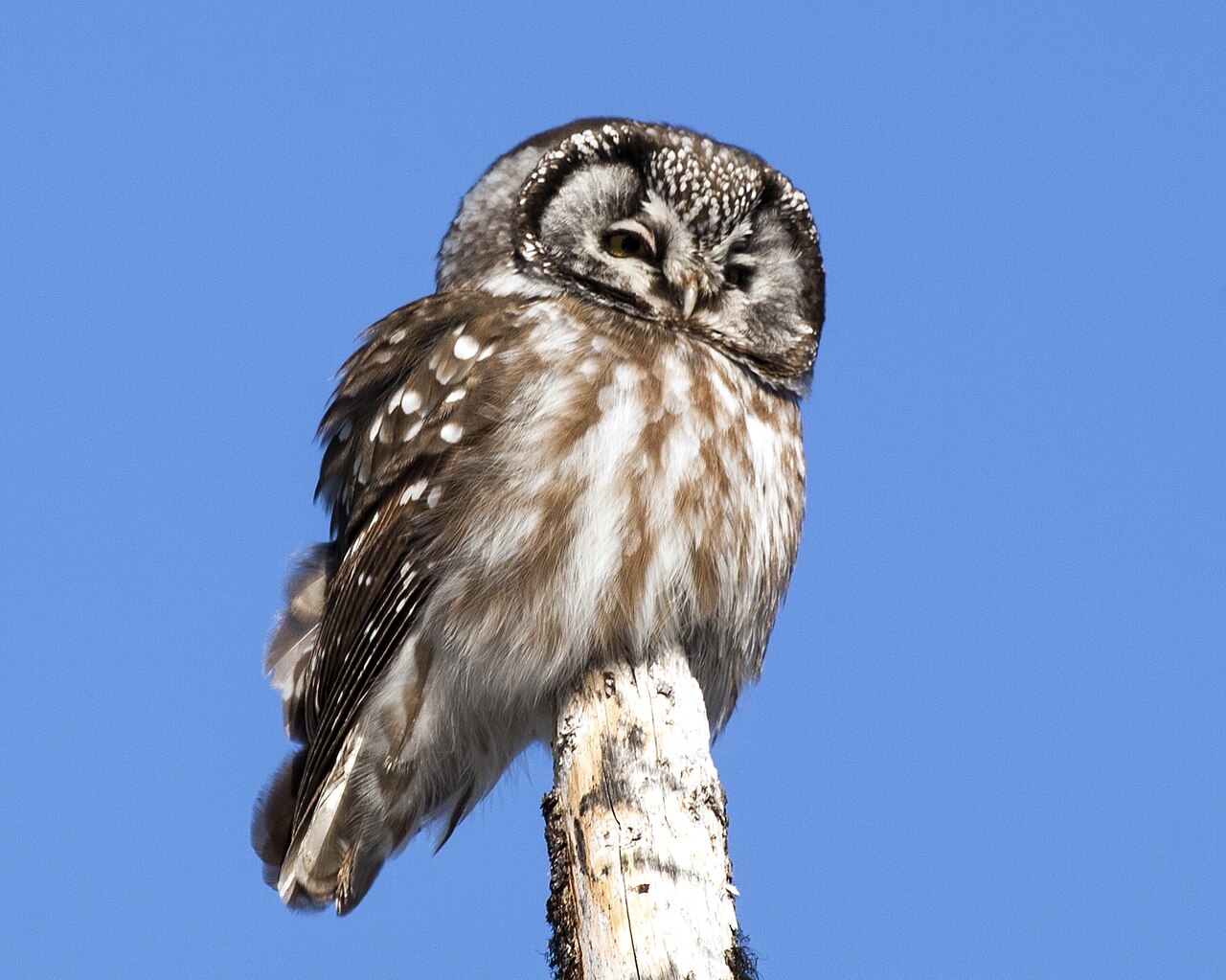
A small, stocky owl with a strikingly large, square head without ear tufts and a short tail. The upperparts are chocolate brown with large white spots, the underparts white with broad brown streaks, and the crown is thickly sprinkled with small round white dots. The greyish white facial disc is framed by a dark border; inside it are yellow eyes with white eyebrows, giving the bird a startled expression. The female is clearly larger and heavier than the male, a difference easy to see when a pair is at the nest. The legs are densely feathered to the toes and the bill is pale horn.
Confusion species
Northern Saw-whet Owl (Aegolius acadicus) is the only species it can really be confused with: it is smaller, has a black rather than a pale bill, fine white streaks on the forehead instead of round dots, and no dark border to the facial disc. The song decides: in the saw-whet an endless, even series of about two notes per second; in the Boreal Owl a swelling series that stops after eight to twenty notes. Screech-owls (Megascops) are slimmer and have ear tufts. In the north the two Aegolius species overlap and sometimes use the same woodpecker holes.
Habitat
Old conifer and mixed forest of spruce, birch, aspen and poplar in the boreal belt, and south of that the subalpine spruce-fir zone of the Rocky Mountains, in Colorado usually above twenty-eight hundred metres. It needs cavities, nearly always old woodpecker holes, and therefore old trees with thick trunks. In winter it hunts where the snow stays soft, because it listens for prey beneath it; a hard ice crust shuts its hunting ground. Unlike Northern Hawk Owl and Short-eared Owl, which also or mainly hunt by day, it is almost wholly nocturnal.
Where the bird is most often found, arranged by the USNVC — the vegetation classification of the United States and Canada — and CMECS for sea and coast.



Range and movements
Resident from Alaska across boreal Canada to Labrador, and south along the mountain ranges into Washington, Oregon, Idaho, Montana, Wyoming, Utah, Colorado and northern New Mexico; in the east the breeding range reaches northern Minnesota. It does not truly migrate, but in winters with few voles mainly young birds and females leave the breeding grounds and appear further south, into Michigan, Wisconsin and North Dakota. Such invasions come irregularly, every few years, and last a single winter. The same species occupies the conifer forests of Europe and Asia.
- Resident
- Breeding (summer)
- Winter
- Passage
- dark = core range, pale = thinly spread
Where and when to look
The only reliable method is to listen at night in March and early April, in calm weather a few degrees below freezing, along a forest road through old spruce. Drive slowly, stop every kilometre and listen for five minutes: the song carries far but is so low that any wind takes it away. Do not look for the bird itself — it sits high and does not move.
Conservation
The world population is put at well over a million and a half birds and the species is listed as not threatened, although its nocturnal habits and remote range make it hard to count. The loss of old trees with woodpecker holes to clear-cutting is the chief threat; for that reason nest boxes have been put up on a large scale in Europe, where northern populations have declined markedly. Where old forest is left standing, the species holds its own.
Scientific name
Aegolius funereus | (Linnaeus, 1758)
Linnaeus described the species in 1758 as Strix funerea; because it was later placed in another genus, author and year stand in parentheses. funereus is Latin for 'of a funeral' and refers to the persistent hollow call, which in Europe was taken as a warning of death. The genus Aegolius was introduced by Kaup in 1829; it is the Latin word for a night owl, taken from Greek aigolios, the name of a bird regarded as an ill omen. The type locality is Europe, later restricted to Sweden.