All species › Owls › Owls › Northern Saw-whet Owl
Northern Saw-whet Owl | Aegolius acadicus
Zaaguil | Tecolote Oyamelero Norteño
The Northern Saw-whet Owl is one of the smallest owls in North America and at the same time one of the commonest, yet well into the twentieth century it was thought rare: it is so small, so silent and so strictly nocturnal that nobody knew how many there were. Only when autumn banding stations began taking hundreds of birds a night in mist nets with played calls did a broad migration stream across the east of the continent come to light.
Click a thumbnail to switch the photo above.
Voice
The song is an endlessly repeated too-too-too-too, level in pitch, at about two notes a second, kept up for hours on end. A singing male carries almost a kilometre on a still night; he starts in late January and continues into May. The English name saw-whet goes back to another sound in the repertoire, likened to the rasp of a saw being sharpened on a whetstone; the Dutch name follows the same comparison. Beyond that there are whines, guttural notes, high tssst calls, squeaks and short barks, and rapid bill-snapping when the bird is disturbed.
Recording: Ray Cooke — CC BY-NC 4.0 · Ryans Road, PF 627513, Avondale, Prince Edward Island, Canada · xeno-canto
Identification
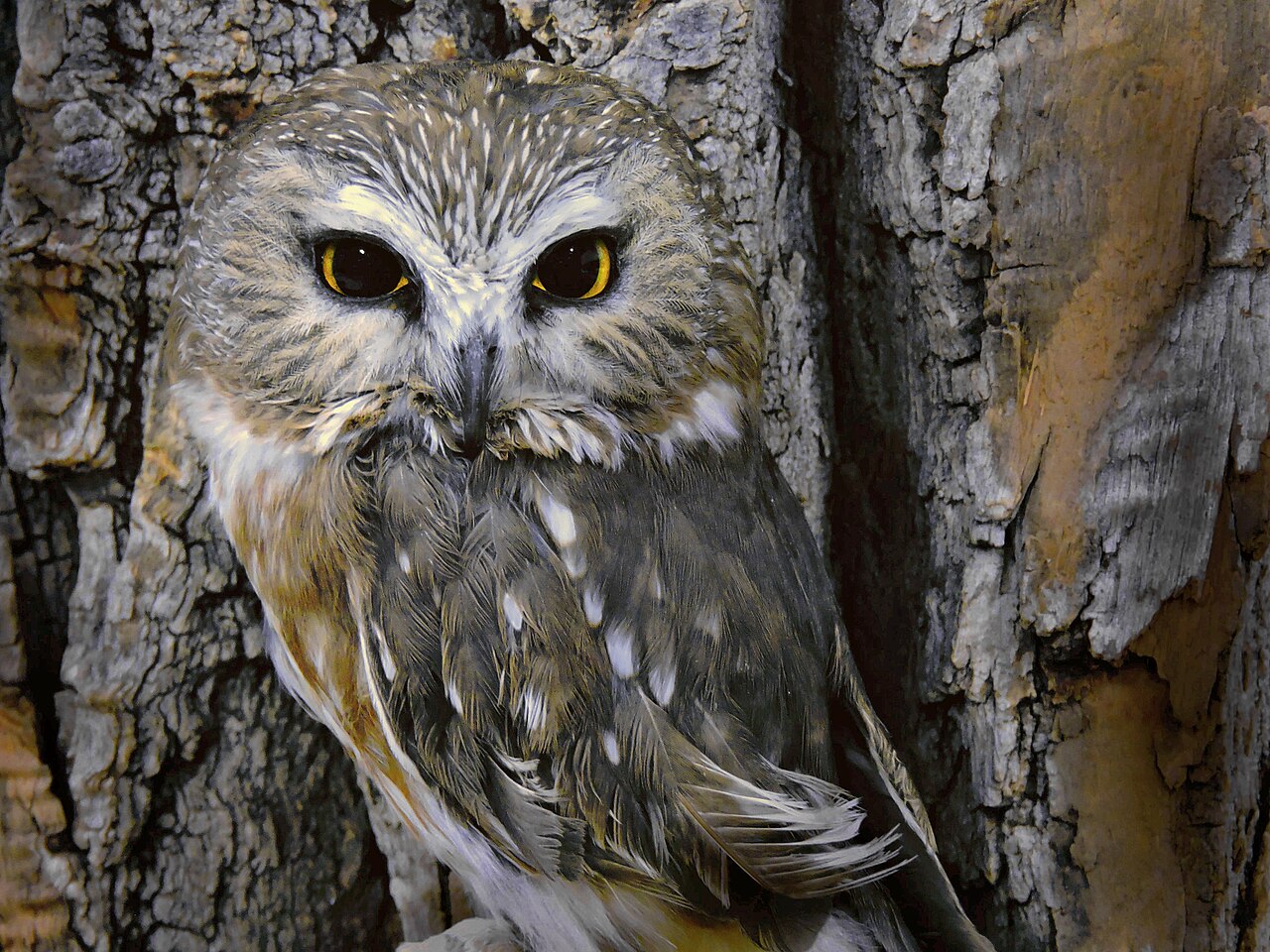
A small owl with a large, round head without ear tufts and a short tail. The upperparts are warm brown with white spots on wing and shoulder, the underparts white with broad rusty streaks, and the forehead carries fine white streaks. The facial disc is pale, with brown and cream rays around large yellow eyes, and has no dark border; the bill is black. Juveniles look different: dark brown head and wings, rusty cinnamon underparts and a white V between the eyes. Here too the female is heavier than the male, on average a hundred grams against seventy-five.
Confusion species
Boreal Owl (Aegolius funereus) is the nearest relative and the main stumbling block in the north: it is larger, has a pale horn-coloured bill instead of a black one, round white dots on the crown instead of streaks, and a dark border to the facial disc. Screech-Owls (Megascops) are larger and have ear tufts. Juvenile saw-whets, with their rusty underparts, have been taken for adults of a different species in July and August. In any case the song separates the two Aegolius species: in the saw-whet the series runs on without end, in the Boreal Owl it stops after twenty notes at most.
Habitat
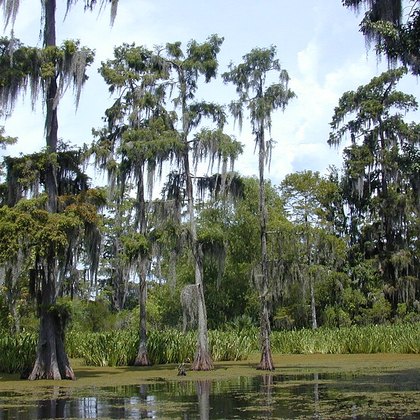
Mature and half-mature forest with an open understorey to hunt in, broadleaf trees with cavities to nest in and dense conifers to sleep in by day — the three together are found from the boreal belt into the mountain forests of the west and in the Appalachians. It also breeds in swamp forest and in heavily disturbed woodland, and takes readily to nest boxes. In winter it sits in dense conifer or shrub stands near water, sometimes only three metres up in a juniper. It avoids open country without cover, and unlike Short-eared Owl is never seen hunting in daylight.
Where the bird is most often found, arranged by the USNVC — the vegetation classification of the United States and Canada — and CMECS for sea and coast.




Range and movements
Resident or short-distance migrant from southern Alaska and southern Canada south through the west to Arizona, New Mexico and the mountains of central Mexico, and in the east to the Appalachians of West Virginia, western North Carolina and eastern Tennessee. Part of the population stays all year; part drops south in winter, into Nebraska, Kansas, Missouri, Kentucky and Delaware. How many move varies sharply from year to year and tracks the rodent supply on the breeding grounds. The subspecies of Haida Gwaii off the coast of British Columbia does not migrate at all.
- Resident
- Breeding (summer)
- Winter
- Passage
- dark = core range, pale = thinly spread
Where and when to look
Look for a singing male in late March or April, a few hours after sunset, along a woodland edge beside a marsh; the series is so monotonous that it resembles a distant frog or a beeping alarm. By day it pays to watch for mobbing chickadees and jays: a party of small birds shrieking around one dense spruce has often found a roosting saw-whet. Do not play recordings in the breeding season.
Conservation
The breeding population is put at about two million birds and the species is listed as Least Concern (LC). It does decline locally where mature forest with cavities disappears; in North Carolina it is listed as threatened after hemlock woolly adelgid damaged the high-elevation conifer forest, and the Haida Gwaii subspecies is small and vulnerable. Leaving dead trees standing and putting up nest boxes are the usual measures.
Scientific name
Aegolius acadicus | (Gmelin, 1788)
Johann Friedrich Gmelin described the species in 1788 as Strix acadica, on the basis of an account by Latham; because it was later placed in another genus, author and year stand in parentheses. acadicus means 'of Acadia', the old name for Nova Scotia and its surroundings, to which the type locality was later restricted. The genus Aegolius was introduced by Kaup in 1829, from the Latin word for a night owl, taken in turn from Greek aigolios. A. acadicus shares that genus with the Boreal Owl, the species with which it is most often confused in the field.