All species › Owls › Owls › Burrowing Owl
Burrowing Owl | Athene cunicularia
Holenuil | Lechuza Terrestre
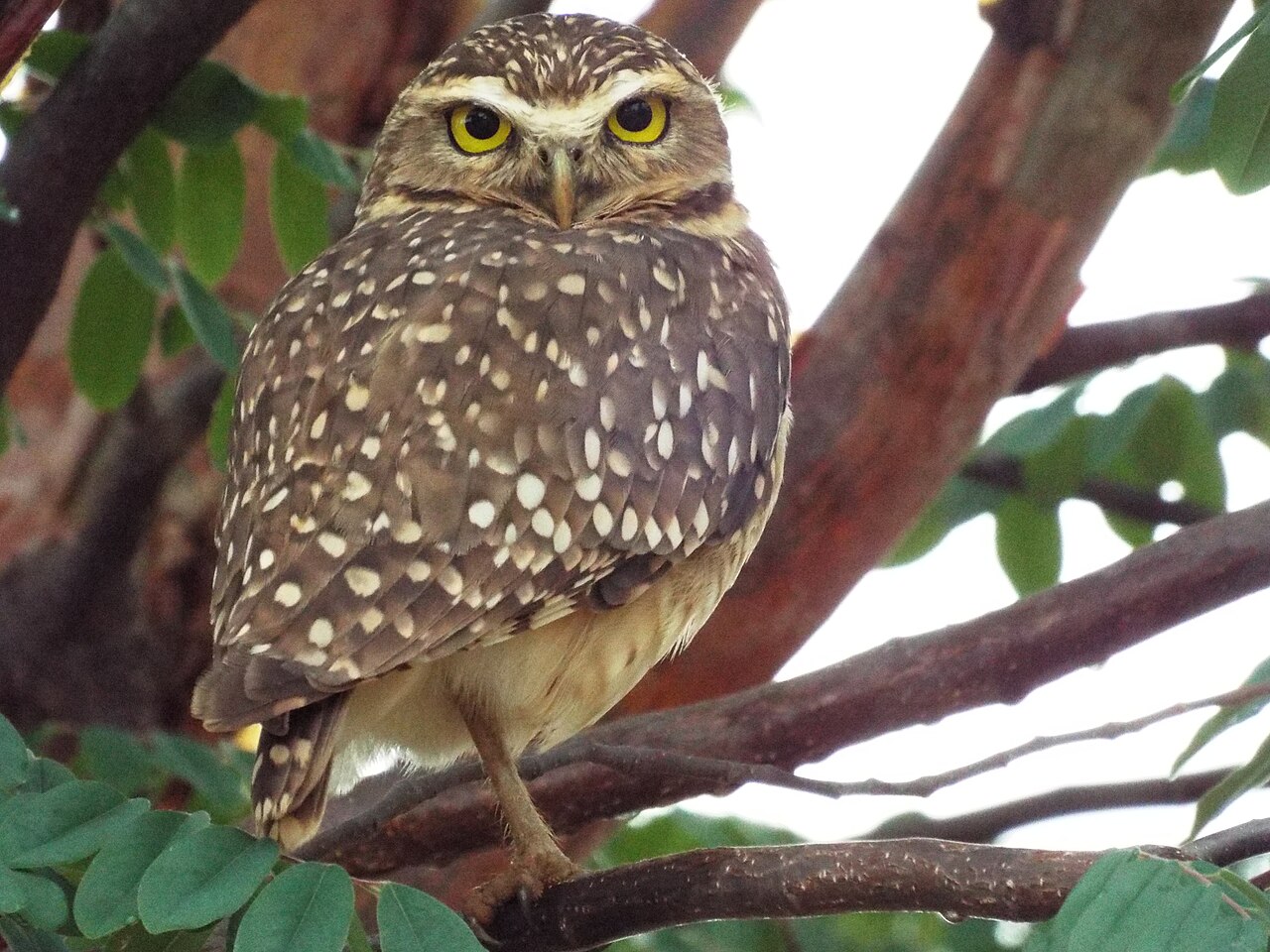
The Burrowing Owl is the owl you meet in daylight: standing upright on a mound or a fence post, long-legged and yellow-eyed above a short tail. It nests underground in tunnels dug by prairie dogs and ground squirrels, which makes it the only North American owl that depends on a mammal for its nest.
Voice
The male's song is a soft, quail-like two-note coo-coooo, given at dusk and after dark from the mouth of the burrow. Around the nest the birds also cluck, chatter and scream, and a sharp chek serves as an alarm. Cornered in the tunnel, the young produce a dry buzzing rasp that closely imitates the warning of a rattlesnake. Outside these situations the species is fairly silent.
Recording: Manuel Grosselet — CC BY-NC-SA 4.0 · Buckeye, Maricopa County, Arizona, United States · xeno-canto
Identification
Small, round-headed and without ear tufts, with long thin legs and a short tail — an owl on stilts. The plumage is brown, heavily spotted with sandy buff; the breast is spotted, the belly barred, and the face shows white eyebrows and a white chin patch above yellow eyes and a yellow bill. The sexes are marked alike, though males bleach paler in the sun while the female sits underground. Juveniles are much plainer, with unmarked buffy-yellow underparts. In flight the wings look long and the bird hunts in a low, buoyant, undulating course over the ground; when alarmed while perched it bobs its whole body rapidly up and down.
Confusion species
No other owl of open treeless country perches upright on the ground in broad daylight. Pygmy-owls of the genus Glaucidium are smaller, short-legged and stay in trees; screech-owls of the genus Megascops have ear tufts and keep to woodland. At a distance a Burrowing Owl on a post is taken for an American Kestrel, but the kestrel has a long tail and pointed wings and never stands waiting on the ground. Hunting low over the flats it recalls a small Short-eared Owl, which is far larger, much longer-winged and streaked rather than spotted below.
Habitat
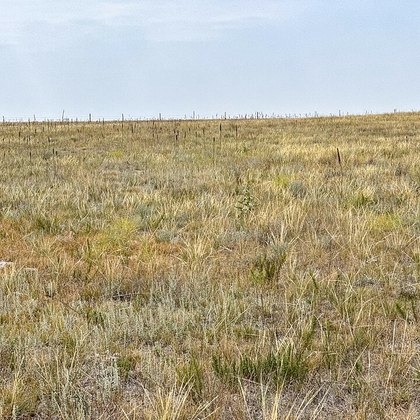
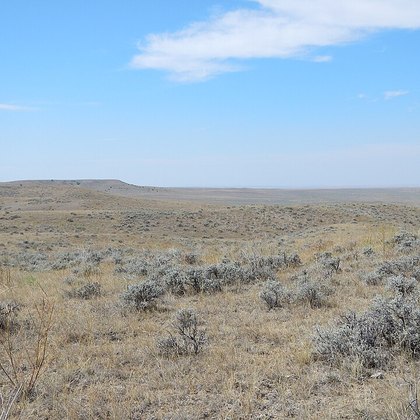
Open, level ground with short or sparse cover: shortgrass prairie, heavily grazed pasture, desert flats, sagebrush (grey-green scrub of the dry western interior) and the margins of fields and airfields. What matters is not the vegetation but the presence of digging mammals — prairie dog towns, ground squirrels, badgers — because the owl barely digs for itself. It avoids tall grass and encroaching scrub: from the burrow mouth it needs a long view. In Florida it uses golf courses, airport verges and vacant building lots, and there it does excavate its own tunnel in the loose sand.
Where the bird is most often found, arranged by the USNVC — the vegetation classification of the United States and Canada — and CMECS for sea and coast.



Range and movements
From the southern prairie provinces of Canada across the western United States and far into Mexico, with a separate population in Florida and on Cuba, the Bahamas and Hispaniola; further south the species continues to Patagonia. Northern breeders leave and winter from Texas and the Gulf Coast into Mexico, while birds in California, the southwest and Florida stay all year. During the twentieth century the range contracted sharply along its northern and eastern edge, following the destruction of prairie dog colonies: it has all but gone from Manitoba, Minnesota and Iowa. In Florida the opposite happened and it spread as forest gave way to mown, open ground.
- Resident
- Breeding (summer)
- Winter
- Passage
- dark = core range, pale = thinly spread
Where and when to look
Drive a gravel road through prairie or rangeland slowly in late afternoon and check the posts and the mounds: a Burrowing Owl gives itself away by an upright silhouette too small for a falcon and too tall for a prairie dog. Unlike most owls it is active by day, so there is no need to be out before dawn. Stay in the car — it tolerates a vehicle at close range, while an observer stepping out sends it straight down the burrow.
Conservation
The species is listed worldwide as Least Concern (LC); the world population is put at roughly eighteen million birds, but in North America it is falling: about 3.5 per cent a year in Canada and more than 4 per cent a year in some states since 1966. Ploughing of prairie, control of prairie dogs, collisions with vehicles and pesticides that remove its insect prey are the main causes. Canada lists it as endangered, and in many areas artificial nest burrows are installed to hold colonies together.
Scientific name
Athene cunicularia | (Molina, 1782)
Molina described the species in 1782 as Strix Cunicularia, among the owls then still kept in a single genus; because it was later moved to another genus, author and year stand in parentheses. The genus Athene refers to Athena, the Greek goddess to whom the owl was dedicated. cunicularia is Latin for 'the burrower', from cuniculus, a rabbit or an underground passage — exactly what the bird lives in. The type locality is Chile.