All species › Owls › Owls › Northern Hawk Owl
Northern Hawk Owl | Surnia ulula
Sperweruil | Cárabo gavilán
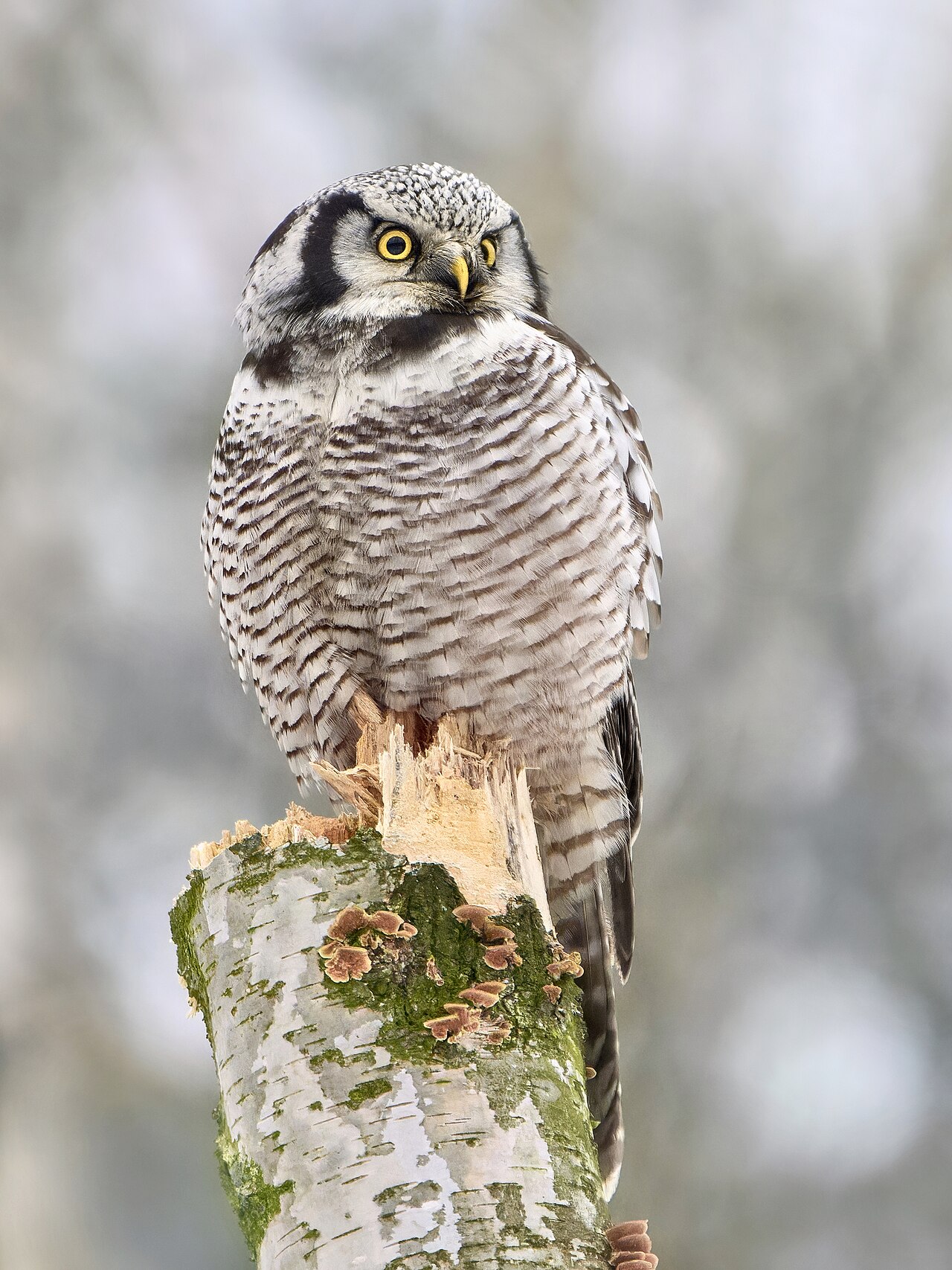
The Northern Hawk Owl is the least owl-like owl of the north: long-tailed, sharp-winged, and hunting by day from the top of a dead spruce. Its name comes from the finely barred underparts and from the hunting flight, low and fast over open boreal ground.
Voice
The male's song is a rolling, high whistled ulululululul that can run on for some fourteen seconds, delivered in a display flight in spring. The female answers with a shorter, harsher version. The alarm is a harsh screech followed by a fast, repeated rasping kip kip kip, which anyone approaching a nest tree will hear. Outside the breeding season, and so in the birds that appear farther south in winter, it is almost silent.
Recording: Stein Ø. Nilsen — CC BY-NC-SA 4.0 · Hansmyra, Straumsbukta, Norway · xeno-canto
Identification
Medium-sized, with a flat head without ear tufts, a long tapered tail and short pointed wings — in silhouette more falcon or hawk than owl. The white face is sharply bordered on each side by a black stripe, with yellow eyes above it. The upperparts are brown with white spotting, the underparts finely barred brown on white. The sexes look alike; young birds have a darker, less spotted head. It perches almost invariably on the highest point of a tree, leaning slightly forward, and flies with deep powerful beats and long glides low over the ground.
Confusion species
No other North American owl combines a long tail, a black-framed face and fine horizontal barring. Great Gray Owl is far larger and greyer, with a large round facial disk and no long tail. Northern Pygmy-Owl also has a long tail and also hunts by day, but is barely a third the size and carries two dark false eyes on the nape. A hawk owl on a post is taken at a distance for a small falcon such as a Merlin, but falcons are streaked rather than barred below and have a dark-masked face without a pale disk.
Habitat
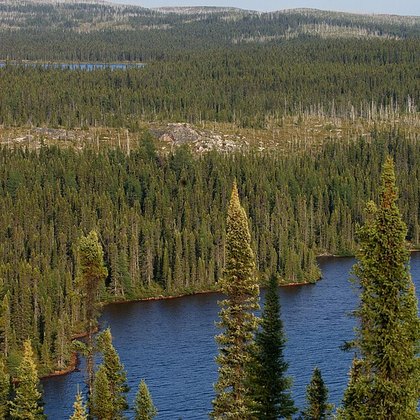
Open conifer and mixed forest at the edge of bogs, muskeg, clearings and burns, throughout the boreal belt. It avoids dense closed spruce: it needs scattered tall lookouts with open ground beneath to watch for voles. Burnt stands full of standing dead timber are a favoured place, both to hunt from and to nest in, in a woodpecker hole or a broken-off trunk. Unlike almost all owls it hunts mainly in daylight, peaking around sunrise and sunset; it hunts at night as well, but does most of its work in the light.
Where the bird is most often found, arranged by the USNVC — the vegetation classification of the United States and Canada — and CMECS for sea and coast.



Range and movements
Resident in the boreal forests of Alaska and Canada from Yukon and British Columbia to Labrador, and across the same belt through northern Europe and Siberia. It does not migrate in the ordinary sense, but in winters when vole numbers collapse birds move irregularly south into Minnesota, Wisconsin, Michigan, Maine and the Canadian Maritimes; such invasions come every few years and then draw many observers. Between those years it can be entirely absent south of the boreal edge. In the southern part of the range large-scale logging has made it locally scarcer.
- Breeding (summer)
- Winter
- Passage
- dark = core range, pale = thinly spread
Where and when to look
In an invasion winter work open roads through young forest and clearcuts and check the top branch of every isolated dead tree: it almost always sits on the extreme tip and can be picked out at several hundred metres. Because it hunts by day, midday is as good as dusk. It is unwary and often stays put as you pass — not an invitation to come closer, but a chance to take in the tail length and the black-framed face at leisure.
Conservation
The global breeding population is estimated at some 200,000 birds and the species is listed as Least Concern (LC) and appears on no watch list. Numbers swing strongly with the vole and lemming cycle, so a single count says little. Large-scale clear-cutting removes both the nest holes and the hunting perches and is the main threat.
Scientific name
Surnia ulula | (Linnaeus, 1758)
Linnaeus described the species in 1758 as Strix Ulula; because it was later placed in another genus, author and year stand in parentheses. The genus Surnia was introduced by Duméril in 1806 without any explanation — the name has no known meaning. ulula is Latin for a screeching owl, from ululare, to howl or wail. The original description covered Europe; the type locality was later restricted to Sweden, after Linnaeus's Fauna Svecica.