All species › Owls › Owls › Northern Pygmy-Owl
Northern Pygmy-Owl | Glaucidium gnoma
Bergdwerguil | Mochuelo Gnomo
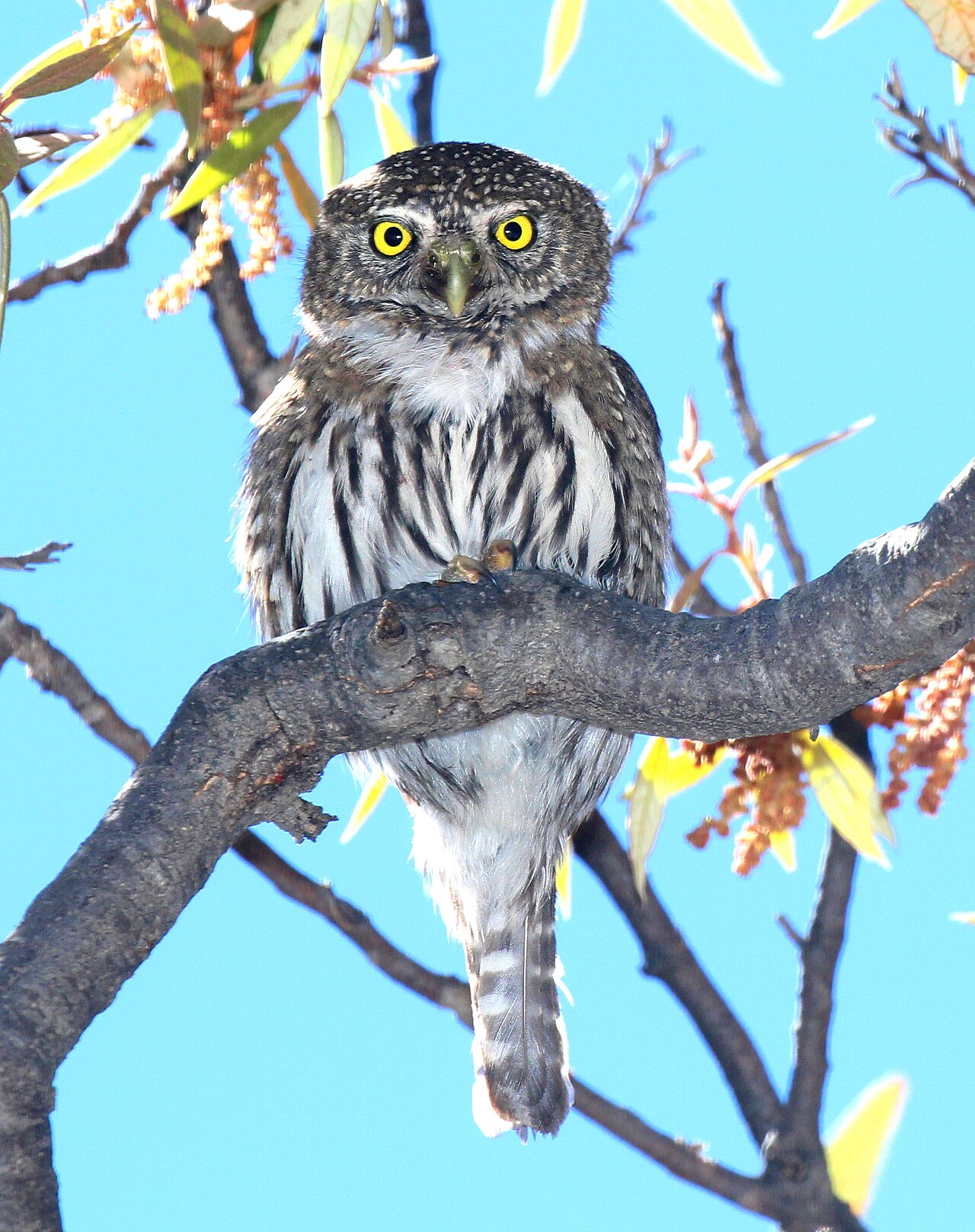
The Northern Pygmy-Owl is barely larger than a robin, yet it kills birds approaching its own weight. It hunts by day in the mountain forests of the west, and on its nape it carries two black patches that look like eyes from behind.
Click a thumbnail to switch the photo above.
Subspecies
Voice
The song is a series of high, hollow toot notes spaced one to two seconds apart, repeated endlessly from cover high in a conifer. Pairs sometimes sing together, the two series running through each other. A rapid high trill often precedes the series. The pace varies by region: Pacific slope birds call more slowly, Rocky Mountain and Mexican birds faster. Whistling an imitation often brings not the owl but an angry crowd of chickadees and sparrows that come to mob it.
No freely licensed recording has been found for this species yet; what to listen for is described below.
Identification
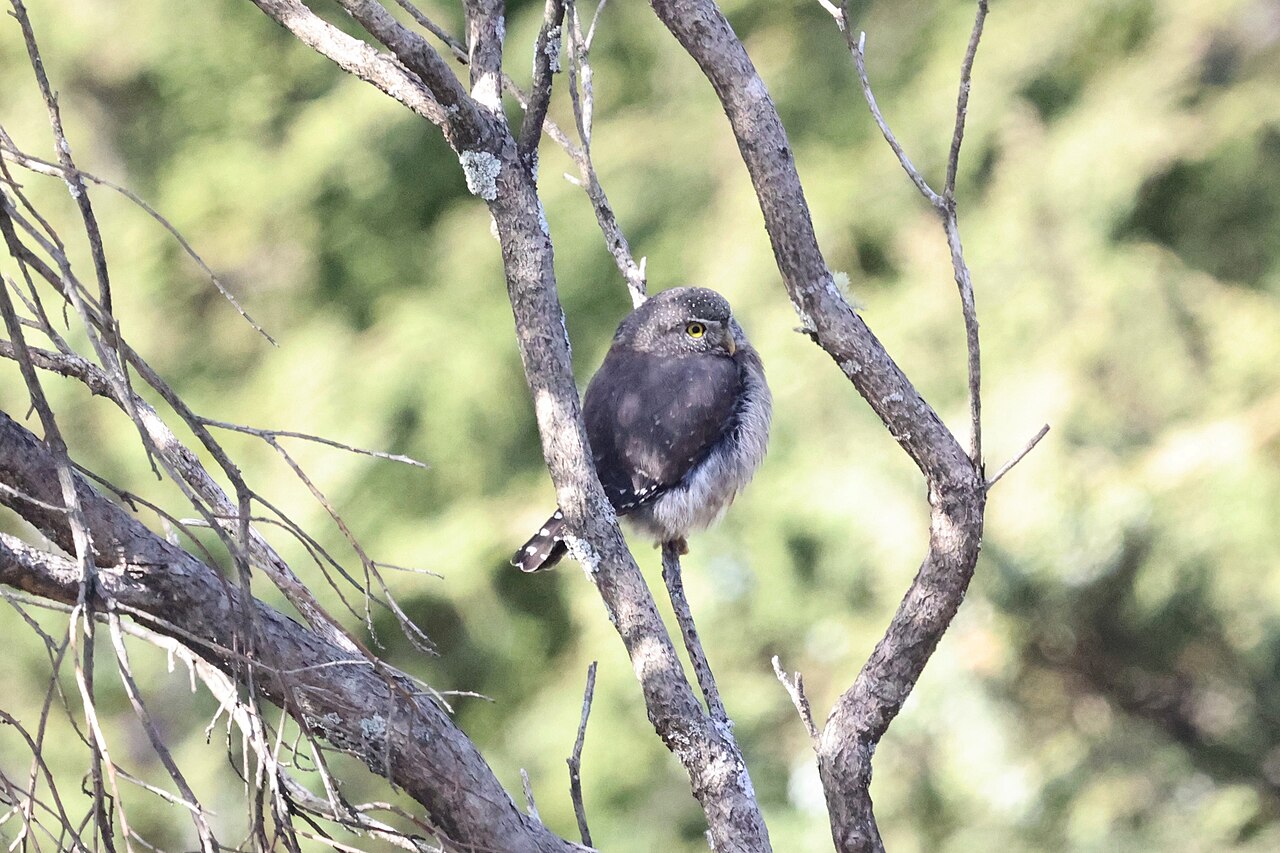
Small and compact, brown or grey-brown, with fine white speckling on the round head and larger white spots on the back. The underparts are white with broad brown streaks; the tail is long for an owl, narrowly barred pale, and often cocked. There are no ear tufts; eyes and bill are yellow. On the back of the neck sit two black, white-rimmed patches that imitate a pair of eyes from behind. The sexes are marked alike, the female slightly larger. The flight is undulating like a woodpecker's: a few quick beats, then a short dip.
Confusion species
Ferruginous Pygmy-Owl is the real problem: it is more rufous, finely pale-streaked rather than speckled on the crown, has rufous rather than pale tail bars, and sings about three notes a second against one every one or two seconds. In the field habitat usually separates them: this species in montane conifers, the other in lowland thorn scrub and desert. Elf Owl is as small but shorter-tailed, finely spotted rather than streaked, and strictly nocturnal. Northern Saw-whet Owl is larger, unspeckled on the crown, short-tailed and has an obvious facial disk.
Habitat
Mountain forests of the west: high spruce and fir, mixed woodland, aspen groves and the deciduous strips along streams. It likes edges and openings — a closed dark forest offers it neither a lookout nor a song post. In Mexico and Honduras it occupies pine-oak and cloud forest. In winter many birds drop to lower elevations and then turn up in gardens, parks and towns at the foot of the mountains.
Where the bird is most often found, arranged by the USNVC — the vegetation classification of the United States and Canada — and CMECS for sea and coast.





Range and movements
From southeast Alaska and British Columbia through the western ranges — Cascades, Sierra Nevada, Rocky Mountains — to Arizona and New Mexico, and on through the mountains of Mexico and Guatemala to Honduras. It does not migrate: its only regular movement is downhill in winter and back up in spring. Across this long range the birds differ noticeably in colour and in song tempo, and the boundaries between those forms are not yet settled. No large shift of range in the past century has been established.
- Resident
- Breeding (summer)
- Winter
- Passage
- dark = core range, pale = thinly spread
Where and when to look
Walk a forest edge or an open logged slope on a clear morning and listen for a single high toot repeated every few seconds; the note is so pure that it carries much farther than it seems. If you cannot find the bird, watch the other birds: a sudden gathering of scolding chickadees, kinglets and hummingbirds around one point in a tree almost always means a pygmy-owl. Look at the top of the crown, not into the dark beneath it.
Conservation
Partners in Flight puts the world population at about 180,000 birds, with a broadly stable trend over fifty years, and the species is of low conservation concern. Because it never cuts a cavity itself, it depends entirely on woodpeckers and on standing dead timber; forest management that removes dead wood takes its nest sites away.
Scientific name
Glaucidium gnoma | Wagler, 1832
Wagler introduced the species in 1832 as Glaucidium Gnoma; author and year stand without parentheses, because it has never changed genus. Glaucidium is a diminutive of Greek glaux, owl — literally 'owlet'. gnoma is New Latin for gnome, the dwarf of folklore, after the size of the bird. The type locality is Mexico.