All species › Owls › Owls › Ferruginous Pygmy-Owl
Ferruginous Pygmy-Owl | Glaucidium brasilianum
Braziliaanse dwerguil | Mochuelo Caburé
The Ferruginous Pygmy-Owl is one of the most widespread owls of Latin America and only just reaches North America: common in southern Texas, reduced to a remnant in southern Arizona. It is rufous, smaller than a robin but long-tailed, and it hunts in full daylight.

Colour forms
Voice
The song is a monotonous series of toot notes at a steady, fast pace of about three a second, running up to ten seconds, with pauses of five to ten seconds between songs. A male may keep this up for minutes or for hours. It also gives short sharp notes in series and a low, drawn-out twittering. The note is easy to whistle, and an imitation draws not only the owl but a furious crowd of small birds.
Recording: steve — CC BY-SA 4.0 · Aruá - Observação de aves e natureza, Mata de São João, Bahia, Brazil · xeno-canto
Identification
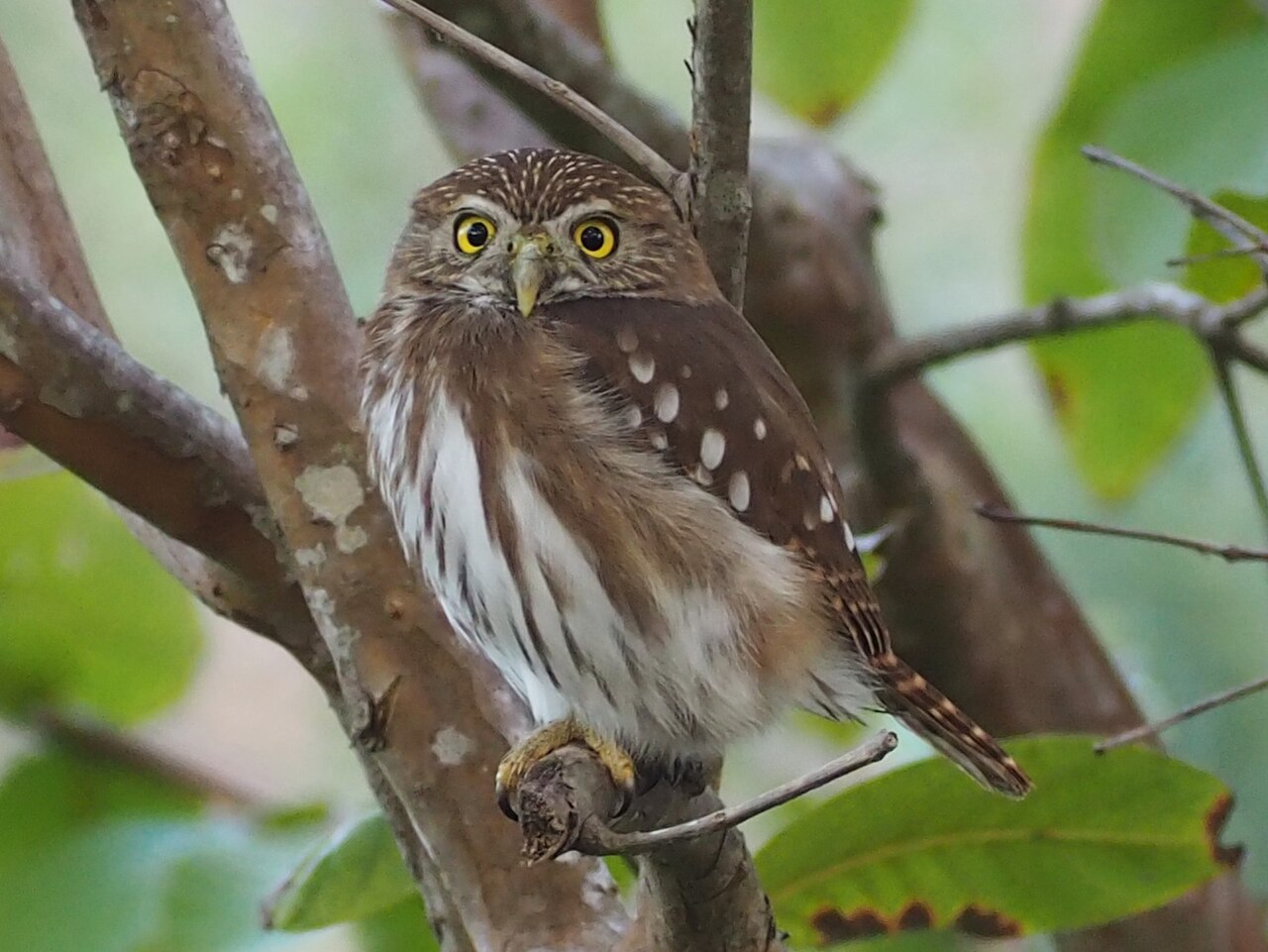
A small, plump owl with a long tail and a round head without ear tufts. The colour ranges from cinnamon to grey-brown; the crown carries fine pale streaks, the facial disk is dark and streaked with white, and the eyes are lemon yellow. The underparts are white with broad rufous streaks, the tail dark with narrow rufous bars. Two black, pale-rimmed patches on the hindneck read as eyes from behind. Females are slightly larger than males; juveniles have an unstreaked crown. The flight is fast and direct, on short quick beats.
Confusion species
Northern Pygmy-Owl is the only real confusion species in North America: it has white speckling rather than streaks on the crown, pale rather than rufous tail bars, and sings far more slowly, one note every one to two seconds. The two come close together in the Arizona mountains, but Northern sits higher, in conifers, and Ferruginous lower, in desert scrub. Elf Owl is as small but shorter-tailed, finely spotted and nocturnal. Screech-owls of the genus Megascops are larger and have ear tufts.
Habitat
Low-lying, half-open country: thorn scrub, mesquite, riverside woodland along dry beds, savanna, dry tropical forest and the edges of gardens and villages. In Arizona it belongs to the Sonoran Desert with its tall columnar cacti, in which it finds the woodpecker holes it nests in. It is an edge bird: what it wants is the join between dense cover and open ground. It avoids high mountain forest and mostly stays below two thousand metres. Unlike most owls it hunts in daylight, most actively around sunrise and sunset.
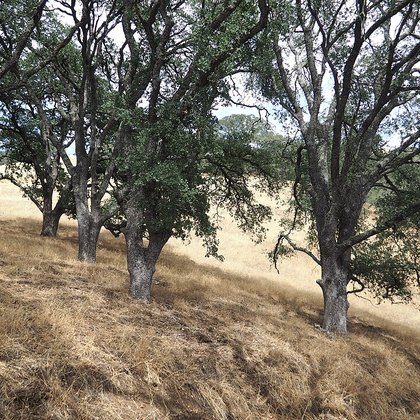
Where the bird is most often found, arranged by the USNVC — the vegetation classification of the United States and Canada — and CMECS for sea and coast.




Range and movements
From southern Arizona and southern Texas through the whole of Mexico and Central America and on south to Argentina — beyond the map window of this guide. It does not migrate; birds stay in the same area all year. In Arizona the range contracted sharply during the twentieth century as the riverside woodlands of the desert disappeared, and most of the owls went with them. In south Texas it holds on in the dense brush of the lower Rio Grande.
- Resident
- Breeding (summer)
- Winter
- Passage
- dark = core range, pale = thinly spread
Where and when to look
Look for it in south Texas on a windless morning in thorn scrub and listen for the counting series of notes; the pace alone separates it from every other owl of the region. Follow the sound and check half-open branches two to five metres up, not the treetop. Imitation works, but it also brings in the small birds that mob it — often you see the mobbing flock first and the owl afterwards.
Conservation
Across its range as a whole the species is common and not threatened, but its northwestern edge is. The Arizona population is estimated in the low hundreds and was listed as threatened by the United States government in July 2023, with urban development, spreading buffelgrass and drought given as the main causes. In Texas the population is steadier, as long as the lowland thorn scrub is not cleared further.
Scientific name
Glaucidium brasilianum | (Gmelin, 1788)
Gmelin described the species in 1788 as Strix brasiliana; because it was later moved to another genus, author and year stand in parentheses. The genus Glaucidium is a diminutive of Greek glaux, owl. brasilianum simply means 'from Brazil'. The specimen described came from Brazil; Hellmayr proposed Ceará as the type locality in 1929.