All species › Waders, gulls and terns › Skimmers, noddies, terns and gulls › Glaucous Gull
Glaucous Gull | Larus hyperboreus
Grote burgemeester | Gavión hiperbóreo
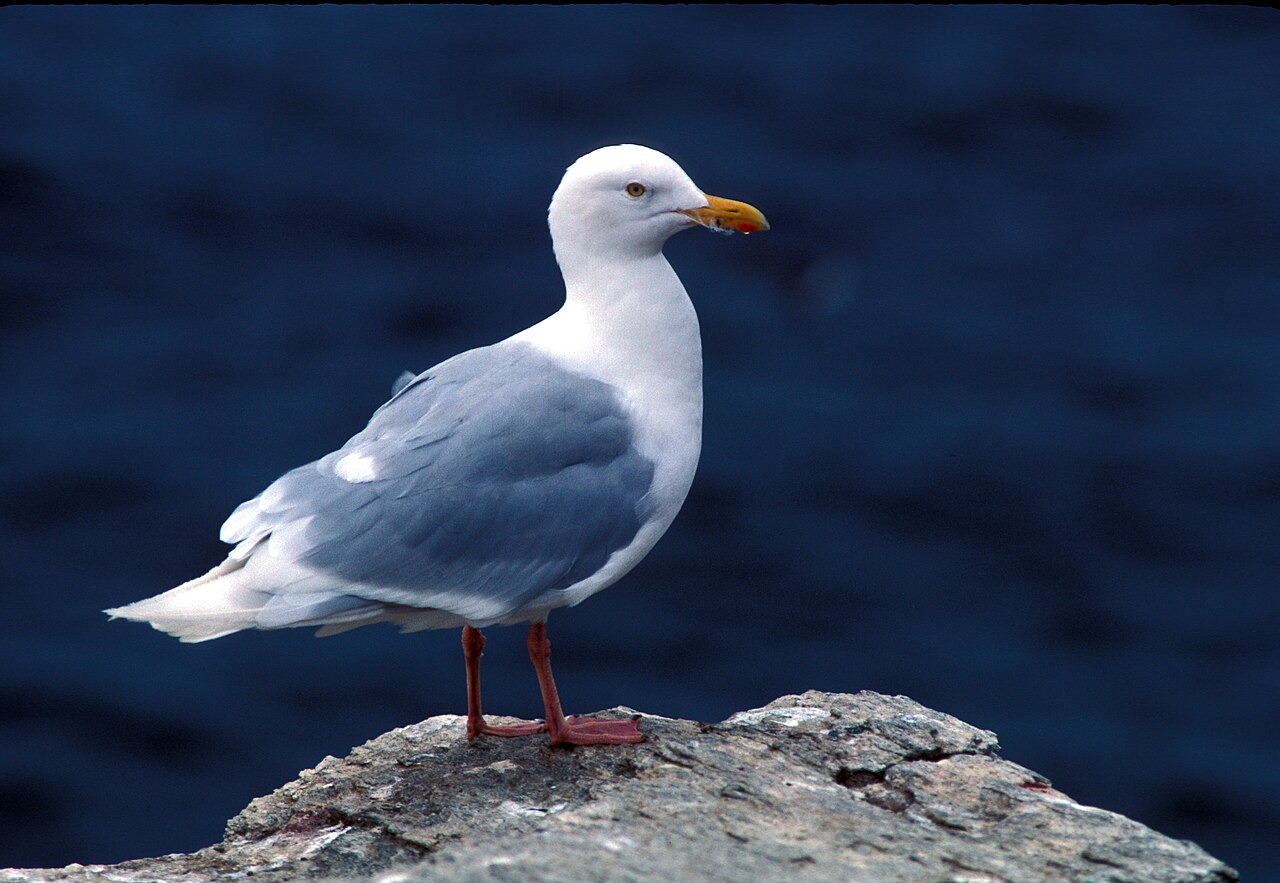
Glaucous Gull is the second largest gull in the world after Great Black-backed Gull, and the largest gull with no trace of black in the wingtip: where other species have a dark tip, it is white and pale grey from head to outermost primary. On its arctic breeding grounds it is scavenger and predator at once, taking eggs and chicks at the edge of an auk colony.
Voice
At the colony it is noisy, with yelping, mewing and clucking notes barely separable from those of an American Herring Gull. The long call is a series of hard cries kyow-kyow-kyow, given with the head first low and then thrown steeply up, and it carries far along a cliff front. Disturbance over the nest brings a short barking gak-gak-gak, and anyone approaching the chicks gets the same barking out of a low diving flight. Outside the breeding season it is often silent, even in a screaming crowd of gulls at a landfill.
Recording: Mats Rellmar — CC BY-NC-SA 4.0 · Longyearbyen river (near Longyearbyen), Svalbard, Norway · xeno-canto
Identification
The adult is white with a pale grey mantle and wingtips as white as the tail; in flight there is no dark corner anywhere in the wing. The bill is heavy and yellow with a red spot, the eye pale yellow with a yellow ring, the legs pink. In winter the head and neck carry faint brownish streaking, much vaguer than on the other large gulls around it. Young birds are coffee-coloured to almost cream, finely marked with brown, and have a sharply patterned two-toned bill: pink with a black tip. The build is bulky — deep chest, big head, small-looking eye — and full adult plumage comes only in the fourth year; females are so much smaller than males that the species can stand in a flock in two sizes at once.
Confusion species
Iceland Gull (Larus glaucoides) has the same white wingtip but is smaller and rounder-headed, with a short bill, often a dark eye, and wings projecting well beyond the tail; young birds have a mostly dark bill instead of a pink one with a crisp black tip. Glaucous-winged Gull (Larus glaucescens) has wingtips of the same grey as the mantle — visible against the white, but not black — a dark eye, and as a young bird an all-dark bill. American Herring Gull (Larus smithsonianus) always has black wingtips with white mirrors. Where Glaucous Gull crosses with American Herring or Glaucous-winged Gull the young are birds with pale grey or dirty white tips that fit no description at all; in the field they are better left unnamed.
Compare gulls: legs, head, bill and wing tip side by side
Habitat
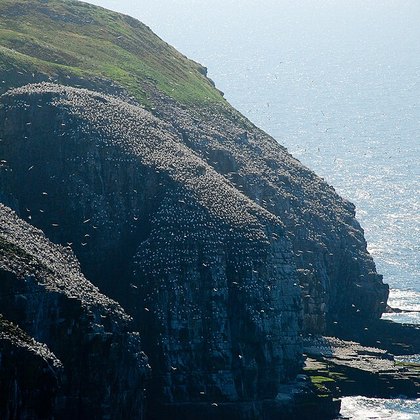
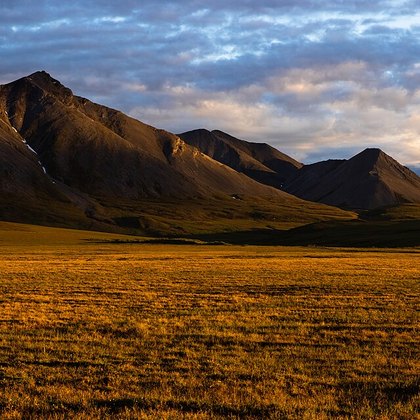
Breeds on sea cliffs, rocky islets and low coastal islands of the high Arctic, by preference out of reach of arctic foxes and close to a colony of auks, kittiwakes or eiders. Outside the breeding season it works the edge of the pack ice and the open leads, and moves to the coast: harbours, river mouths, fishing ports and any place where fish are cleaned. Further south it is nearly always where food lies ready to be picked up — landfills, sewage works and fishing harbours — and on the Great Lakes at the open patches in the ice. Closed inland country without water it avoids.
Where the bird is most often found, arranged by the USNVC — the vegetation classification of the United States and Canada — and CMECS for sea and coast.


Range and movements
Breeds right around the Pole: in North America from western and northern Alaska through the Canadian arctic islands and the coasts of Nunavut to Labrador, and across the whole of Greenland. In winter most birds move to open water further south: down the Pacific coast to California, down the Atlantic coast to the Carolinas, across the Great Lakes, and in small numbers far inland. Some birds stay north all year wherever leads and fisheries persist, so that in southwest Greenland the species is present the year round. It is mainly young birds that push furthest south, and they make up the great majority of winter records in the United States.
- Resident
- Breeding (summer)
- Winter
- Passage
- dark = core range, pale = thinly spread
Where and when to look
Look for it in January and February at a landfill, a harbour mole or a fishing quay among hundreds of gulls, and scan not for white but for the absence of black: one bird without a dark wingtip stands out instantly in a sleeping flock. On first-year birds the two-toned bill — clean pink with a sharply cut black tip — is the quickest mark, quicker than colour or size. Do not fix on size: a female is little bigger than an American Herring Gull.
Conservation
The world population is put at over nine hundred thousand birds and the species is listed as Least Concern (LC), but North American counts point to more than a halving in fifty years, which has placed it among the tipping-point species. As a top predator of the arctic coast it accumulates organochlorines, PCBs and mercury to the highest levels measured in any seabird; in the best-studied colonies that has been linked to raised mortality among adults. It is also culled locally in Greenland and Russia to spare eider colonies.
Scientific name
Larus hyperboreus | Gunnerus, 1767
Johan Ernst Gunnerus, bishop of Trondheim, described the species in 1767 as Larus hyperboreus, in the notes he wrote to Knud Leem's book on the Sami of Finnmark; because the species still stands in the same genus, author and year carry no parentheses. Larus is the Latin form of Greek laros, an unspecified seabird in the classical writers. hyperboreus comes from Greek hyperboreos, 'beyond the north wind': the far north, where the Greeks placed the Hyperboreans. The type locality is northern Norway.