All species › Passerines › Tyrant flycatchers and allies › Gray Flycatcher
Gray Flycatcher | Empidonax wrightii
Alsemfeetiran | Mosquero Gris
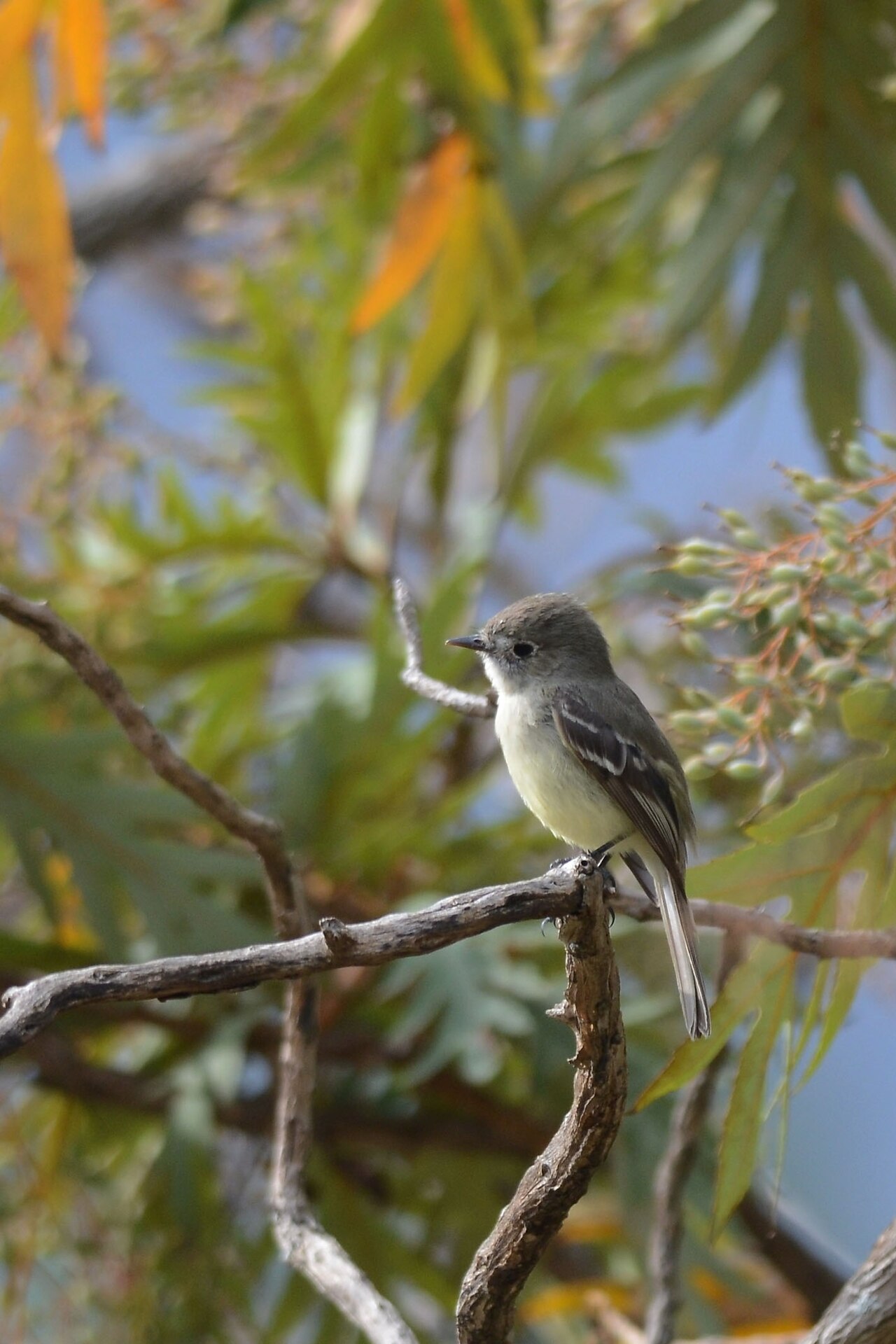
Gray Flycatcher is the empid of the sagebrush (grey-green wormwood scrub of the dry western interior) plains and the pinyon-juniper woodland of the Great Basin. It is the palest and longest-billed of the group and the only one that moves its tail downward rather than up. It winters farther north than any other empid: in southern Arizona and northwestern Mexico.
Voice
The song is two-parted and rises in pitch: a vigorous chu-wip or chi-bit, between which the bird inserts a weaker, higher cheep. The two elements alternate in a fixed, unhurried rhythm — a short song against the three parts of Dusky and Hammond's Flycatchers. Only males sing. The call of both sexes is a dry whit or pit, all but identical to Dusky Flycatcher's; the call alone will not get you there, the song will.
Recording: Manuel Grosselet — CC BY-NC-SA 4.0 · Grand Canyon Village, Coconino County, Arizona, United States · xeno-canto
Identification
Pale grey above with little olive, dingy white below with at most a hint of yellow; the white eyering is narrow and inconspicuous, the wingbars pale. The tail is long, the bill long and straight, with a clean orange-pink lower mandible ending sharply in a dark tip. The key character is behaviour: it lowers the tail slowly, like a phoebe, where all other empids flick it upward with a quick movement. Here too a silent bird often cannot be identified in the field, and the song is the only fully reliable character.
Confusion species
Dusky Flycatcher is the most similar species, and also the one with a tangled naming history: the type material under the name wrightii proved in the end to belong to this species, which is why Dusky needed a new name in 1939. To tell them apart: the song here is two-parted chu-wip … cheep, there three-parted with a high pseet at the end; the call is a dry whit in both and so does not help. Beyond that, the tail goes down rather than up, the bill is longer with a sharply cut dark tip, the plumage paler and greyer, and the habitat is sagebrush and juniper against mountain brush and aspen at greater elevation. Hammond's Flycatcher calls a sharp, high peek, has a small dark bill and stays in tall conifer forest. Least Flycatcher sings a rapidly repeated che-BEK and has a broader eyering and a shorter bill. Buff-breasted Flycatcher sings chee-lick and has a buff breast.
Habitat
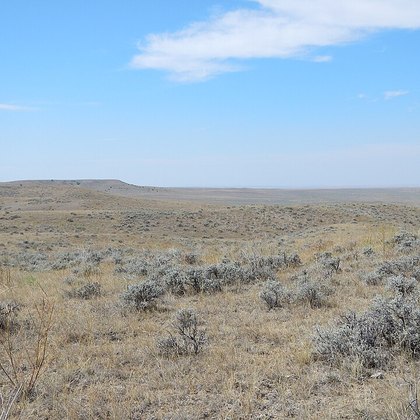
High desert and Great Basin: tall old big sagebrush along valley edges, open juniper and pinyon woodland, and thin ponderosa pine forest with a bare understorey. The core lies above roughly 1200 metres, with outliers from under 600 to about 2400 metres. It forages low, down to the ground, from a low lookout perch. In winter it uses mesquite bosques, riparian groves, subtropical thorn forest and scrub.
Where the bird is most often found, arranged by the USNVC — the vegetation classification of the United States and Canada — and CMECS for sea and coast.





Range and movements
It breeds from southern British Columbia through Washington, Oregon, Idaho and southwestern Montana across the whole Great Basin — Nevada, Utah, eastern California, Wyoming, Colorado — to northern Arizona and northwestern New Mexico. Migration is short: the first birds are on the breeding range in April and on the wintering range from August. It winters in southern Arizona and West Texas, in Baja California Sur, and from Sonora south to Oaxaca. In Arizona, then, different birds breed and winter in different parts of the state.
- Resident
- Breeding (summer)
- Winter
- Passage
- dark = core range, pale = thinly spread
Where and when to look
Watch the tail before the colour: one slow downward movement from a low sagebrush top or juniper branch saves you the rest of the identification work. In May and June it sings from sunrise; the two-parted chu-wip … cheep has a slow, regular rhythm that separates it from the more hurried song of Dusky Flycatcher at a distance. In winter it is the only empid to be expected in the mesquite bosques of southern Arizona.
Conservation
Partners in Flight puts the world population at about 2.9 million birds and gives 9 out of 20 on the Continental Concern Score. The Breeding Bird Survey indicated an increase of about 2.4 per cent a year between 1968 and 2014. The pressure lies on habitat: building, timber extraction, mining and oil and gas drilling take in sagebrush and juniper woodland, and where introduced cheatgrass (an annual grass that crowds out the sagebrush steppe) replaces native sagebrush, fires follow after which the old, tall shrubland does not return.
Scientific name
Empidonax wrightii | Baird, 1858
Spencer F. Baird described the species in 1858 as Empidonax wrightii, from material at El Paso, Texas; the name has not changed genus since and therefore stands without parentheses. The species name honours Charles Wright, the botanist who collected for the Mexican Boundary Survey. The genus Empidonax was introduced in 1855 by Cabanis, from Greek empis, empidos 'gnat' and anax 'ruler'. The Dutch name refers to sagebrush, a wormwood (Artemisia tridentata), in which it breeds.