All species › Passerines › New World sparrows › Harris's Sparrow
Harris's Sparrow | Zonotrichia querula
Zwartkruingors | Chingolo de Harris
Harris's Sparrow is the largest sparrow in North America and the only bird species that breeds solely in Canada. It nests on the transition from boreal forest to tundra between the Northwest Territories and Hudson Bay, and winters in a narrow strip of the Great Plains between South Dakota and central Texas.
Voice
The song consists of two or three clear, slightly wavering whistles on one pitch, followed by a second series at a distinctly higher or lower pitch. The male sings from an open perch atop a small spruce or a willow. The call is a hard, metallic wink, heard continually in winter from a flock in a hedgerow, alongside a musical twittering within the flock. Males also sing on migration and in the winter quarters.
Recording: Ian Cruickshank — CC BY-NC-SA 4.0 · Swan Lake, Victoria, B.C., Canada, Canada · xeno-canto
Identification
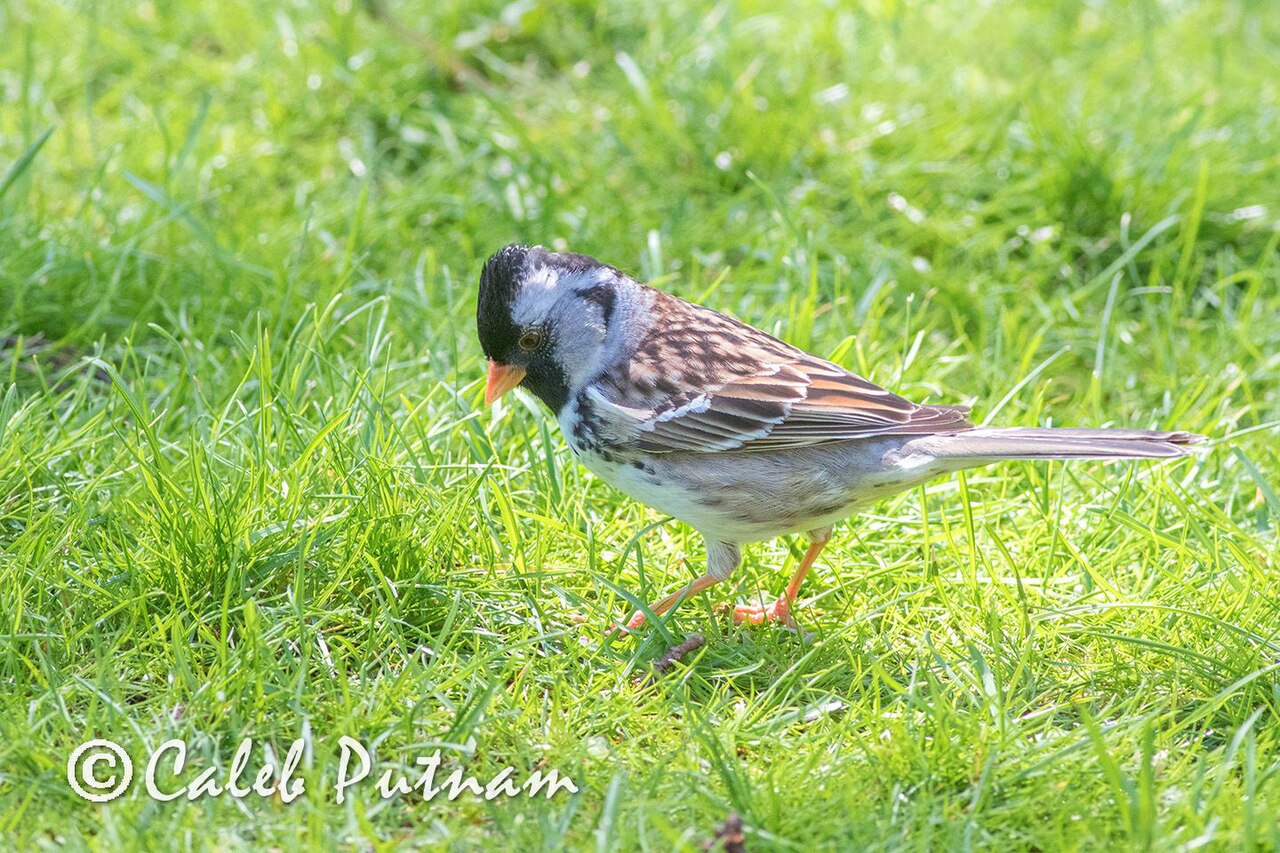
A large, long-tailed sparrow with a pink bill that stands out against the black of head and throat. The adult in breeding plumage has a black crown, black face and a black bib ending in a ragged edge on the breast, with grey sides to the head, a brown-streaked back and white underparts with dark spots on the flanks. In winter plumage the black is less extensive and fringed with buff, and the throat is often white with a black band below it. First-winter birds show a largely white throat and only a few black marks.
Confusion species
White-throated Sparrow is clearly smaller, with a grey bill, a sharply bounded white throat and yellow on the lore. White-crowned Sparrow has a black-and-white striped crown but an evenly grey throat and breast. Male House Sparrow also has a black throat, but is far smaller and shorter-tailed, with a brown wing and a white shoulder stripe and no pink bill. On a young bird with little black, the combination of size, pink bill and dark spots on the sides of the breast remains decisive.
Habitat
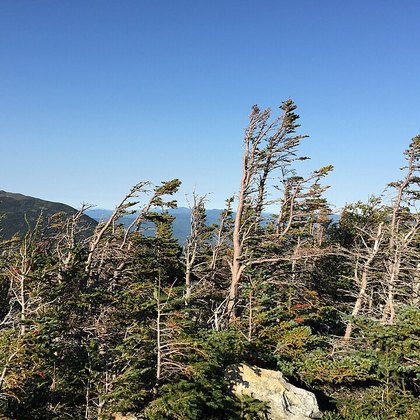
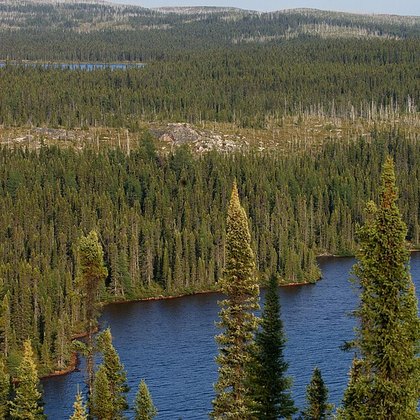
Breeds in semiforested tundra, where open tundra is broken up by patches of black spruce, larch, alder and willow, usually at the edge of a sphagnum bog or a pond. The nest sits on the ground under a low shrub. In winter it uses hedgerows, field edges, weedy pasture, dense riparian thickets and gardens at the edge of towns; it avoids closed forest and dry, bare grassland. On the breeding grounds it eats buds and young spruce needles, in winter mainly ragweed and knotweed seed.
Where the bird is most often found, arranged by the USNVC — the vegetation classification of the United States and Canada — and CMECS for sea and coast.




Range and movements
The breeding range lies in north-central Canada: the southern Northwest Territories, the adjoining part of Nunavut and the northern edge of Manitoba and Saskatchewan. Migration runs through a narrow corridor straight over the central prairies — from central Canada to the central Great Plains — with Alberta, North Dakota, Minnesota and Iowa as passage areas. The winter range runs from South Dakota and Nebraska south to central Texas and from eastern Colorado east to Arkansas, centred on Kansas and Oklahoma. Autumn migration begins in mid-September and peaks in October; the return falls mainly in April and the first half of May.
- Resident
- Breeding (summer)
- Winter
- Passage
- dark = core range, pale = thinly spread
Where and when to look
In winter, look along hedgerows on the prairie of Kansas or Oklahoma, among flocks of White-crowned Sparrows and Dark-eyed Juncos: size and pink bill stand out at once in such a mixed group. In the winter quarters the extent of the black bib sets the rank within a flock — older birds with a darker throat displace younger, paler ones at food, and this can be followed at a feeder.
Conservation
The breeding population is estimated at about 2 million birds, but the species has declined by more than half since 1970 and is therefore listed as Near Threatened (NT) and placed on the Partners in Flight watch list. The breeding range is so remote that standard surveys barely cover it; the decline is derived mainly from Christmas Bird Counts in the winter quarters. Causes named are the advance of the treeline and changing snow and fire regimes on the breeding grounds, and the conversion of hedgerows and rough field margins in the Great Plains. The narrow migration window means a large share of the population passes through the same area in the same weeks.
Scientific name
Zonotrichia querula | (Nuttall, 1840)
Nuttall described the species in 1840 as Fringilla querula, from a specimen taken a few kilometres west of Independence, Missouri; because it was later moved to another genus, author and year stand in parentheses. The species name querula is Latin for 'complaining', after the tone of the song. The genus Zonotrichia was introduced in 1832 by William Swainson, from Greek zōnē 'band' and trikhos 'hair'. The English and Spanish names refer to Edward Harris (1799–1863), an American ornithologist and travelling companion of Audubon, after whom Audubon named the bird Fringilla harrisii in 1843 — a name that lost out to Nuttall's but survived in the vernacular. The Dutch name names the black crown.