All species › Passerines › New World sparrows › Golden-crowned Sparrow
Golden-crowned Sparrow | Zonotrichia atricapilla
Goudkruingors | Chingolo coronidorado
The Golden-crowned Sparrow is the largest sparrow of the American west coast and the only one with a yellow band down the centre of the crown. It breeds in the shrub tundra and treeline scrub of Alaska and northwestern Canada, and spends the rest of the year in the thickets, roadsides and gardens of the coastal strip between British Columbia and Baja California.

Voice
The song is three clear, drawn-out whistles descending in pitch step by step, usually rendered oh-dear-me. Yukon gold miners fitted other words to it — 'no gold here' and 'I'm so weary', the source of the nickname Weary Willie. The call is a sharp, flat tseew. Unlike most sparrows it sings in midwinter and on migration as well, generally from inside a dense shrub.
No freely licensed recording has been found for this species yet; what to listen for is described below.
Identification
A heavy, long-tailed sparrow with greyish-brown upperparts streaked blackish, two narrow white wingbars and dull grey, unstreaked underparts. In breeding plumage a broad yellow band runs down the centre of the crown, fading to grey towards the nape and bordered on each side by a broad black band. The bill is two-toned: dark above, pale below. In winter plumage and in young birds the yellow shrinks to a faint golden wash on the forehead and the black bands fade to brown.
Confusion species
White-crowned Sparrow is the standing confusion species: it has a pure white central crown stripe between sharply drawn black bands, a plain pink or orange-yellow bill and a greyer, neater face. In young birds most of that distinction disappears; then look at the dull brown, low-contrast head stripes and the golden wash on the forehead of Golden-crowned, and at the dark upper mandible. Golden-crowned also looks larger, bulkier and darker below. White-throated Sparrow has a sharply outlined white throat patch and a yellow spot before the eye, and barely overlaps in winter range.
Habitat
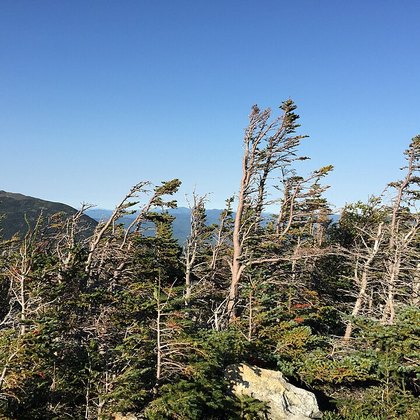
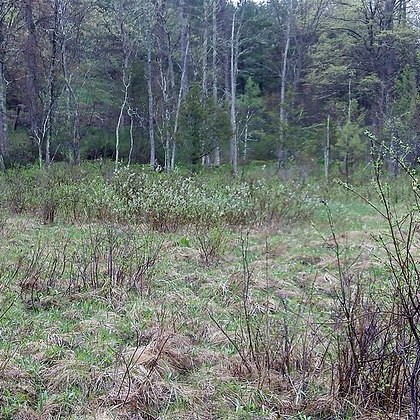
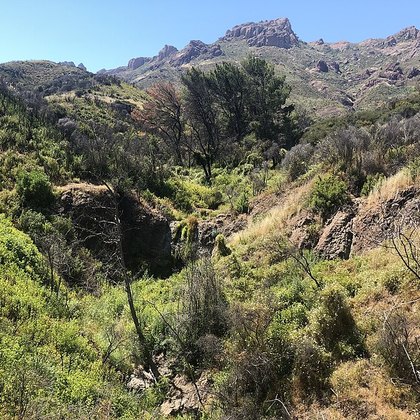
Breeds in low scrub at the forest-tundra transition: willow, alder, dwarf birch and scattered spruce along streams, in mountain passes and on damp slopes up beyond treeline. The nest is usually on the ground, hidden under a shrub. In winter it uses dense brush, chaparral, weedy field edges, hedgerows and city gardens west of the main mountain ranges, often at feeders.
Where the bird is most often found, arranged by the USNVC — the vegetation classification of the United States and Canada — and CMECS for sea and coast.



Range and movements
The breeding range runs from northern and western Alaska, including the Aleutians east to Unimak, through the Yukon and the mountains of British Columbia to northwestern Washington. The winter range lies almost entirely in the coastal strip: from southern Alaska and British Columbia through Washington, Oregon and California to northern Baja California, plus the desert edges of Nevada and Arizona. It arrives early in September and leaves late in April or May, staying on its Californian wintering ground longer than almost any other migrant there. Away from the west it is a rare vagrant, with records as far as Nova Scotia and Florida.
- Resident
- Breeding (summer)
- Winter
- Passage
- dark = core range, pale = thinly spread
Where and when to look
Look for it between October and April in dense brush along a trail or under a feeder on the west coast: it forages on the ground and hops backwards with both feet to scrape leaves aside. The best way to pick it out among White-crowned Sparrows is by sound — the three descending whistles carry even in January.
Conservation
Partners in Flight puts the breeding population at about 7.5 million birds; the trend is stable and the species rates as low concern. It is among the least studied songbirds in North America, because the breeding range is thinly populated and hard to reach. Warming of the subarctic scrub and a shifting treeline may alter the breeding range, but the size of that effect has not been measured. One ringed bird lived more than ten years.
Scientific name
Zonotrichia atricapilla | (Gmelin, 1789)
Gmelin described the species in 1789 as Emberiza atricapilla; because it later moved to Zonotrichia, author and year stand in parentheses. Stresemann fixed the type locality in 1949 at Prince William Sound, Alaska; Gmelin's original statement also named the Sandwich Islands, where the species does not occur. Zonotrichia is Greek, from zōnē 'band' and thrix 'hair', after the bands across the crown. Atricapilla is Latin for 'black-haired', after the black borders of the yellow crown band.