All species › Birds of prey › Kites, Old World vultures, eagles and hawks › Hawaiian Hawk
Hawaiian Hawk | Buteo solitarius
Hawaiibuizerd | Busardo hawaiano
The Hawaiian Hawk is the only diurnal raptor that breeds in the Hawaiian Islands, and it does so on a single island: Hawaii itself, the largest of the group. Its Hawaiian name, ʻio, imitates its call, and survives in ʻiolani, 'exalted ʻio', the name of the royal palace in Honolulu.
Voice
The call is a short, raspy scream, eee-oh, from which the Hawaiian name ʻio is taken. It is given mostly in flight, above the canopy or while circling over a territory. There is also a long series of shorter notes about a second apart, gradually growing louder and rising slightly in pitch. Outside the breeding season the bird is largely silent, so a single scream over the forest is often the only sign that it is there.
Recording: Jonas Nilsson — CC BY-NC-SA 4.0 · El Oro: Reserva Buenaventura 9 km WNW Piñas, Ecuador · xeno-canto
Identification
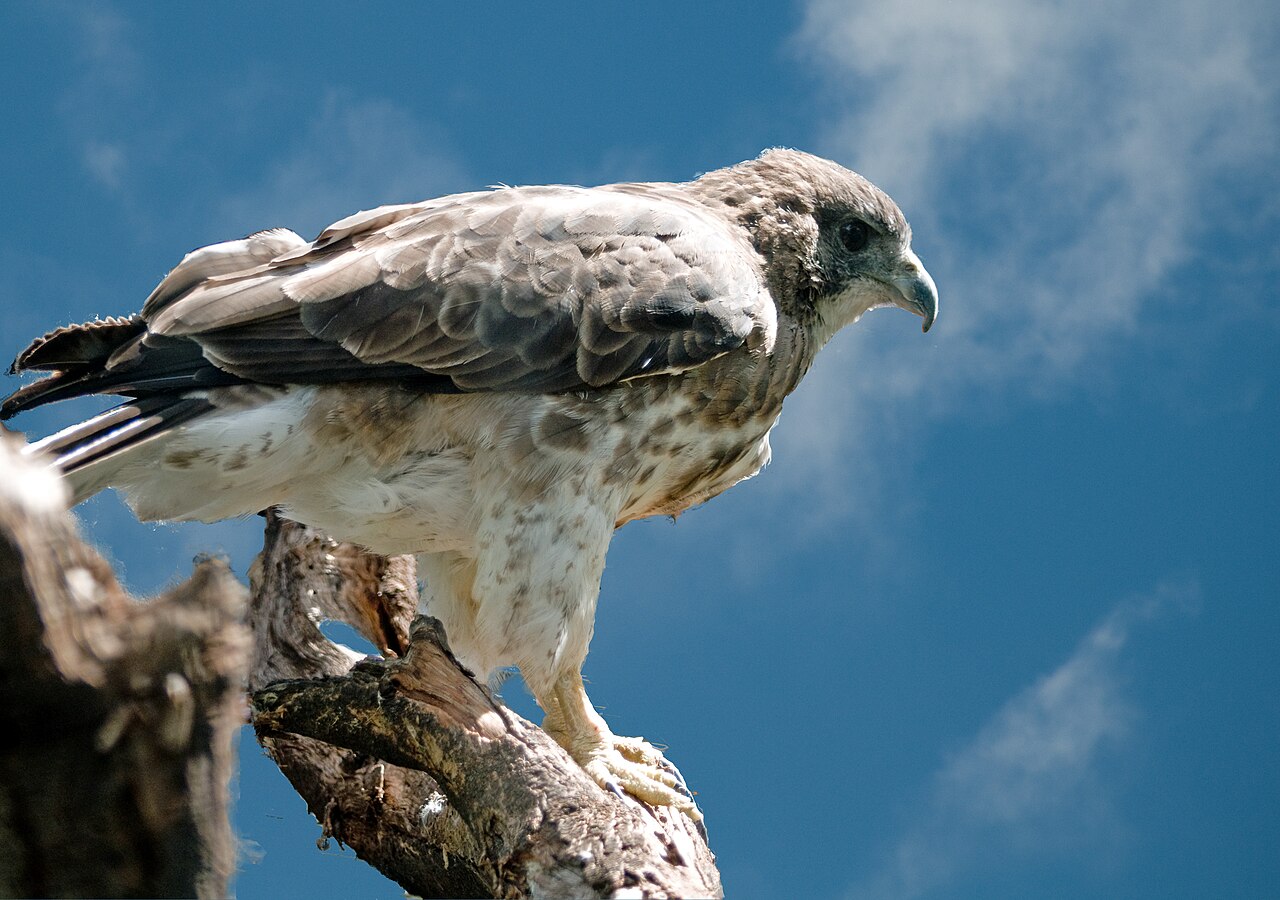
A compact buteo with short, broad wings and a short tail — the build of a bird that hunts above and among trees rather than over open plains. There are two colour morphs, independent of age and sex: a dark form, uniformly dark brown including the wing linings, and a light form with whitish underparts and brown streaking across the breast. Both have a yellow cere at the base of the bill and yellow legs and feet; juveniles of the light form are whiter, with a buff wash over head and underparts. As in almost all hawks and buteos the female is larger: about 46 against 41 centimetres, and at some 600 against 440 grams more than a third heavier.
Confusion species
There is no second buteo on Hawaii, so confusion arises mainly with other large birds above the forest. The pueo, the Hawaiian Short-eared Owl, also hunts by day over open ground, but has a round head profile with no projecting bill, longer and narrower wings, and a loose, rocking flight. The introduced American Barn Owl is far paler, with a heart-shaped facial disc, and flies mostly at dusk. The worst trap lies within the species itself: a dark and a light bird side by side look like two species, yet they interbreed and both forms come out of the same nest.
Habitat
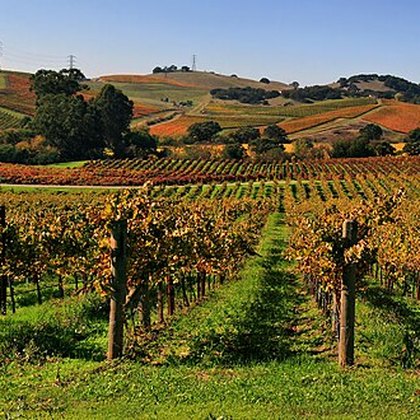
It occupies the whole elevational range of its island, from sea level to about 1,700 metres. The nest is usually in a tall ʻohiʻa, the native tree of the wet slopes, but hunting goes on just as readily over planted lowland forest, macadamia orchards, pasture and forest edge. It avoids bare lava fields and the open high country above the treeline, where there are no lookouts. What makes a place suitable is cover to watch from with open ground beside it.
Where the bird is most often found, arranged by the USNVC — the vegetation classification of the United States and Canada — and CMECS for sea and coast.



Range and movements
The species occurs only on the island of Hawaii, the southeasternmost and largest of the archipelago; the map unit used in this guide covers all the Hawaiian islands together, but in fact only that one island is involved. Subfossil bones show that the species was once present on Molokaʻi, Oʻahu, Maui and Kauaʻi as well. There is no migration: pairs hold the same territory all year and the bond between partners lasts for years. Single birds turn up rarely on the other islands, but none breed there.
- Resident
Where and when to look
Look late in the morning, when thermals build over the eastern flank of the island and pairs begin circling above the canopy. Along roads through pasture and macadamia plantations it often sits motionless on a pole or dead branch, where it can stay still for minutes before dropping onto prey below. The voice gives it away before the eye does: one raspy eee-oh over the forest is enough to place it.
Conservation
The population is put at 1,700 to 2,500 mature birds, all on one island, and the species is listed as Near Threatened (NT). In the United States it stood on the endangered species list for decades, until it was removed in 2020. The recorded threats are illegal shooting, loss and degradation of native forest, poisoning and vehicle collisions. The hawk is itself a major predator of the critically endangered Hawaiian Crow, which complicates every attempt to put that species back.
Scientific name
Buteo solitarius | Peale, 1849
Titian Ramsay Peale described the species in 1849 as Buteo solitarius, from material taken on the island of Hawaii, which is the type locality. The genus Buteo was introduced by Lacépède in 1799, after Latin buteo, the classical name for a buzzard-like bird of prey. solitarius means 'solitary' or 'living alone': the bird is almost always seen singly or in a pair. The Hawaiian name ʻio imitates the call, and in ʻiolani, 'exalted ʻio', it became a term for royal standing.