All species › Birds of prey › Kites, Old World vultures, eagles and hawks › Short-tailed Hawk
Short-tailed Hawk | Buteo brachyurus
Kortstaartbuizerd | Busardo colicorto
The Short-tailed Hawk is a small, compact buteo that finds nearly all its prey from a great height: it soars hundreds of metres above woodland edges and drops steeply from there onto perched birds. In the United States it breeds only in Florida and in the mountains of southeastern Arizona; the rest of its range lies in the tropics.
Voice
It is usually silent. Those who do hear it hear a high, thin keeee-a, pitched between Broad-winged Hawk and Red-tailed Hawk: lower than the first, higher than the second. The call comes mostly in spring, from a bird circling over its nesting wood or when it is disturbed. Outside the breeding season the species is effectively mute in the field, so voice is of little use as a mark.
Recording: Rolf A. de By — CC BY-NC-SA 4.0 · new Chinese connect rd JFK highway/Martin Luthere Kingweg, S Para, Suriname · xeno-canto
Identification
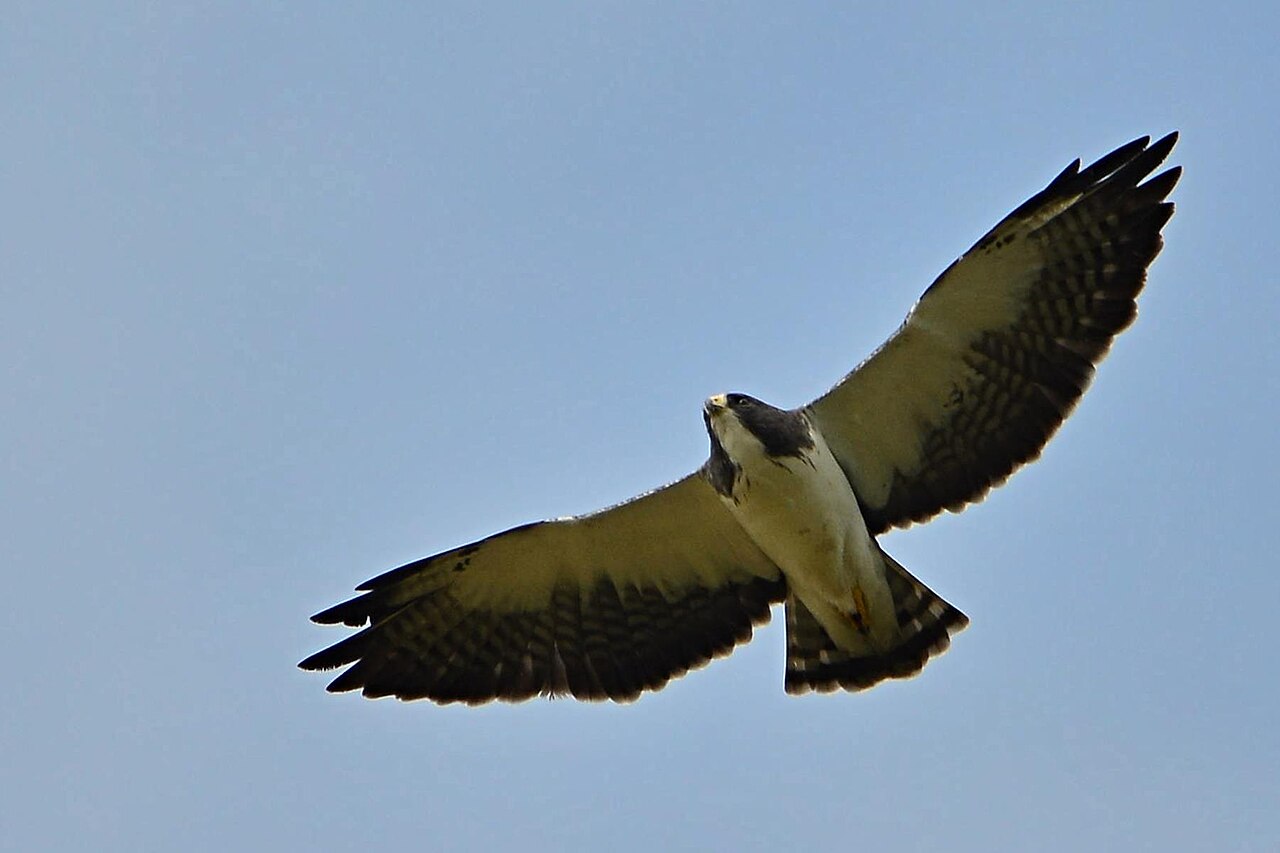
One of the smallest buteos in the region, with fairly broad wings and the short, square-cut tail the name refers to. There are two colour morphs, independent of age and sex: the light form is dark brown above and clean white below, with a dark hood reaching below the eye and cutting sharply against the white throat; the dark form is blackish brown throughout, with a banded tail and fine pale barring in the flight feathers. In both forms the flight feathers are pale below and sparsely barred, so the wing glows in backlight with a darker trailing edge. Juveniles are more irregularly mottled on breast and flanks; the female is larger than the male, though that is rarely visible in the field.
Confusion species
Broad-winged Hawk is just as small but has broad black and white tail bands and streaked rather than clean white underparts. Dark Short-tailed Hawks are confused with Zone-tailed Hawk (Buteo albonotatus), which is far longer in wing and tail, holds its wings in a clear V and rocks along like a Turkey Vulture, while the Short-tailed soars flat and steady. Dark Red-tailed Hawks are considerably larger, with a longer reddish or banded tail and dark patagial marks on a paler underwing. Finally, a kiting Short-tailed Hawk suggests an American Kestrel, but the kestrel hovers just above the ground and this hawk does it hundreds of metres up.
Habitat
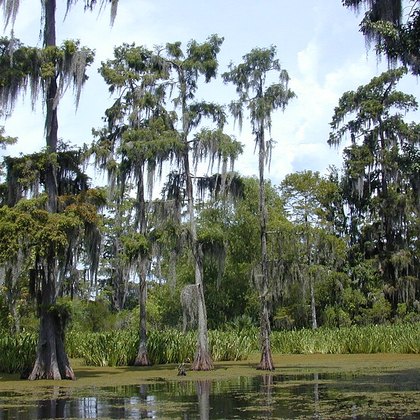
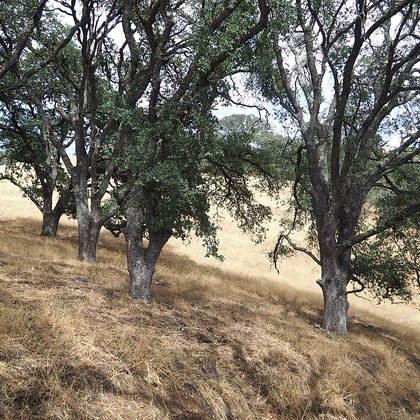
It nests in unbroken, hard-to-enter forest: in Florida in swamp forest of bald cypress, magnolia and tupelo, elsewhere in subtropical and tropical forest on mountain slopes. It does not hunt inside that forest but above and beside it, along woodland edges and over savanna, pasture, prairie and sedge marsh. In south Florida it hangs in winter over the edges of sawgrass marsh and mangrove and over the green strips within built-up land. In the tropics it generally stays below 1,400 metres.
Where the bird is most often found, arranged by the USNVC — the vegetation classification of the United States and Canada — and CMECS for sea and coast.



Range and movements
The range runs from southeastern Brazil and northern Argentina north through Central America to the mountains on the Mexico–Arizona border, with a separate population in Florida. In Mexico and the tropics it is resident, moving locally at most. Florida birds breed in the north and centre of the state and move in winter to the southern tip and the Keys, where the small population concentrates over the Everglades. In Arizona a few pairs have bred in the southeastern ranges since the late twentieth century; those birds withdraw south for the winter.
- Resident
- Breeding (summer)
- Winter
- Passage
- dark = core range, pale = thinly spread
Where and when to look
Do not look in the forest but in the air above it: on clear days from mid-morning onwards, scan the sky over a woodland edge higher than you would normally search for hawks. A bird holding motionless into the wind at great height and then dropping almost vertically with folded wings is almost certainly this species. In Florida the odds are best in winter in the far south, where the whole state population gathers in a small area.
Conservation
Globally the species is listed as Least Concern (LC) and it is common over most of its tropical range. The Florida population is put at five hundred birds or fewer, which leaves it exposed to chance: vehicle strikes, window collisions, shooting and the loss of unbroken nesting forest are the recorded causes of death. Rising sea level is in addition eating into the wintering ground at the southern end of the state.
Scientific name
Buteo brachyurus | Vieillot, 1816
Vieillot described the species in 1816 as Buteo brachyurus. The specific name is Greek: brakhus 'short' and oura 'tail', after the short, square-cut tail. The genus Buteo was introduced by Lacépède in 1799, after Latin buteo, the classical name for a buzzard-like bird of prey. Vieillot gave no type locality with his description; Berlepsch fixed it on Cayenne in French Guiana in 1908.