All species › Birds of prey › Kites, Old World vultures, eagles and hawks › Swainson's Hawk
Swainson's Hawk | Buteo swainsoni
Prairiebuizerd | Busardo chapulinero
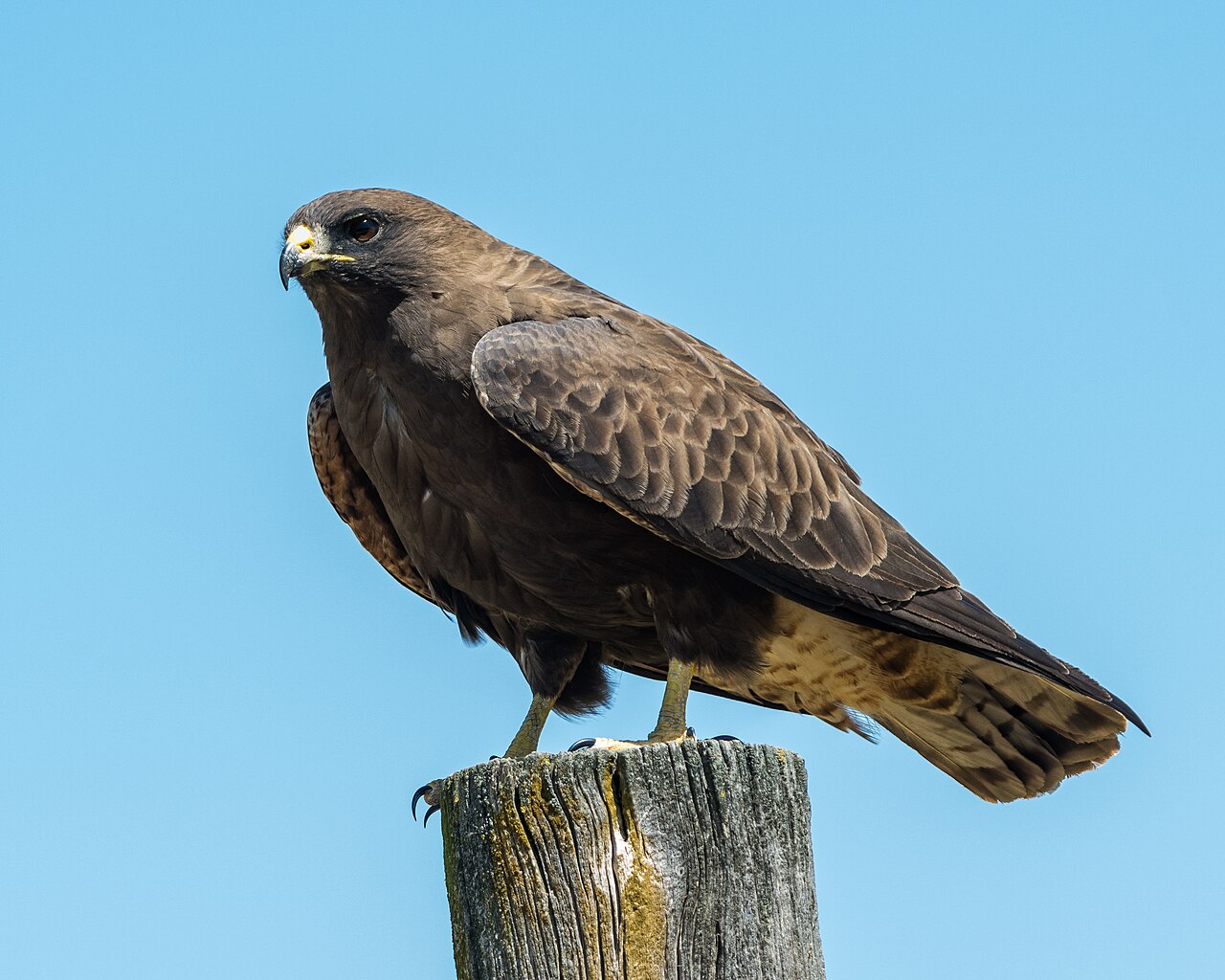
Swainson's Hawk is the slim, long-winged buteo of the open west, and it makes one of the longest migrations of any North American raptor: from the Canadian prairies to the pampas of Argentina. Outside the breeding season it lives almost entirely on insects, which it catches and eats on the wing.

Colour forms
Voice
The alarm call is a shrill, drawn-out kreeeee of two to three seconds that fades at the end; it is given perched as well as in flight, usually at an intruder near the nest. The female gives a shorter, lower-pitched version when the male arrives with food. During copulation there is a soft weeee. When both birds defend a territorial boundary they use a short pi-tick, pi-tick while pursuing.
Recording: Sue Riffe — CC BY-NC-SA 4.0 · Burnt Mill Rd, Pueblo County, Colorado, United States · xeno-canto
Identification
A large but narrowly built buteo with long, pointed wings and a fairly short tail; when soaring it holds its wings in a shallow V. In the light form, much the commonest, the breast is dark brown or rufous and the belly pale, with a sharp line between them; most males have a grey head, females a brown one. From below the pattern is distinctive: white wing linings against blackish flight feathers, so that the trailing edge of the wing forms a broad dark band. Dark birds range from rufous to nearly black and lack that contrast; east of the Rocky Mountains nearly all are light, in the west more than a tenth are dark. Juveniles are paler and finely streaked, and the female is larger than the male.
Confusion species
Red-tailed Hawk is more heavily built, with broad rounded wings, a shorter and wider tail and a dark band across the belly rather than the breast. Rough-legged Hawk instead shows a black belly patch, black carpal patches and a white tail base, and its legs are feathered to the toes. With dark birds shape helps more than colour: Swainson's is narrower in the wing and more pointed at the hand than any other buteo in the region. Zone-tailed Hawk also holds its wings in a V, but has a longer, clearly banded tail and rocks continuously instead of soaring steadily.
Habitat
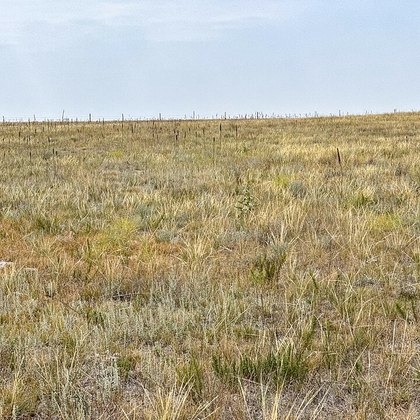
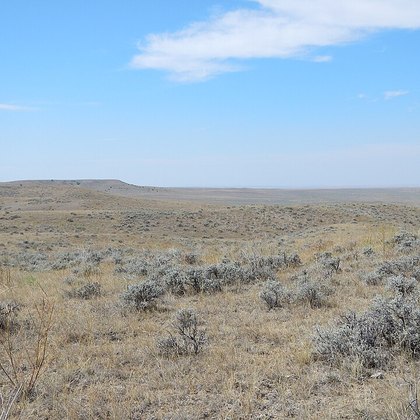
Open country: shortgrass prairie, steppe and sagebrush, and above all the farmland that has replaced them. It hunts over hay, alfalfa, grain and row crops, and nests in a lone tree or a small grove at the edge of these, often along a stream. It avoids tall forest and enclosed landscapes; what it needs is a single tree to nest in with kilometres of open ground around it. On migration and in winter it follows the insects, which brings it to freshly cut or ploughed land.
Where the bird is most often found, arranged by the USNVC — the vegetation classification of the United States and Canada — and CMECS for sea and coast.


Range and movements
A breeding bird of western North America, from the Canadian prairie provinces and interior British Columbia south through the Great Plains and the Great Basin into northern Mexico, east to western Minnesota. Almost the entire population travels to the pampas of Argentina, Uruguay and southern Brazil — outside the guide area — in flocks of hundreds to thousands, which compress over Mexico and the isthmus of Central America into one of the densest raptor streams anywhere. In autumn hundreds of thousands pass Veracruz within a few weeks. Small numbers stay behind in southeastern Florida and along the Texas coast; birds from California's Central Valley winter in western Mexico and Central America.
- Resident
- Breeding (summer)
- Winter
- Passage
- dark = core range, pale = thinly spread
Where and when to look
Go to a hawk watch on the flyway in September and read the shape of the flock itself: Swainson's Hawks screw upward in dense, turning columns — a kettle — and then glide off in a long string to the next thermal. In the breeding season it is often seen along prairie roads: it perches low on a fence post, or even stands on the ground in a freshly mown field among the grasshoppers. With every soaring buteo over open country, check for the shallow V and the broad dark trailing edge of the wing.
Conservation
The world population is put at about 900,000 birds and has risen by more than one per cent a year since 1966; the species is listed as Least Concern (LC). In the 1990s the pesticides monocrotophos and dimethoate, used against grasshoppers in Argentina, killed thousands of wintering Swainson's Hawks at one roost after another; after bans that mortality dropped sharply. Because virtually the whole species gathers in the same wintering area, a single measure there acts at once on the whole of it.
Scientific name
Buteo swainsoni | Bonaparte, 1838
Bonaparte described the species in 1838 as Buteo Swainsoni; the name honours the British naturalist and illustrator William Swainson. The genus Buteo was introduced by Lacépède in 1799, after Latin buteo, the classical name for a buzzard-like bird of prey. No type locality was fixed with the description. The Dutch name of the species refers to the prairie, the landscape in which it breeds most abundantly in North America.