All species › Birds of prey › Kites, Old World vultures, eagles and hawks › Red-tailed Hawk
Red-tailed Hawk | Buteo jamaicensis
Roodstaartbuizerd | Busardo colirrojo
Red-tailed Hawk is the raptor perched on almost every roadside pole, tree limb and lamppost across North America, scanning for prey, and the source of the piercing, descending scream that films and television have used for decades to voice almost any raptor on screen, eagle or not. Few raptors on the continent are as common, as adaptable, or as varied in colour: forms ranging from nearly white to almost black occur within a single species.

Voice
The familiar call is a hoarse, drawn-out, descending kee-eeeeerr, usually given while soaring over the territory or in response to a disturbance near the nest. Young birds beg with a higher, more persistent squeal. The call has become so recognisable that films and television routinely dub it over footage of eagles and other raptors, even when those species have an entirely different voice.
Recording: Manuel Grosselet — CC BY-NC-SA 4.0 · Salinas, Monterey County, California, United States · xeno-canto
Identification
A large, chunky buteo with broad, rounded wings and a short, wide tail. Adults of the common light morph have a brick-red tail, a pale breast crossed by a dark belly band, and a dark leading edge on the underwing. The species also shows markedly different colour forms: the near-black 'Harlan's Hawk' of Alaska and northwestern Canada largely lacks red in the tail, while the pale 'Krider's Hawk' of the northern prairies has a washed-out, pinkish tail and an almost white head. Juveniles of every form have a brown-banded rather than red tail.
Confusion species
Red-shouldered Hawk is smaller, with a black-and-white banded tail, reddish shoulders, and a pale crescent near the wingtips that shows through against the light; its call is a more even kee-yer. Rough-legged Hawk, a winter visitor, has legs feathered to the toes and hovers on beating wings more often. In the west the species is also confused with Swainson's Hawk, which has narrower wings and a dark breast band and migrates in large flocks, and with Ferruginous Hawk, which is larger, paler, and has rusty leg feathering that meets in a distinct V.
Habitat
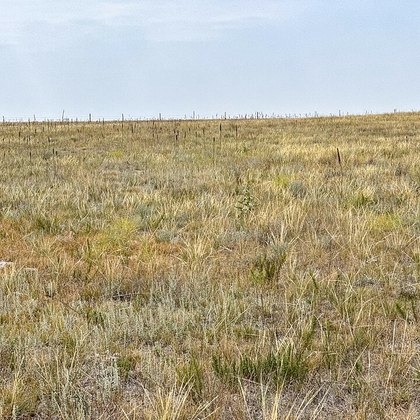
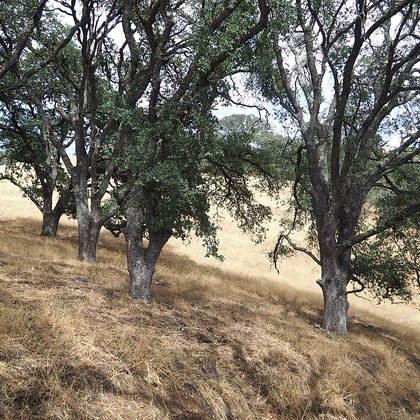
Almost any open landscape with scattered lookout perches: farmland, pasture, desert, prairie, woodland edge and city parks, as long as there are trees, poles or buildings to hunt from and open ground to find prey on. It avoids closed, unbroken forest without clearings and the treeless high polar regions.
Where the bird is most often found, arranged by the USNVC — the vegetation classification of the United States and Canada — and CMECS for sea and coast.



Range and movements
Breeds from central Alaska and northern Canada to Florida, the Caribbean and Central America, and is at least partly resident across most of that range. Birds from the far north of Canada and Alaska withdraw almost entirely in winter, while populations along the west coast and in Nova Scotia stay put year-round. Numbers rise in most states during winter as northern birds join the residents. It is one of the most common and widely distributed raptors on the continent.
- Resident
- Breeding (summer)
- Winter
- Passage
- dark = core range, pale = thinly spread
Where and when to look
Look along any highway or open stretch of land for a raptor sitting upright on a pole, lamppost or bare tree limb, its head somewhat sunk between the shoulders — the species' classic perched posture. In flight, the rust-red tail lit from below, glowing translucent, is often the first thing that catches the eye.
Conservation
One of the most numerous and widely distributed raptors in North America, listed as Least Concern (LC), with a large population that is stable or increasing. The species has benefited from roads and open farmland providing hunting perches; rodenticide poisoning and collisions along highways remain the main risks.
Scientific name
Buteo jamaicensis | (Gmelin, 1788)
Gmelin described the species in 1788 as Falco jamaicensis, in the genus of the falcons; since moved to another genus, author and year stand in parentheses. The genus Buteo was introduced by de Lacépède in 1799. jamaicensis means 'from Jamaica', after the island the type specimen came from — the species does breed there, but most of its range lies on the North American mainland.