All species › Birds of prey › Kites, Old World vultures, eagles and hawks › Ferruginous Hawk
Ferruginous Hawk | Buteo regalis
Rosse ruigpootbuizerd | Busardo herrumbroso
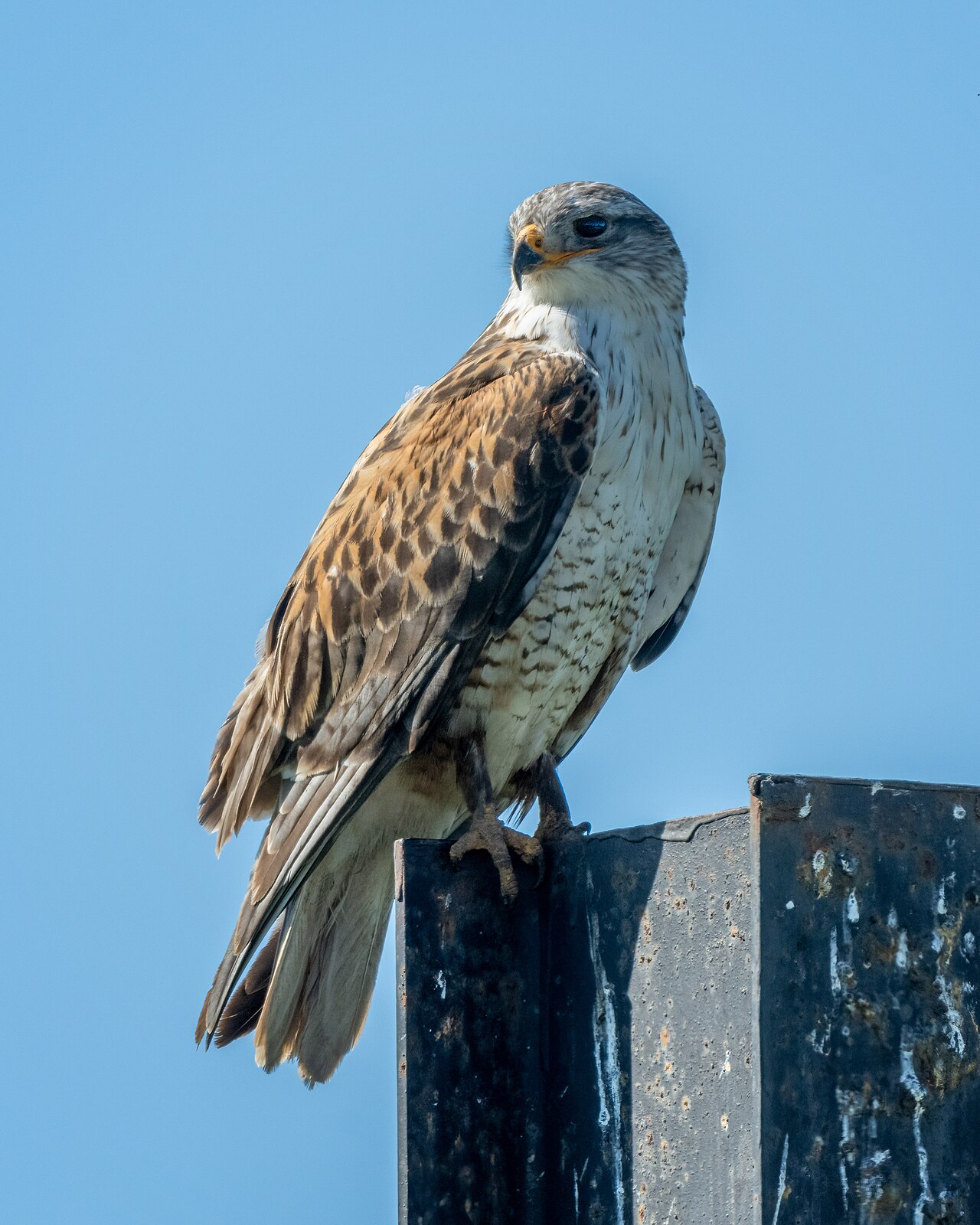
The Ferruginous Hawk is the largest buteo in North America: a bird of dry plains, with rusty upperparts, a heavy head and legs feathered all the way to the toes. It hunts almost exclusively ground-dwelling mammals — hares, rabbits, ground squirrels and prairie dogs.
Click a thumbnail to switch the photo above.
Voice
It is rarely heard. When disturbed at the nest both parents and newly fledged young give a scratchy scream reminiscent of a large gull. Small nestlings chirp briefly and thinly. During a stoop at an intruder the loudest sound is not the voice but the wing: a pronounced whoosh as the bird sweeps past.
Recording: Sue Riffe — CC BY-NC-SA 4.0 · CR25, Crowley Cty, Colorado, United States · xeno-canto
Identification
A large buteo with long, pointed wings, a big head and a heavy bill. The common light form is white below, with rusty upperparts, a pale head and rusty feathered legs that form a dark V against the white belly when the bird soars. The rarer dark form is deep rufous to chocolate over body and wing linings, but keeps the white tail and pale flight feathers. In all plumages the bases of the primaries are white, giving a pale panel in the outer wing in flight, and the feathering runs down to the toes — which together with Rough-legged Hawk separates it from every other buteo in the region. Juveniles lack the rust on the legs and are brown-spotted on belly and flanks; the female is larger than the male.
Confusion species
Light Red-tailed Hawk has a dark band across the belly, a reddish tail and shorter, more rounded wings, and its legs are bare and yellow. Rough-legged Hawk likewise has feathered legs, but is smaller, with a black belly patch, black carpal patches and a white tail base with a dark terminal band. A dark Ferruginous Hawk suggests a young Golden Eagle at distance; the eagle is larger, longer-tailed and smaller-headed, and holds its wings flatter and stiffer. Even on dark birds the white tail and pale wing panels remain the mark to work from.
Habitat
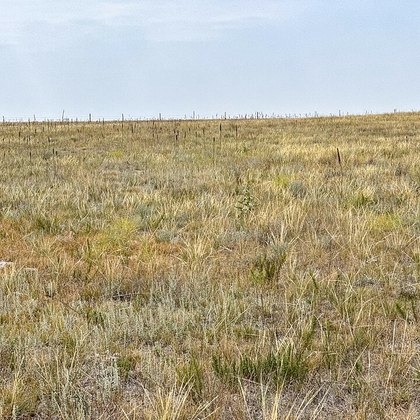
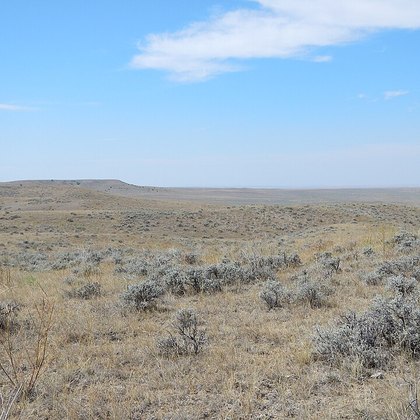
Open, dry country at low to moderate elevations: shortgrass prairie, sagebrush (grey-green wormwood scrub of the dry western interior) steppe, semi-desert and lightly grazed rangeland. For the nest it needs something raised — a cliff, a rock outcrop, a lone tree or a power pylon — but it will nest on the ground on a slope if it must. It avoids forest, tall buildings and intensive arable land. In winter western birds seek grassland and desert rich in rabbits, eastern birds grassland with prairie dog colonies.
Where the bird is most often found, arranged by the USNVC — the vegetation classification of the United States and Canada — and CMECS for sea and coast.


Range and movements
A breeding bird of interior North America, from the Canadian prairie provinces south through the Great Plains and the Great Basin into northern Mexico. Northern breeders move out, while in the southwestern United States part of the population stays all year; the winter range reaches Chihuahua, Coahuila and Nuevo León. The movements are not fixed: where prey is plentiful birds stay put, and when rabbit or ground squirrel numbers collapse large numbers shift elsewhere, so that a district may be full one year and empty the next. In the east of the range it has declined with the breaking up of the prairie and the control of prairie dogs.
- Resident
- Breeding (summer)
- Winter
- dark = core range, pale = thinly spread
Where and when to look
In winter, drive the edges of a prairie dog colony or a large block of shortgrass prairie and look low: it often sits on the ground, on a mound of earth or on a fence post, far lower than a Red-tailed Hawk would choose. In soaring flight the best mark is the dark V formed by the rusty feathered legs against the white belly. In strong wind it hangs kiting over one spot for long periods with its legs dangling.
Conservation
The world population is put at about 110,000 birds and rose by nearly one per cent a year between 1966 and 2019; the species is listed as Least Concern (LC). Conversion of prairie to cropland, grazing, mining and building cost it nest sites, and the systematic control of prairie dogs takes away its main winter food. At the nest it is sensitive to disturbance and abandons a clutch more readily than most other buteos.
Scientific name
Buteo regalis | (Gray, 1844)
George Robert Gray described the species in 1844 as Archibuteo regalis, in a genus no longer recognised; because it was later moved to Buteo, author and year stand in parentheses. The genus Buteo was introduced by Lacépède in 1799, after Latin buteo, the classical name for a buzzard-like bird of prey. regalis is Latin for 'royal', from rex, regis 'king'. The specimen described came from Real del Monte in Mexico. The Dutch name points both to the rusty colour and to the feathered legs it shares with Rough-legged Hawk.