All species › Birds of prey › Kites, Old World vultures, eagles and hawks › Zone-tailed Hawk
Zone-tailed Hawk | Buteo albonotatus
Bandstaartbuizerd | Busardo aura
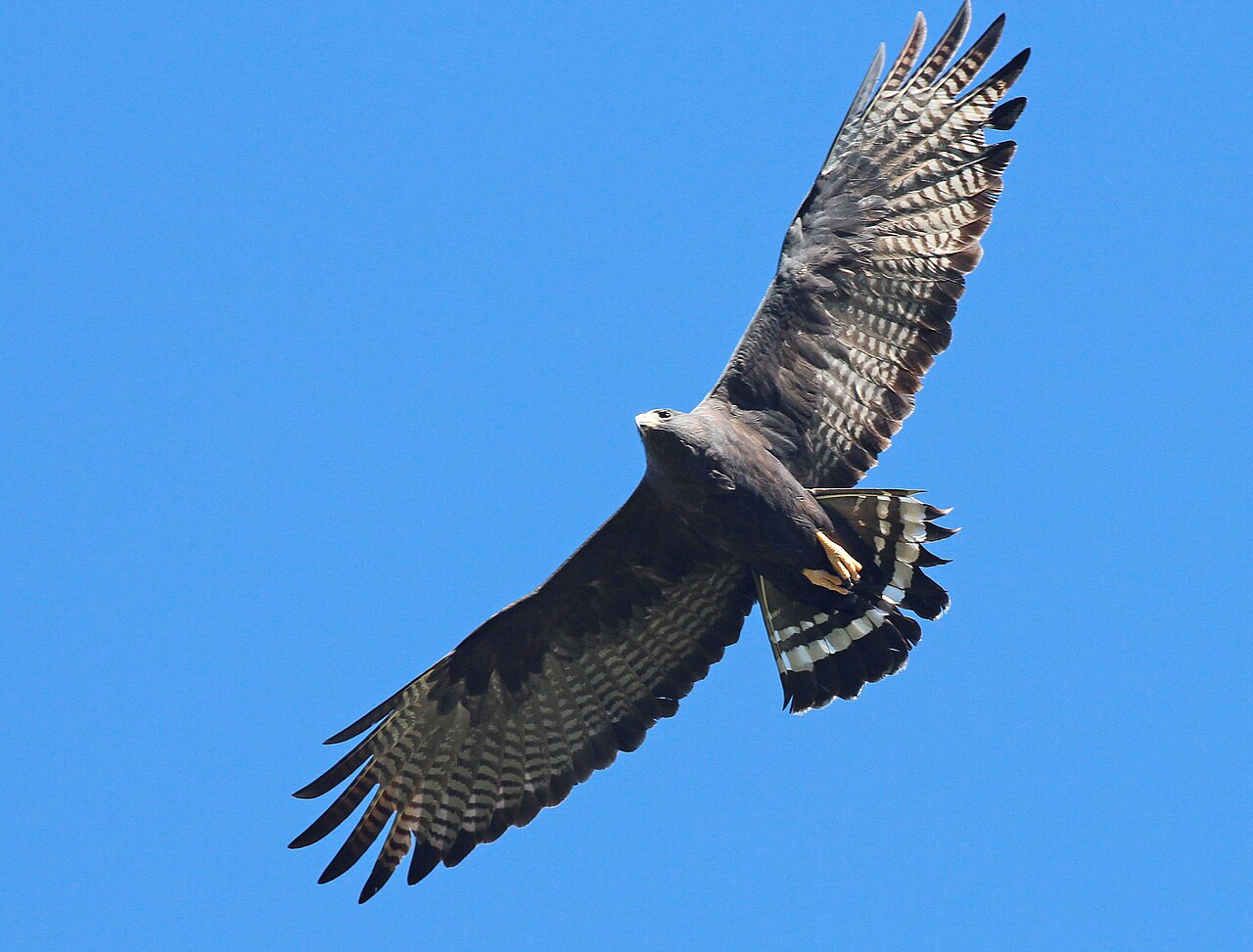
The Zone-tailed Hawk is a blackish raptor of south-western canyons and river woods that is almost impossible to separate from a Turkey Vulture in the air: the same raised wings held in a V, the same rocking on the wind, the same silvery flight feathers. Only the black tail with its broad white bands and the feathered head give away that this is a hunter and not a scavenger.
Voice
The call is a high, screaming kreeee or kreeee-ah that drops in pitch at the end, close in quality to a Red-tailed Hawk's but thinner and sharper. In the breeding season many short, yapping calls are added, and in nest defence a drawn-out, lower raaaauu. It is most vocal early in the season, during the display flights above the canyon walls, and notably silent otherwise. Anyone who hears what sounds like a Red-tailed Hawk in a canyon while a 'vulture' circles overhead would do well to look again.
No freely licensed recording has been found for this species yet; what to listen for is described below.
Identification
The adult is entirely sooty black, with a yellow cere above the bill and yellow legs, and a small touch of white on the face. The flight feathers are finely barred grey and look plain silver-grey at a distance, so that the underwing appears two-toned: black coverts, pale remiges. The tail carries three or four bands — the 'zones' of the English name — white from below and light grey from above, of which the second from the tip is by far the broadest. The flight is the key mark: slim, with long narrow wings and a long tail, the wings held in a distinct V and the body rocking from side to side, exactly as a Turkey Vulture does; that likeness lets it drift low over open ground without lizards and birds taking cover, and its hunting success is higher when it flies among real vultures. Juveniles have small white spots on the breast and a tail with many narrow grey and black bars and a broad dark tip; the female is larger and heavier than the male, at 845 to 937 grams against 607 to 667.
Confusion species
Turkey Vulture is the daily confusion: it has a small bare red head, unbarred silvery flight feathers, an unbanded tail, and it rocks slowly with hardly a wingbeat, while Zone-tailed Hawk has a feathered black head with a yellow cere, a tail with white bands, and can travel on steady, powerful beats. Common Black Hawk has shorter, broader wings, a much shorter tail with a single broad white band and long yellow legs, and soars on flat wings rather than in a V. Dark-morph Red-tailed Hawk has far broader wings, a short reddish or pale tail, and likewise soars flatter. Gray Hawk is far smaller and pale grey — no risk in flight, but a hurried perched view can mislead.
Habitat
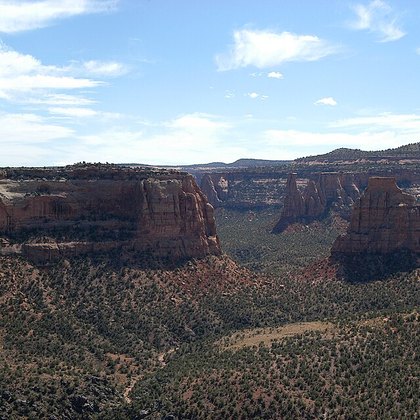
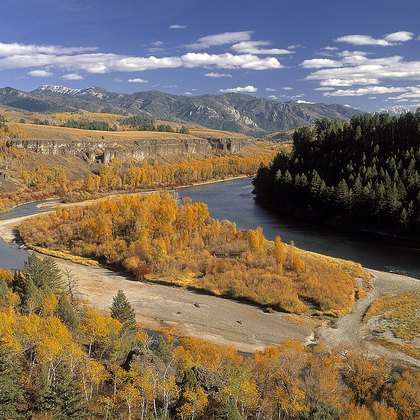
Rocky canyons, mesas and cliffs overlooking open country, combined with riparian cottonwood and willow woodland. It hunts out into dry desert foothills and up into pine-oak forest to about 2,300 metres, favouring edges, clearings and stream valleys. It avoids the lowest flat desert without relief and the alpine zone above. Water is almost always nearby; the nest is built in a tall oak or pine, or on a rock ledge.
Where the bird is most often found, arranged by the USNVC — the vegetation classification of the United States and Canada — and CMECS for sea and coast.


Range and movements
Breeds in the south-western United States — Arizona, New Mexico, western Texas and in small numbers California — and through interior Mexico and Central America; the range continues into Bolivia, Paraguay and Brazil, beyond the map of this guide. In winter it withdraws almost entirely from the United States and northernmost Mexico, those birds wintering mainly in Oaxaca and on the Yucatán Peninsula. Since the 1990s it has been spreading north, with vagrants far outside the range, as far as Nova Scotia and Virginia. In the United States the numbers involved remain small.
- Resident
- Breeding (summer)
- Winter
- Passage
- dark = core range, pale = thinly spread
Where and when to look
In the southwest, from March to September, check every passing Turkey Vulture. A 'vulture' with a feathered head, a yellow cere and a white band across the tail is this hawk and nothing else, and it is fond of drifting along among real vultures. The best views come from the rim of a canyon, level with the bird, in the morning before the thermals lift it out of sight.
Conservation
Partners in Flight puts the global population at two million birds and scores the species 10 out of 20 on its concern scale; the United States population is estimated at fewer than two thousand breeding birds. The main threat is habitat loss through development and changes in the landscape; direct persecution has declined. The range appears to be expanding northward.
Scientific name
Buteo albonotatus | Kaup, 1847
Kaup described the species in 1847 as Buteo albonotatus, and in that genus it still stands. The species name combines Latin albus, 'white', with notatus, 'marked', after the white bands in the tail. Buteo is the ordinary Latin word for a buzzard. Kaup gave no locality with the description; the type came from Mexico.