All species › Birds of prey › Kites, Old World vultures, eagles and hawks › Hook-billed Kite
Hook-billed Kite | Chondrohierax uncinatus
Langsnavelwouw | Milano picogarfio
A kite with a heavy, deeply hooked bill that it uses to lever tree snails out of their shells — a diet no other North American raptor shares. Male and female look so unlike each other that they were long taken for two species, and on top of that there is a rare all-black form. In the United States it nests only along a short stretch of the Rio Grande in South Texas.
Click a thumbnail to switch the photo above.
Voice
A conspicuously noisy raptor, above all in courtship. The best-known sound is a fast rattling trill much like a woodpecker's, sometimes running into a slower, descending rattle. Alongside it come a soft hoo-ee, shrill screams and a clear oriole-like whistle. Displaying pairs spiral upward in tight circles calling all the while, and in the dense riverside woodland of the Rio Grande that is often the first sign the species is present.
No freely licensed recording has been found for this species yet; what to listen for is described below.
Identification
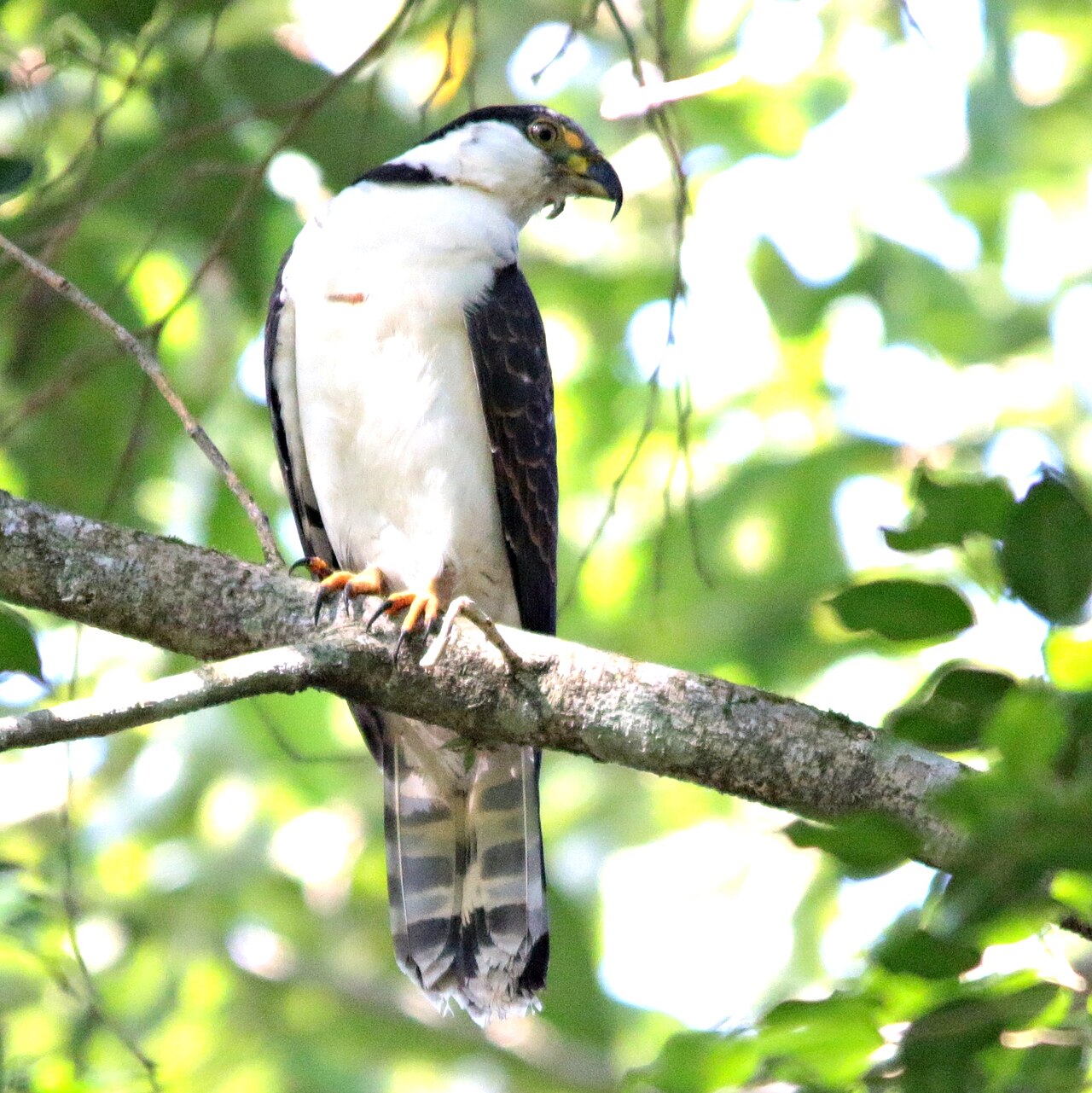
The wings are very broad and rounded at the tip but pinched in at the body, so that the soaring silhouette looks like a pair of paddles; the long tail carries two or three broad pale bands. Every plumage shows the strikingly large, strongly curved bill, and adults add a pale yellow-orange eye and greenish, fleshy skin at the base of the bill. The male is slate grey above and finely barred white and grey below; the female is dark brown above and barred chestnut and white below, with an orange-brown collar. Juveniles are paler brown above and mostly white below with some dark barring on breast and flanks, and a dark eye. Mainland birds also produce a rare dark morph: black throughout, with white banding in the primaries and one broad white tail band. As in almost all hawks and kites the female is the larger of the pair, and bill size varies markedly from bird to bird even within one district.
Confusion species
Gray Hawk is also grey and finely barred, but has an ordinary, far smaller bill, more pointed wings and a crisper black-and-white tail. Broad-winged Hawk shows even rufous barring across the breast, a shorter tail with a single broad white band, and a steadier wing outline without the pinched base. The dark morph is taken for Common Black Hawk or Zone-tailed Hawk; look then for the chequered primaries and the pale, narrow base to the bill. Juveniles resemble young Broad-winged Hawks from below, but give themselves away by bill size and by the blocky pattern in the flight feathers.
Habitat
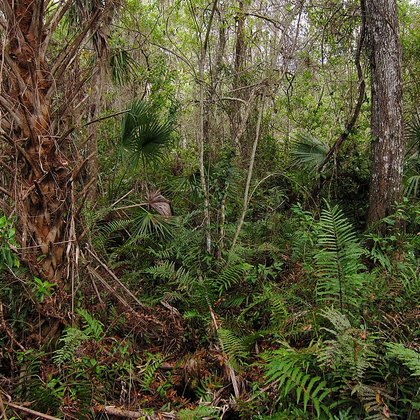
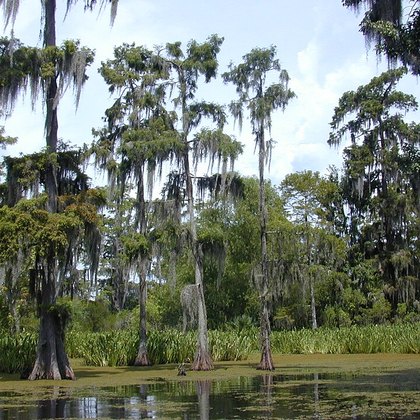
Broadleaf and gallery woodland along streams and rivers, lowland rainforest, and in Texas the surviving strips of cypress, palm and mesquite beside the Rio Grande. It usually keeps low and hidden inside the canopy and rises above the trees mainly around midday to soar. Exactly where it sits depends on the tree snails: when these are scarce it moves on, and outside the breeding season fixed territories barely exist. Mangrove and drier thorn woodland are used as well, open farmland is not.
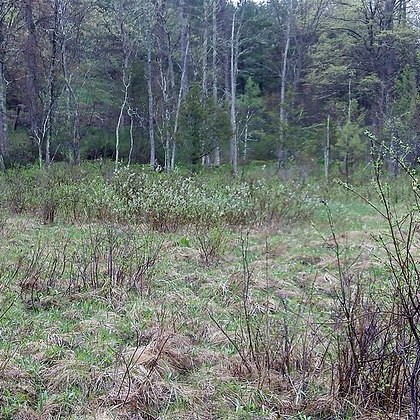
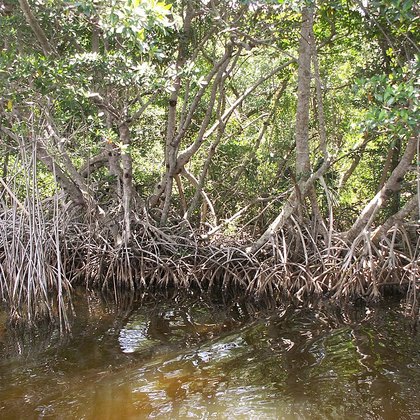
Where the bird is most often found, arranged by the USNVC — the vegetation classification of the United States and Canada — and CMECS for sea and coast.

Range and movements
Resident from South Texas and Mexico through Central America and, beyond the edge of the map, on to Argentina; a separate and very rare form lives in eastern Cuba. In the United States it is confined to some hundred and fifty kilometres of the Rio Grande, where it has bred with certainty only since the 1960s and where the total rarely exceeds a few dozen birds. Across its large range it is local and wandering rather than evenly spread. Breeding coincides with the rainy season, when snails are most abundant.
- Resident
- Breeding (summer)
- Winter
- Passage
- dark = core range, pale = thinly spread
Where and when to look
In South Texas take a vantage point above the riverside woodland on a windless morning and wait for the thermals, usually between ten and twelve o'clock; the birds then come up briefly over the trees and the paddle-shaped wing is the best mark you will get. Look also for heaps of broken snail shells under a regular perch — that is the surest evidence the bird is there.
Conservation
The world population is put at some two hundred thousand breeding birds and is rated of low conservation concern. Locally it declines with the clearing of riverside and lowland forest, and with introduced snails displacing the native tree snails. Two island forms are far worse off: fewer than seventy birds remain of the Grenada form, and the Cuban form has been seen only a handful of times since the 1990s.
Scientific name
Chondrohierax uncinatus | (Temminck, 1822)
Temminck described the species in 1822 as Falco uncinatus, among the falcons; because it was later moved to another genus, author and year stand in parentheses. uncinatus is Latin for 'furnished with a hook', from uncinus, 'barb' — after the heavily curved upper mandible. The genus Chondrohierax was introduced by Lesson in 1843 and is built from Greek khondros, 'cartilage', and hierax, 'hawk', after the soft, swollen skin above the bill. The described specimen came, in Temminck's words, from the vicinity of Rio northward through Brazil and all of Guiana.