All species › Birds of prey › Kites, Old World vultures, eagles and hawks › White-tailed Kite
White-tailed Kite | Elanus leucurus
Amerikaanse grijze wouw | Elanio maromero
A small, pale raptor that holds itself motionless on the wind above grassland for minutes at a time before dropping feet-first into the grass: white below, pale grey above, with black shoulder patches and red eyes. By about 1930 shooting and egg-collecting had reduced it to a handful of pairs in California and Texas. It has recovered since, spreading north to Washington and east to Florida.
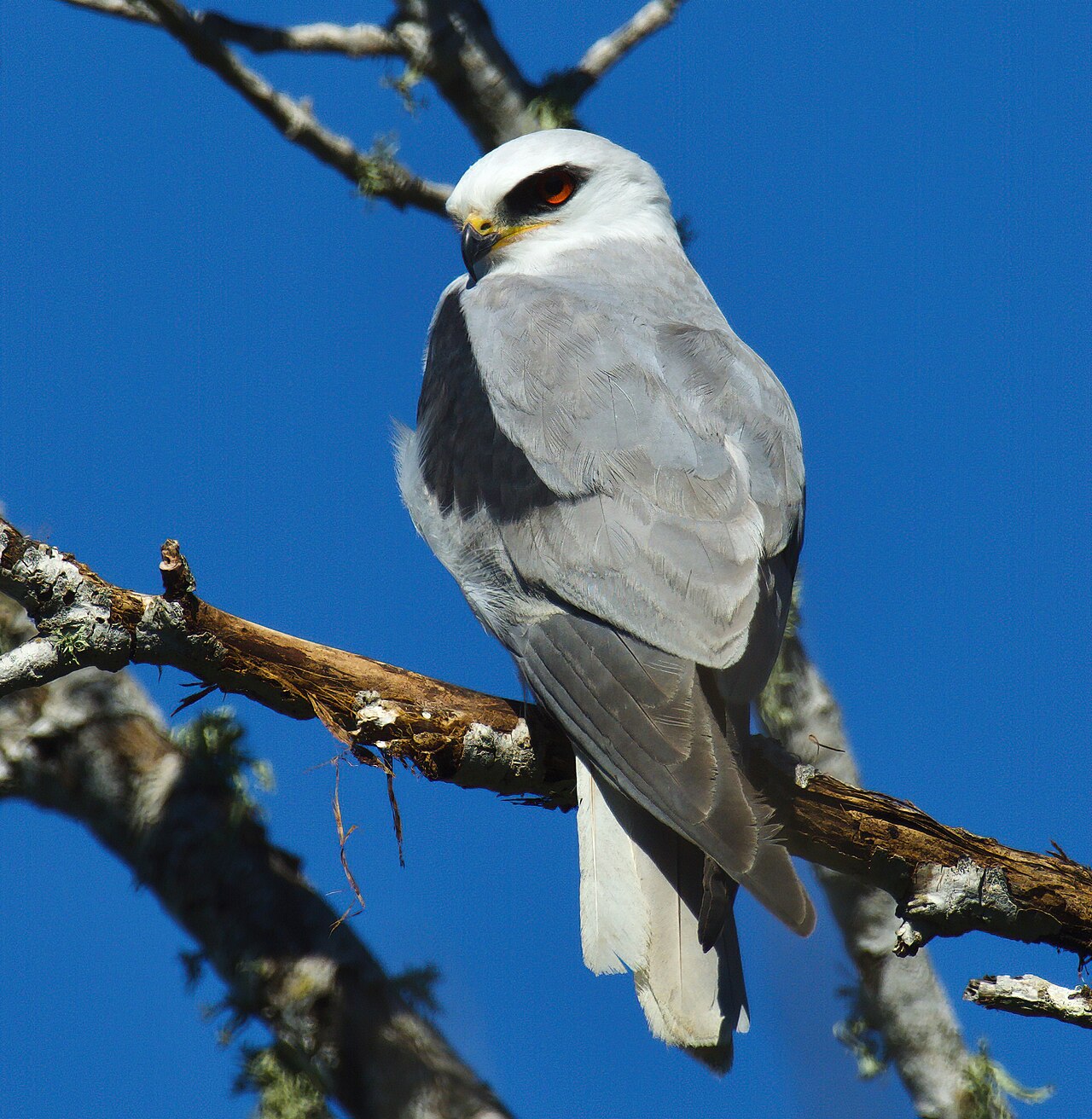
Click a thumbnail to switch the photo above.
Voice
By raptor standards a quiet bird, one that rarely gives itself away before you see it. The usual call is a soft whistled keep or kewp, given year-round and carrying only a short distance. At the nest and during prey transfers it becomes a harsher, rapidly repeated grrip grrip grrip. Fledged young beg with a thin, persistent squealing that carries out from the nest tree. Finding this kite is therefore a matter of looking rather than listening: the hovering silhouette shows from hundreds of metres, the voice only from close by.
Recording: José María Loaiza B. — CC BY-NC-SA 4.0 · Calacali, 1.5Km desde la "Y a Moraspungo, Hacienda grande Amarilla, Ecuador · xeno-canto
Identification
Adults are clean white below and pale grey above, with a large black patch on the shoulder and a black wrist patch on the underwing. The head is white with a black smudge around a deep crimson eye, and the tail is white and almost unmarked from below. The wings are long, narrow and pointed, and are held in a shallow V when soaring. Hunting birds kite: they beat into the wind with head and tail angled down, hang on one spot without drifting, and then drop in stages to the ground. The sexes look alike; as in almost all hawks and kites the female is slightly larger and heavier, but the difference is not usable in the field. Juveniles have a cinnamon wash over crown and breast and a brown-mottled back, but already show the black shoulder.
Confusion species
Mississippi Kite is also grey, but lacks the black shoulder, has a dark tail and does not hover. Male Northern Harrier is grey and white but has black wingtips and a white rump, and quarters low over the field rather than hanging in one place. American Kestrel does hover, but is far smaller, rufous on back and tail, and much quicker in the wingbeat. At long range a hovering kite is taken for a gull or tern; the black shoulder, the short broad head and the downward-angled tail settle it.
Habitat
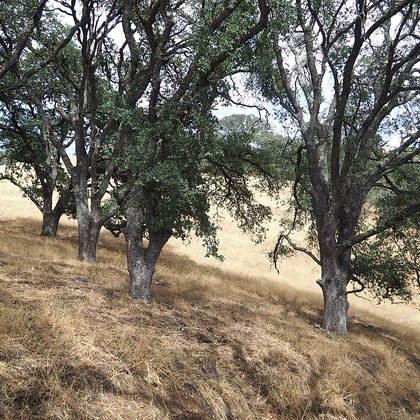
Open and half-open lowland with a low, dense herb layer: grassland with scattered oaks, pasture, damp hollows, marshy tangles, levees and field margins. It needs two things at once — a good supply of voles to hunt, and a tall tree to nest and roost in. It avoids heavily grazed ground, where there is no cover and therefore few voles, and makes no use of closed high forest. Outside the breeding season birds roost communally, sometimes dozens together in one stand of trees.
Where the bird is most often found, arranged by the USNVC — the vegetation classification of the United States and Canada — and CMECS for sea and coast.




Range and movements
Resident in California, western Oregon and southwestern Washington, in Texas and the coastal strips of Louisiana and Florida, and on through Mexico and Central America to Nicaragua; beyond the area covered by this guide the range continues to Chile and Argentina. It does not migrate but wanders: when voles peak, many pairs settle in a district within a season and leave again when the prey crashes. Through the first half of the twentieth century shooting and egg-collecting had cut it back to remnants in California and South Texas. Recovery was rapid afterwards: Oregon was occupied in the 1970s, the first Washington nest dates from 1988, and populations have established themselves in Louisiana and Florida as well.
- Resident
- Breeding (summer)
- Winter
- Passage
- dark = core range, pale = thinly spread
Where and when to look
Drive grassland, levees and fallow fields by day and watch for a white bird standing still in the air — no other raptor of this size holds one spot so long and so steadily. The last hour before sunset is best: hunting is most intense then, and in winter the birds gather afterwards at their communal roost trees.
Conservation
The world population is put at around two million birds, but North American numbers fell by more than a third between 1970 and 2014. The main threat is the loss of open grassland to housing and to intensive arable farming, which strips away the cover voles depend on. Because the species tracks rodent cycles so closely, numbers swing sharply from year to year and district to district in any case.
Scientific name
Elanus leucurus | (Vieillot, 1818)
Vieillot described the species in 1818 as Milvus leucurus, among the true kites; because it was later moved to another genus, author and year stand in parentheses. The genus Elanus was introduced by Savigny in 1809 and goes back to Greek elanos, 'kite'. leucurus is built from leukos, 'white', and oura, 'tail': white-tailed, after the most conspicuous mark on a flying bird. The described specimen came from Paraguay. For decades E. leucurus was lumped with the Old World Elanus caeruleus; on grounds of size, shape, plumage and behaviour it has been treated as a separate species again since the 1990s.