All species › Gamebirds › Partridges, pheasants, grouse and allies › Indian Peafowl
Indian Peafowl | Pavo cristatus
Blauwe Pauw | Pavo Real Común
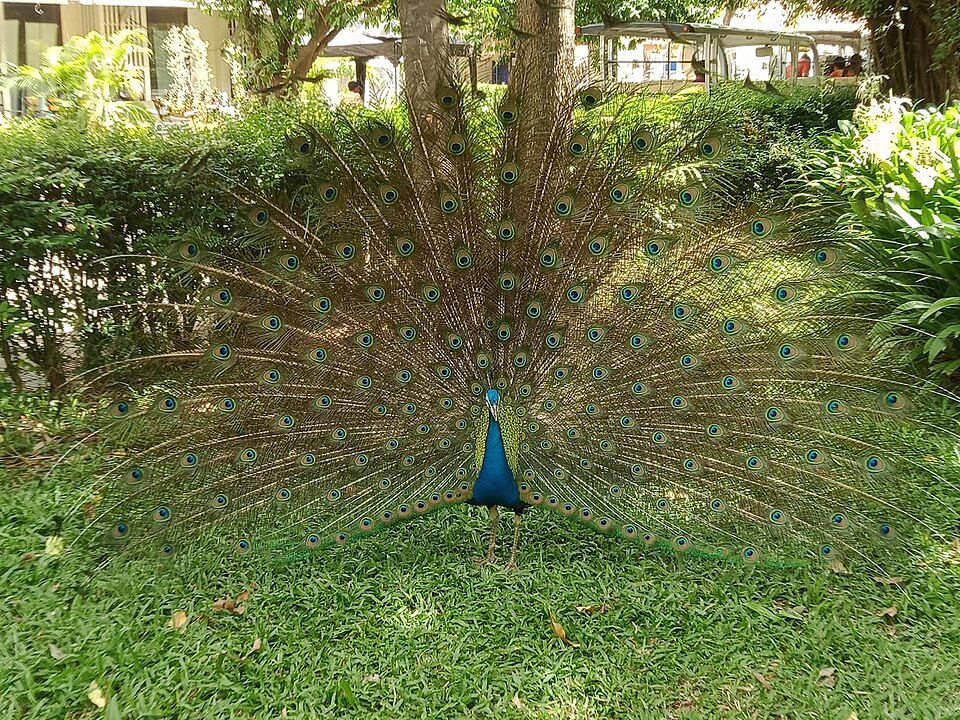
The Indian Peafowl is the largest galliform found free-living in North America: the male trails a train of upper tail coverts a metre to a metre and a half long, set with eyes of bronze and blue. The species is not a game bird here but an ornamental one from South Asia, escaped or released from gardens and zoos, that maintains itself unaided in parts of Florida and California. It is one of the few non-native birds on the continent that lives almost entirely around people.
Voice
Especially in the display season, from February to April, and often just before rain, a loud, far-carrying may-awe or kee-ow call is given, usually in series of two to four repeats, from a roof or a high branch, morning and evening. Alarm brings a harsh, cackling note that spreads through the whole group. During the train display the male shivers the raised feathers, producing a low, rattling sound best heard at close range.
Recording: Uku Paal — CC BY-NC-SA 4.0 · Tissamaharama, Hambantota, Southern Province, Sri Lanka · xeno-canto
Identification
The male has a metallic blue neck and breast, a bronze-green back and a large train of upper tail coverts, each tipped with an eyespot of blue and bronze, raised into a fan during display; on the head stands an upright crest of wiry feathers each tipped with a tiny fan. The female is far smaller and lacks the train: brownish-green above, whitish below, with a shorter crest. Young males resemble the female for two to three years before the full train grows in. Feral birds are often white or pied through crossing with ornamental colour forms, but the build and the crest stay the same.
Confusion species
A white bird is sometimes taken for a swan, but the crest, the legs and the walk immediately show a gamebird. Green Peafowl (Pavo muticus) of Southeast Asia, rarely kept as an ornamental bird, has a green rather than blue neck and an upright rather than drooping crest, but is seldom found in North America. A young male without a train is confused with the hen, but already shows the longer legs and spurs of the male.
Habitat
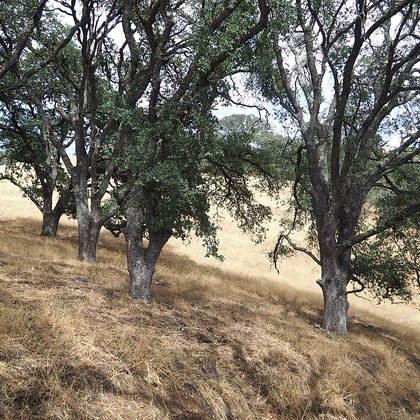
Around buildings: gardens, parks, ranches and golf courses with tall trees to roost in and lawn or open ground to feed on. In Florida the densest populations occur in suburban neighbourhoods with old, tall trees, in California around hillside estates near Los Angeles. In the wild the species occupies open forest and scrub in South Asia; in North America it occurs almost nowhere outside the immediate vicinity of people.
Where the bird is most often found, arranged by the USNVC — the vegetation classification of the United States and Canada — and CMECS for sea and coast.



Range and movements
In Florida the species has been recorded in Orange County since the 1950s and has since been seen in at least twenty counties, with confirmed breeding populations in Palm Beach County among others. In California the best-known population, around the city of Arcadia near Los Angeles, descends from birds that escaped from an estate in the early twentieth century; a second holds on the Palos Verdes Peninsula. Smaller, scattered groups occur in Hawaii. All these populations are the result of repeated, unplanned escapes and releases, not of a single deliberate introduction.
- Resident
- Breeding (summer)
- Winter
- Passage
- dark = core range, pale = thinly spread
Where and when to look
Look for it in early morning on the streets of an old-tree neighbourhood in South Florida or in Arcadia, California: the loud calls carry far and the birds themselves often perch on a roof or a fence. Between February and April the chance of seeing a male with the train fully raised is highest.
Conservation
Not threatened worldwide. The North American populations are local and remain largely dependent on ongoing escapes; as permanent residents of neighbourhoods they sometimes cause noise and property complaints, after which municipalities trap and relocate birds.
Scientific name
Pavo cristatus | Linnaeus, 1758
Linnaeus described the species in 1758 as Pavo cristatus, in the genus it still stands in, so author and year carry no parentheses. Pavo is the ordinary Latin word for peafowl; cristatus means 'crested', after the crest on the head. Linnaeus gave the type locality as 'India orientali, Zeylona', East India and Ceylon, now simply treated as India.