All species › Gamebirds › Partridges, pheasants, grouse and allies › Kalij Pheasant
Kalij Pheasant | Lophura leucomelanos
Nepalfazant | Faisán Kálij
The Kalij Pheasant is a medium-sized pheasant from the mountain forests of the Himalaya, released as a gamebird on the Big Island of Hawaii in 1962. From a single ranch in the interior it spread through the forested country over almost the whole island, where it is now a common forest bird of the lower and middle slopes. Elsewhere in North America the species does not occur.
Voice
The male gives a series of harsh, scraping cackling notes, often followed by a short, whirring drum of the wings in territorial display, usually delivered from the ground in dense cover. In alarm a sharp, sustained cackling call sends the whole group flushing at once. The sound carries less far through the dense forest understory than a pheasant's crow does across open land, so the bird is more often heard than seen.
Recording: KALYAN SINGH SAJWAN — CC BY-NC-SA 4.0 · Forest Lodge Bellview East Tallital Nainital, India · xeno-canto
Identification
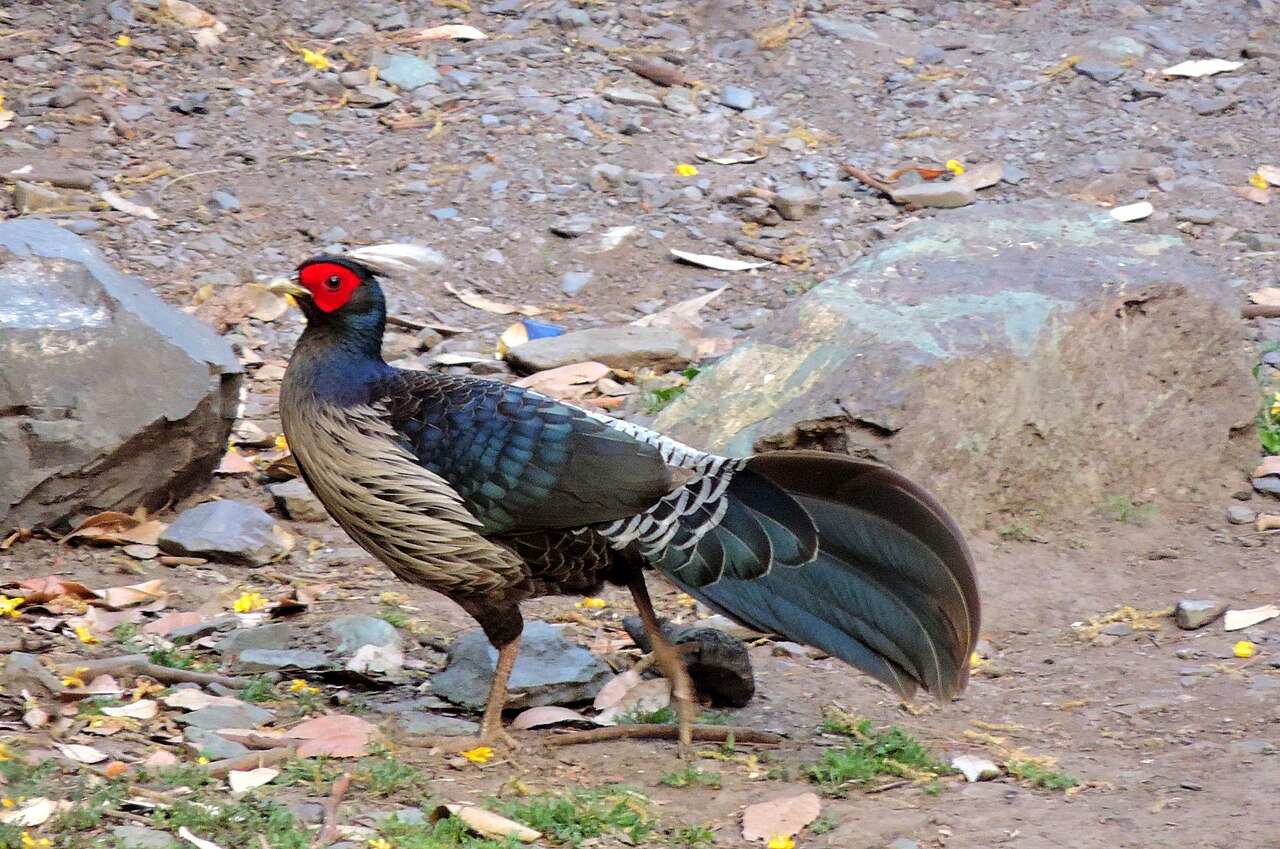
The male is mostly glossy blue-black, with a whitish, finely barred lower back and rump, a long backward-sweeping crest and bare red skin around the eye; the long tail is laterally compressed and gently curved. The female is sooty brown with scaly patterning below, a shorter crest and the same red facial skin, though far less conspicuous. Both sexes have grey legs and an upright, gamebird stance. On the forest floor the male's white lower back is the mark that stands out against the shadows.
Confusion species
Ring-necked Pheasant (Phasianus colchicus), found elsewhere in Hawaii, has a far longer, coppery tail and no crest; in practice the two overlap little, since the Kalij keeps to forest and the pheasant to open land. The female Red Junglefowl is more rufous-brown and lacks the white patterning on the Kalij hen's lower back. Feral dark-plumaged domestic chickens can be mistaken for a male at a distance but lack the bare red facial skin and the crest.
Habitat
Humid forest on the slopes of the Big Island, from low-elevation woodland mixed with introduced trees to forest at around two thousand metres, with a dense understory of ferns and shrubs for cover. It forages by day on the forest floor, sifting leaf litter for seeds, insects and small invertebrates, and withdraws into the trees at night. Open pasture, dry lowland and continuous built-up land are avoided.
Where the bird is most often found, arranged by the USNVC — the vegetation classification of the United States and Canada — and CMECS for sea and coast.


Range and movements
In 1962 Kalij Pheasants from South Asia were released on the Big Island of Hawaii to establish a gamebird there. From the original release site at Puʻu Waʻawaʻa the species spread across nearly all the forested slopes of the island, and the advance continues. Scattered records also come from Maui and Oʻahu, but with no sign of an established population. Elsewhere in North America the species has not been released.
- Resident
Where and when to look
Walk an early-morning forest road in Hawaii Volcanoes National Park, for instance at Kipuka Puaulu: Kalij Pheasants scratch through the leaf litter close to the trail and only flush, in a short explosive burst, once you are nearly upon them. The scraping cackle is often heard well before the bird is seen.
Conservation
Least Concern (LC) worldwide; on the Big Island numbers and range are still increasing since the 1962 release. The species is managed there as a gamebird with its own hunting season, and there is no programme aimed at reducing the population.
Scientific name
Lophura leucomelanos | (Latham, 1790)
Latham described the species in 1790 as Phasianus leucomelanos; it has since been moved to another genus, so author and year stand in parentheses. Fleming introduced the genus Lophura in 1822, from Greek lophos 'crest' and oura 'tail'. leucomelanos is Greek for 'black-and-white', after the male's contrasting plumage. The type locality was originally given broadly as India and later restricted to Nepal, the source of the Dutch name for the species, nepalfazant.