All species › Waders, gulls and terns › Skimmers, noddies, terns and gulls › Least Tern
Least Tern | Sternula antillarum
Amerikaanse dwergstern | Charrancito americano
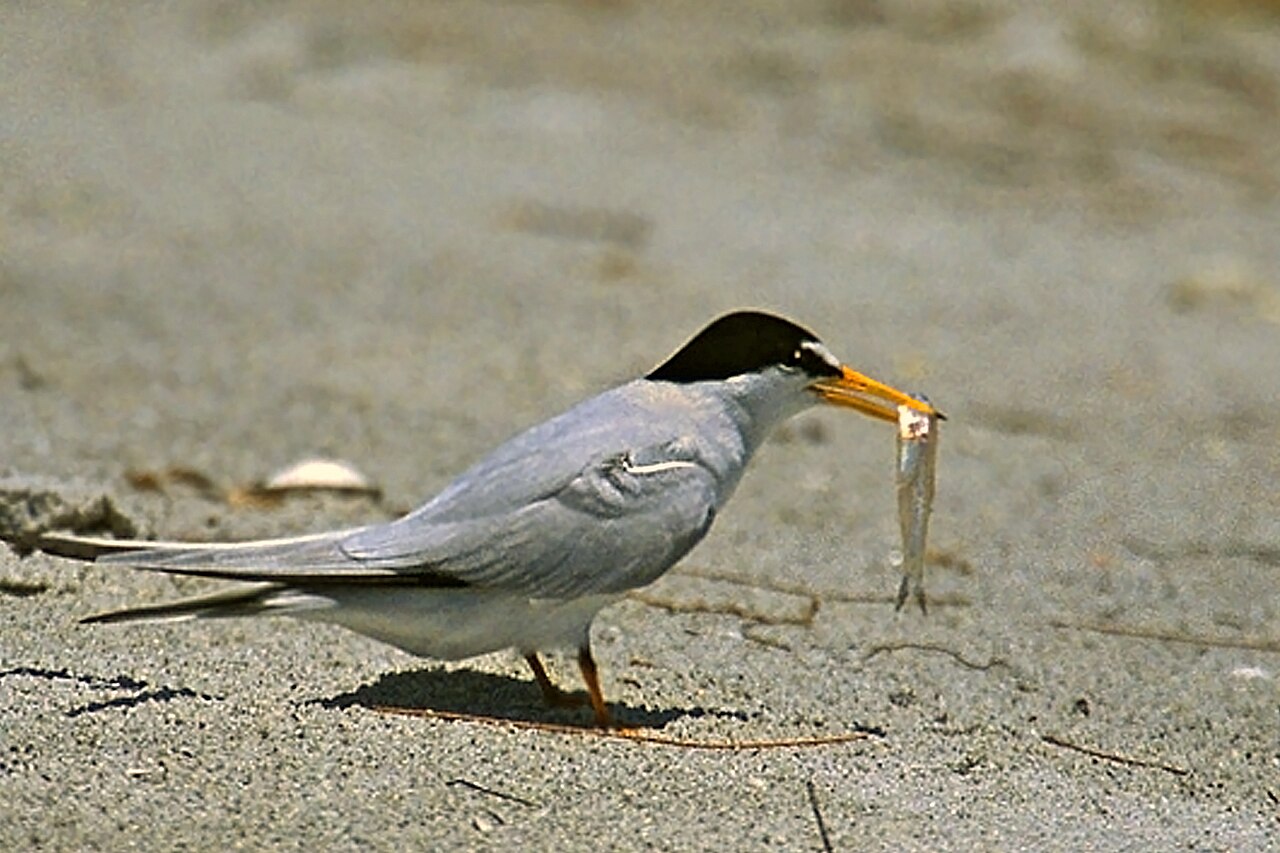
The Least Tern is the smallest tern of the continent: barely larger than a starling, with a yellow bill, a white forehead set in a black cap, and a hurried, angular flight. It breeds on bare sand, exactly where people like to lie, and has become one of the most closely guarded birds of the American coast.
Voice
Over the colony comes a high, sharp, insistent kip kip kip, quickening when the birds are agitated into a rattling ki-di-deek. Hunting birds give a rasping zreep, often just before they drop. Anyone approaching a breeding beach is mobbed by dozens of birds at once: a shrill, metallic chorus audible along the whole shore. The voice is higher and thinner than that of any other tern in the region, and usually betrays the bird before it is seen.
No freely licensed recording has been found for this species yet; what to listen for is described below.
Identification
In breeding plumage pale grey above and white below, with a black cap into which a sharp white triangle runs back over the eye, a yellow bill with a small black tip, and yellow legs. The two outer primaries are black and form a narrow dark leading edge to the wingtip in flight — the best mark at a distance. In winter the bill darkens, the crown becomes smudgy grey, and the white of the forehead extends far back. Juveniles resemble winter adults but have a scaly-patterned mantle and a dark patch behind the eye. Male and female are alike. The flight is fast and stiff with deep beats; the bird often hovers two or three times over the same spot before plunging.
Confusion species
Every other tern in the region is clearly larger: Common Tern (Sterna hirundo) is nearly half as long again, with a red black-tipped bill and a wholly black cap without a white forehead. Forster's Tern (Sterna forsteri) is also much bigger and shows in winter a sharply defined black eye mask on an otherwise white head. At range a distant small tern in winter plumage can stay difficult; then look for the yellow legs, the very rapid shallow wingbeats and the tiny size beside the plovers on the same beach. In Europe the Little Tern (Sternula albifrons) takes its place; it is built almost identically but has a longer white forehead wedge and a less squeaky call.
Habitat
Bare or sparsely vegetated sand and shell grit: outer beaches and young dunes on the coast, exposed sandbars and islands in the large interior rivers, and the bare edges of lagoons and salt pans. It avoids anything tall or densely grown; a colony is abandoned as soon as scrub comes up and the sand is bound. Where natural bare ground has gone it turns to what people make: gravel-covered flat roofs in the southeast, dredge-spoil islands, parking lots and airfields. It fishes in shallow water close to the colony — in the surf, in creeks and in the estuary, rarely far offshore.
Where the bird is most often found, arranged by the USNVC — the vegetation classification of the United States and Canada — and CMECS for sea and coast.




Range and movements
It breeds in three separate regions: along the Atlantic and Gulf coasts from Maine to Texas, along the great interior rivers — Missouri, Mississippi, Arkansas, Red and Rio Grande — and on the Pacific from central California into Baja California. Colonies also occur in the Bahamas and the Greater Antilles. In autumn it leaves North America entirely, wintering along the coasts of Central and South America as far as northern Brazil, a winter range still poorly mapped. The river population lost most of its sandbars to dams and channelisation during the twentieth century and is now crowded onto the few bars that still emerge.
- Resident
- Breeding (summer)
- Winter
- Passage
- dark = core range, pale = thinly spread
Where and when to look
Look for it from May to August from a beach crossing or a pier: it fishes right in the surf and calls almost continuously. Stay outside the roped-off stretches of beach — the eggs lie loose in a scrape in the sand and are invisible until you are standing on them. Over a large river it pays to scan the sandbars with a telescope in June; the birds stand there in small groups on the bare sand, heads into the wind.
Conservation
The world population is put at some 120,000 birds, more than half of them in the United States and Canada; the Red List treats the species as not threatened. Even so it declined by about 2.6 percent a year between 1966 and 2023 — nearly eighty percent in total — and is treated as a tipping-point species. The interior river population was federally listed as endangered from 1985 to 2021 and grew under protection from fewer than two thousand to more than eighteen thousand birds; the California population is still federally endangered. Beach nesting remains the problem: recreation, loose dogs, storm tides, coastal development and rising sea level.
Scientific name
Sternula antillarum | Lesson, 1847
Lesson described the species in 1847 as Sternula antillarum; author and year stand without parentheses, because the bird is still in the genus in which it was described. Sternula is a diminutive of Sterna, the classical word for a tern, and suits the smallest member of the family. antillarum means 'of the Antilles'. The described specimen came from Guadeloupe in the West Indies — an island at the edge of the range, far from the rivers and beaches where the species is most numerous today.