All species › Waders, gulls and terns › Skimmers, noddies, terns and gulls › Caspian Tern
Caspian Tern | Hydroprogne caspia
Reuzenstern | Pagaza piquirroja
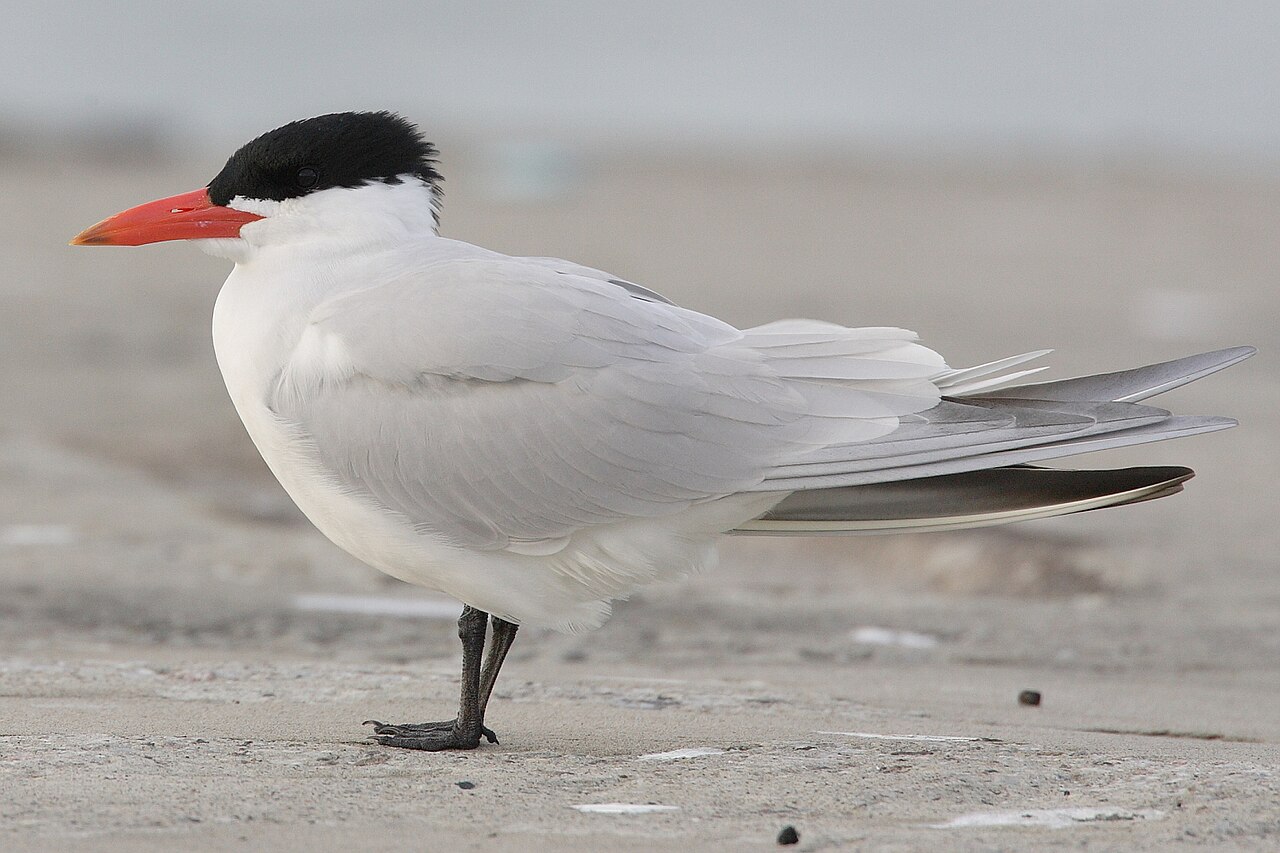
The Caspian Tern is the largest tern in the world, the size of a Herring Gull, with a heavy carrot-red dagger of a bill that shows at a great distance. It breeds scattered across five continents, and in North America as readily on a bare islet in a prairie lake as on a dredge-spoil bar in a river mouth.
Voice
The call is a deep, hoarse, far-carrying kraah, more the croak of a heron than the shrill cry of a tern; two or three birds over a colony already sound like a quarrel. In alarm it becomes a short, raw series, rah-rah-rah. Young birds beg with a thin, plaintive whee-you that stands out beside the croaking of the adults. That begging goes on for months: even in winter, hundreds of kilometres from the colony, a young bird still follows its parent over the water, calling.
No freely licensed recording has been found for this species yet; what to listen for is described below.
Identification
A heavy, broad-winged tern the size of a large gull, white with pale grey upperwings and a thick, bright red bill usually tipped darker. In breeding plumage the crown is jet black to below the eye; outside the breeding season the cap stays dark but becomes streaked with white — unlike most terns it never turns truly white. From below the outer primaries are strikingly dark grey, a mark that holds even against the light. The legs are black, the tail short and only shallowly forked. The flight is powerful and gull-like with slow beats; it fishes with a heavy plunge from ten to thirty metres and carries the fish crosswise in the bill.
Confusion species
Royal Tern (Thalasseus maximus) is the main confusion species: slimmer, with a thinner orange bill without a dark tip, a more deeply forked tail, pale underwing tips, and for most of the year a white forehead with a shaggy black crest on the nape. Elegant Tern (Thalasseus elegans) of the west coast is slimmer still and has a long, slightly drooping orange bill. At long range a Caspian Tern is sometimes taken for a gull; the straight bill held into the neck and the head angled downward while searching then settle it. Juvenile Caspian Terns are greyly scaled on the mantle but carry the full red bill from the start.
Habitat
Large waters with a bare, low island to nest on: river mouths, lagoons, salt pans and barrier islands on the coast, and inland the big lakes, reservoirs and broad rivers. Dredge-spoil ground serves particularly well as a nest site — bare sand and shell islands that no fox or raccoon reaches. It fishes in shallow, clear water, including in harbours and over fish ponds. It seldom goes far out to sea, staying within sight of the coast or over fresh water.
Where the bird is most often found, arranged by the USNVC — the vegetation classification of the United States and Canada — and CMECS for sea and coast.





Range and movements
In North America the colonies are widely scattered: on the Great Lakes, on the prairie lakes from Alberta to Manitoba, at Great Slave Lake, at the Great Salt Lake, in the estuaries of the Pacific Northwest and along the Gulf and Atlantic coasts. Northern breeders move to the southern coasts of the United States, Mexico, the Caribbean and Central America; at the southern edge of the breeding range birds stay all year. During the twentieth century it expanded strongly in the Pacific Northwest, where dredged islands provided new nest sites, and it has recently begun to breed in Alaska. The same species breeds on the Baltic, in Africa, in Asia and in Australia, which makes it one of the most widely spread of all terns.
- Resident
- Breeding (summer)
- Winter
- Passage
- dark = core range, pale = thinly spread
Where and when to look
Look for it in a river mouth or over a reservoir and judge the size first: a tern as large as a gull is almost always this species here. Sound works better than sight — the hoarse croak carries for kilometres and is unlike anything else in the family. A bird coming low over the water with a fish held crosswise is usually heading for a colony, and the direction in which it disappears points the colony out.
Conservation
The world population is estimated at some 530,000 birds and is considered stable; North America holds roughly 66,000 to 78,000. Canada treats it as a species of concern and several American states give it protected status, because the colonies are few and large and a single disturbance can cost an entire breeding season. In the mouth of the Columbia the colony grew so large that the birds were estimated to take a substantial share of the young salmon migrating to sea; by shrinking and shifting the nesting ground it has been deliberately halved — a management problem in which two protected species stand against each other. Beyond that, disturbance of colonies, pollutants and the loss of low nesting islands to rising sea level all count.
Scientific name
Hydroprogne caspia | (Pallas, 1770)
Pallas described the species in 1770 as Sterna caspia; because it was later moved to another genus, author and year stand in parentheses. The genus Hydroprogne is formed from Greek hudro-, 'water', and progne, 'swallow' — a water swallow, the image by which terns are often named in Latin. caspia refers to the Caspian Sea, where the described specimen came from. That the name comes from a single inland sea while the bird breeds on five continents is one of the pleasanter accidents among tern names.