All species › Waders, gulls and terns › Skimmers, noddies, terns and gulls › Gull-billed Tern
Gull-billed Tern | Gelochelidon nilotica
Lachstern | Pagaza piconegra
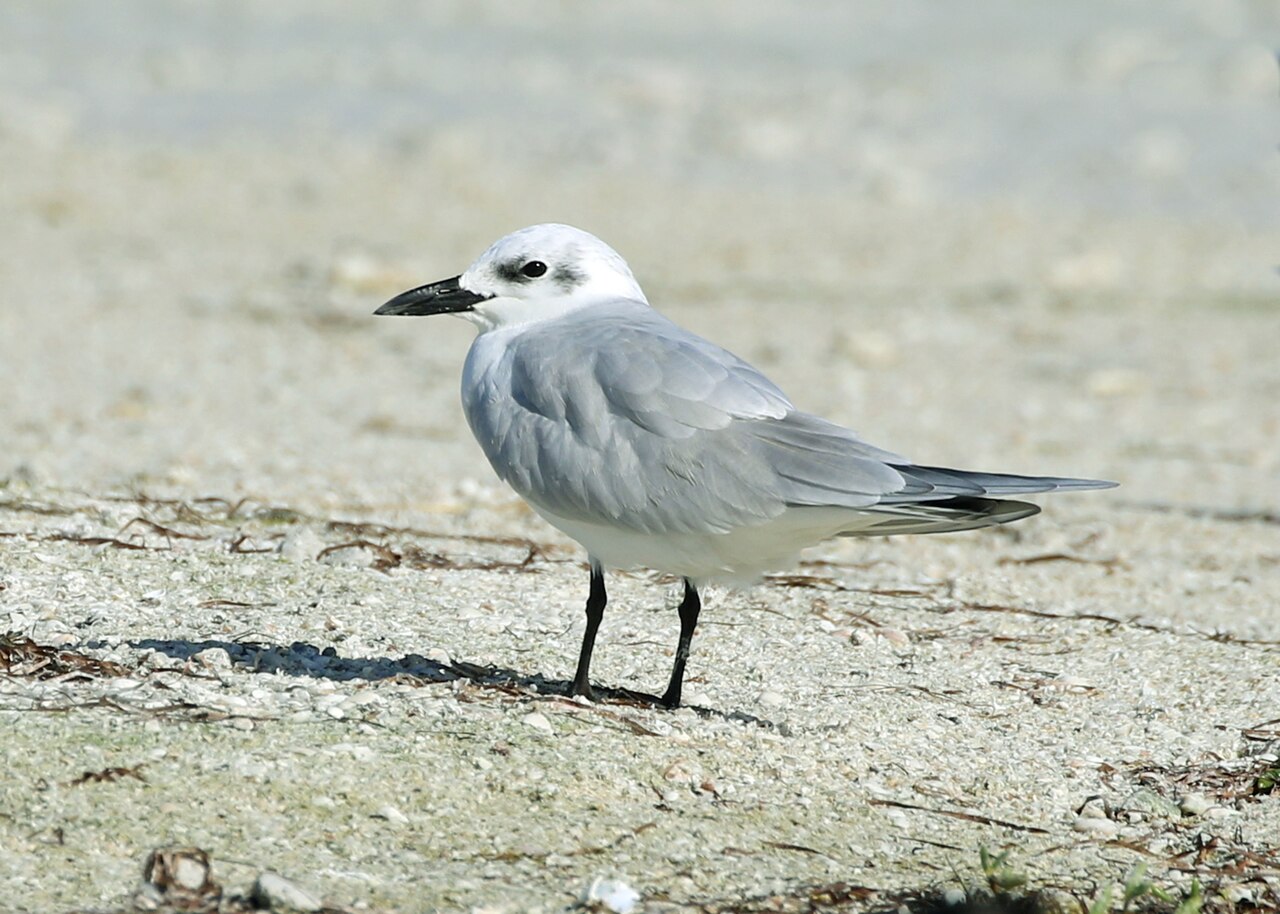
The Gull-billed Tern is the tern that does not dive: it quarters low over salt marsh and pasture and picks crabs, grasshoppers and lizards off the ground. Its short, thick, jet-black bill belongs to a gull rather than a tern, and gives it away at any distance.
Voice
The call is a rasping, two-syllable ker-wik, likened to the sound of a katydid and the source of one of its old American names. Over the colony it runs into a laughing, hoarse series, kek-kek-kek. Young birds beg with a high, insistent piping that cuts sharply through the low rasping of the adults. Away from the colony it is often silent, and then the flight is the first thing to notice.
Recording: Walter Wallner — CC BY-NC-SA 4.0 · Etoloakarnania, Western Greece, Decentralized Administration of Peloponnese, Western Greece and the Ionian, Greece · xeno-canto
Identification
A pale, solidly built tern with broad wings, a short shallowly forked tail and long black legs. The bill is short, thick and entirely black — the mark that identifies it all year round. In breeding plumage it wears a smooth black cap; in winter the head is white with only a dark smudge behind and around the eye, which gives it a bare-faced look. The upperparts are pale grey, paler than in most terns, and the wingtips stay light instead of standing out dark. At rest the wingtips project beyond the tail; in flight it looks slow and gull-like, with a characteristic swooping dip to the ground.
Confusion species
Sandwich Tern (Thalasseus sandvicensis) has a longer, thinner black bill with a yellow tip, a shaggy crest and a more deeply forked tail. Common Tern (Sterna hirundo) and Forster's Tern (Sterna forsteri) are slimmer, have an orange or red bill and longer tail streamers, and do plunge into the water. The most similar species is Forster's Tern in winter plumage, which like this bird shows a black eye patch on a white head; the thick black bill and shorter tail then settle it. Even without a good view the behaviour helps: a tern hunting low over pasture or a draining salt flat, and never diving, is almost certainly this species.
Compare terns: bill, legs, head and tail side by side
Habitat
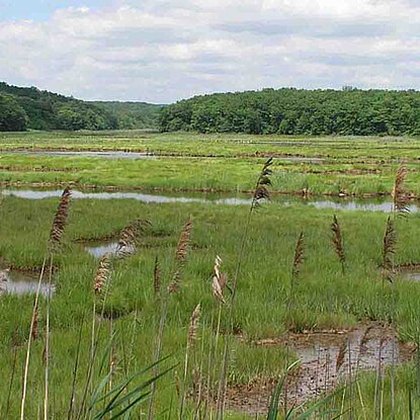
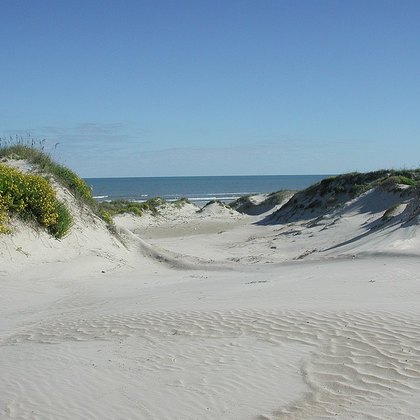
It nests on bare sand and shell: the edges of salt marsh, barrier islands, dredge-spoil ground and the dykes of salt pans, often among colonies of other terns. It hunts somewhere else entirely — over salt marsh at low tide, over pasture, arable land, drying mud and even over dry rough ground, kilometres from the nest. At the Salton Sea in California it breeds far inland, which is exceptional for the species in North America. It avoids deep water and the open sea; it needs an edge where prey walks on the ground.
Where the bird is most often found, arranged by the USNVC — the vegetation classification of the United States and Canada — and CMECS for sea and coast.


Range and movements
In North America it breeds along the Atlantic coast from Virginia southward, along the whole Gulf Coast to Texas, and on both coasts of Mexico; a separate, small population occupies southern California and Baja California, where it settled in the 1920s and reached San Diego Bay in the 1980s. In the Greater Antilles and the Bahamas it is present all year. Northern birds move in winter to Central America and the north coast of South America, while part of the Gulf Coast and Florida population stays put. The same species breeds in Europe, Africa, Asia and Australia, everywhere in small, scattered colonies.
- Resident
- Breeding (summer)
- Winter
- Passage
- dark = core range, pale = thinly spread
Where and when to look
Watch a salt marsh at low tide and judge the hunting style: a pale tern swinging low over the mud edge, dipping repeatedly without entering the water, is this one. What it takes there is mostly fiddler crabs. Inland of the coast it also pays to scan a freshly mown pasture or a ploughed field — a tern over land here is nearly always a Gull-billed.
Conservation
Worldwide it is listed as Least Concern (LC), with an estimated 190,000 birds, but in North America it is scarce: a survey in 2002 found six to eight thousand breeding birds on the whole continent. The North American trend appears stable over the long run, although the estimate is imprecise because the colonies are small and shift about. Disturbance by boats and beach recreation is the chief cause of nest failure, along with loss of salt marsh and changing water levels. Awkwardly, it takes the chicks of Least Terns and plovers itself, so that people protecting three scarce birds can find themselves working against each other.
Scientific name
Gelochelidon nilotica | (Gmelin, 1789)
Gmelin described the species in 1789 as Sterna nilotica; because it was later placed in another genus, author and year stand in parentheses. The genus Gelochelidon is formed from Greek gelan, 'to laugh', and khelidon, 'swallow' — the laughing swallow, after the same call that names it in several European languages. nilotica means 'of the Nile'. The described specimen indeed came from Egypt, where the species breeds along the river and the delta lakes.