All species › Waders, gulls and terns › Skimmers, noddies, terns and gulls › White-winged Tern
White-winged Tern | Chlidonias leucopterus
Witvleugelstern | Fumarel aliblanco
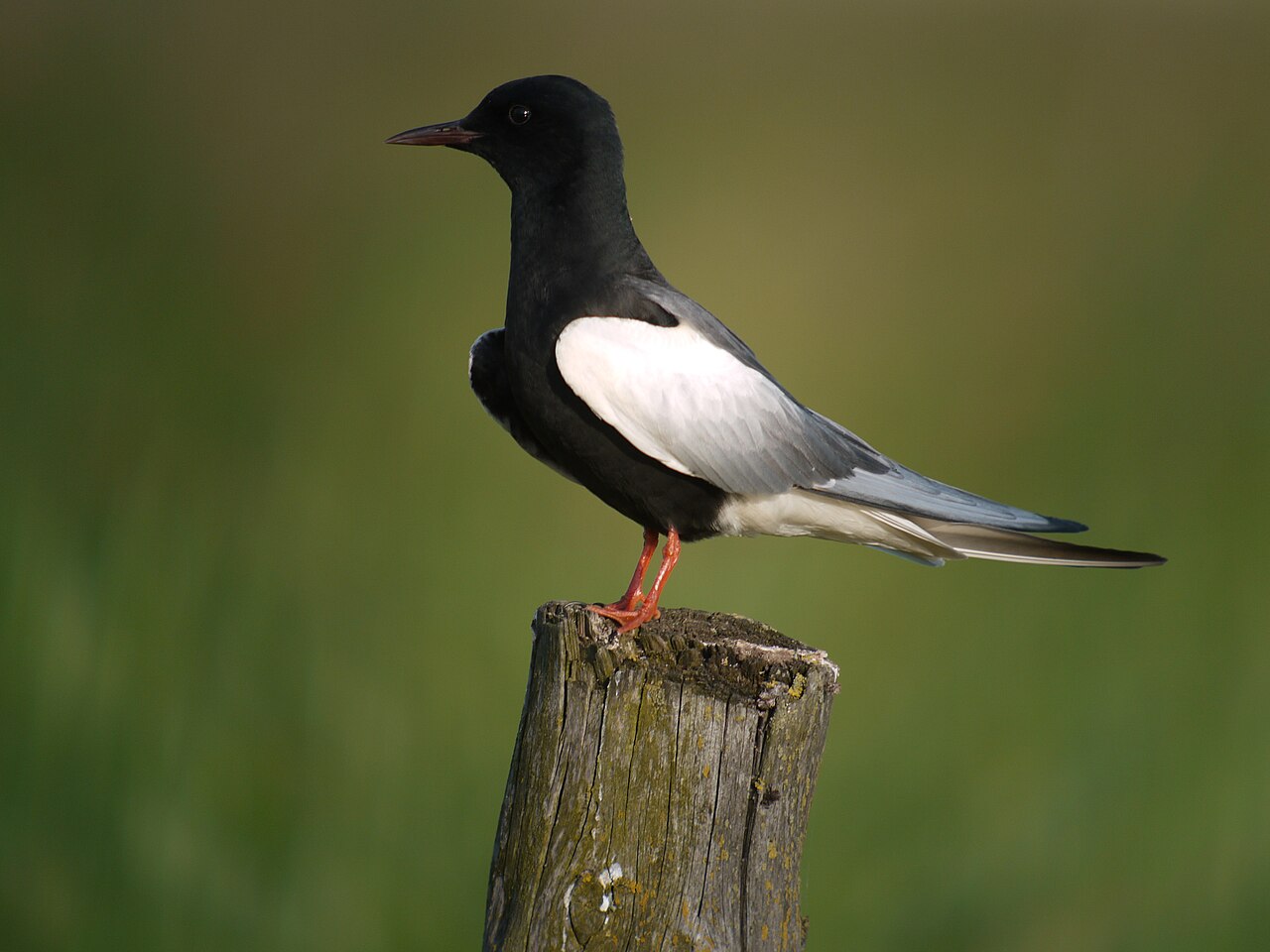
The White-winged Tern is a Eurasian marsh tern that turns up in North America only as a rare vagrant, almost always among a flock of Black Terns. In breeding plumage it is the most strongly patterned tern there is: a velvet-black body and underwing against a snow-white forewing, rump and tail.
Voice
The call is a short, harsh kresh or kreck, drier and lower than the sharp kik of the Black Tern and without the squeaky edge of the terns of open water. Over a breeding marsh in Eurasia a disturbance sets off a sustained, rattling clamour from dozens of birds at once. In alarm the call becomes a scraping kerr. A vagrant in North America is usually silent; sound is not something to count on here.
Recording: Paul Kelly — CC BY-NC-SA 4.0 · Tacumshin Lake (East End), County Wexford, Ireland · xeno-canto
Identification
In breeding plumage the head, body and underwing coverts are deep black, while the upperwing pales to white towards the leading edge and the rump and tail are white — a black-and-white contrast no other tern matches. The bill is short and dark red, blackish at a distance, the legs orange-red. In winter plumage the bird is white with pale grey upperparts; the dark ear patch then stands clear of the crown, and there is no dark mark at the side of the breast. Juveniles have a dark brown saddle that contrasts sharply with pale grey wings and a white rump. It is slightly smaller and shorter-billed than the Black Tern, with a less deeply forked tail, and its flight is lighter and more fluttering.
Confusion species
In every plumage the confusion is with the Black Tern (Chlidonias niger), the species it travels with here. The rump decides it: white and clearly paler than back and wings in the White-winged, as grey as the back in the Black Tern. In winter plumage the Black Tern also shows a dark mark at the side of the breast and a cap joined to the ear patch; in the White-winged, crown and ear patch are separate and the breast side is clean white. Whiskered Tern (Chlidonias hybrida), also a great rarity here, is larger and paler, with a longer bill and a grey rump. Distant juveniles of all three look alike; the contrast between dark saddle and pale wing is then the most usable mark.
Compare terns: bill, legs, head and tail side by side
Habitat
On its breeding grounds it is a bird of shallow freshwater marshes with floating plants, of overgrown lake margins, rice fields and flooded grassland; it nests on floating leaves and on tufts of vegetation just above the water. It does not plunge-dive but quarters low, plucking insects from the air and picking food off the surface. In North America the few birds recorded are nearly always on shallow coastal pools, in impoundments, over lagoons and along lake shores where Black Terns are staging. Deep or open water it hardly uses.
Where the bird is most often found, arranged by the USNVC — the vegetation classification of the United States and Canada — and CMECS for sea and coast.




Range and movements
It breeds from central and eastern Europe east through southern Siberia to northeastern China, and winters in Africa, southern Asia, Australia and New Zealand. In North America it is a scarce vagrant with a few dozen accepted records, by far the most on the Atlantic coast of the middle states and New England, with a handful in the Great Lakes and on the Pacific, and a number of birds in western Alaska arriving directly from Asia. Records fall mainly in late summer, when Black Terns are gathered in flocks on the coast. In Quebec one bird stayed long enough to pair with a Black Tern and nest.
Where and when to look
Do not look for it as a species but as the odd bird in a crowd: in July and August work through the flock of Black Terns at a coastal pool or impoundment one bird at a time. Watch the rump — a pale, almost white rump among grey backs is the only mark that also works on a bird flying past at a distance. Birds in moult in August are blotchy; look twice before writing one off.
Conservation
In Eurasia this is a numerous species with a large and continuous range, and the Red List lists it as Least Concern (LC). It declines locally where marshes are drained or water levels are held artificially fixed, because its floating nests cannot cope with a level that does not move with them. For North America the species carries no conservation interest of its own: every bird here is a stray, and the numbers say more about observer effort than about the state of the population.
Scientific name
Chlidonias leucopterus | (Temminck, 1815)
Temminck described the species in 1815 as Sterna leucoptera; because it was later placed in another genus, author and year stand in parentheses. The genus Chlidonias goes back to Greek khelidonios, 'swallow-like', after the light, bouncing flight of the marsh terns. leucopterus means 'white-winged' and refers to the white forewing of the bird in summer plumage. The original description gives the coasts of the Mediterranean as the source of the material, a region the species passes through on migration but where it does not breed.