All species › Waders, gulls and terns › Skimmers, noddies, terns and gulls › Black Tern
Black Tern | Chlidonias niger
Zwarte stern | Fumarel común
The Black Tern is the tern of the interior: a small, sooty black bird with grey wings that hunts over a marsh with a light, bouncing flight and picks insects off the water instead of diving. It nests on floating plant litter in prairie marshes, and it is exactly that which has cost it half its numbers in fifty years.

Voice
The call is a sharp, high kik and a slightly longer kyew, which over a colony strings together into a sustained clamour. Disturbed birds switch to a shrill, scraping kseek, dozens of them hanging over the intruder at once. On migration it is usually silent; a party moving along the coast passes without a sound. In spring the birds of a pair also exchange a soft, rapid chattering over the marsh.
Recording: Ricardo Hevia — CC BY-NC-SA 4.0 · Ortegal (near Cariño), A Coruña, Galicia, Spain · xeno-canto
Identification
In breeding plumage the head, neck and belly are black, the back and wings slate grey, and the underwing and undertail coverts pale — those pale trousers under a black bird are the most usable mark at a distance. The bill is short, thin and black, the legs dark red, the tail short and only shallowly forked. In winter plumage it is white below with a dark crown joined to the ear patch, and with a dark mark at the side of the breast that no other small tern shows in the same way. Juveniles resemble winter adults but have a brown-scaled mantle. In August, moulting birds are blotched black and white and confusing enough to be taken for something rare. The flight is light, dancing and erratic, with many short turns just above the water.
Confusion species
White-winged Tern (Chlidonias leucopterus) from Eurasia is a vagrant here and the most similar species: in every plumage it shows a pale, almost white rump against grey wings, lacks the dark mark at the side of the breast in winter, and has crown and ear patch separated. Forster's Tern (Sterna forsteri) in winter plumage is much larger and whiter, with a long forked tail and a sharply edged black eye mask, and does plunge into the water. Common Tern (Sterna hirundo) is also larger, paler above, with red or orange legs and a longer bill. When in doubt at a distance the flight decides it: the Black Tern swings and snatches above the surface, the other terns fly straight and dive.
Compare terns: bill, legs, head and tail side by side
Habitat
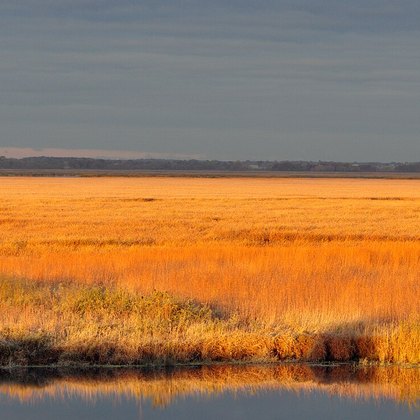
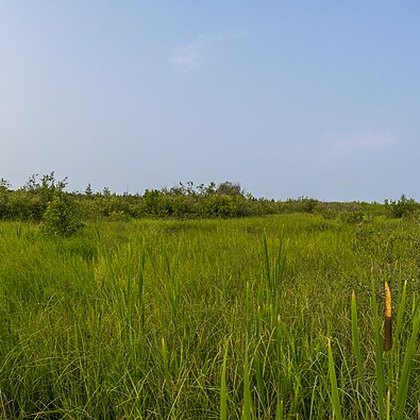
It breeds in large freshwater marshes with a mixture of reed, cattail or sedge and open water, preferring complexes of tens of hectares; the nest sits on floating plant litter, on a collapsed stand of reed or on a muskrat house. It needs a water level that moves gradually: a sudden rise washes the nests away, a drying-out puts them within reach of ground predators. Outside the breeding season it shifts entirely to salt water — coastal lagoons, estuaries and, in winter, the open ocean off the tropics. In the breeding season it eats mainly insects and small fish, in winter almost only marine fish.
Where the bird is most often found, arranged by the USNVC — the vegetation classification of the United States and Canada — and CMECS for sea and coast.



Range and movements
The North American breeders form a subspecies of their own and nest from British Columbia and the Northwest Territories across the prairie provinces and prairie states to the Great Lakes, the northeastern United States and Quebec. They leave from July onward, partly overland and partly along the coast, and winter at sea off Panama, Colombia and Suriname — beyond the area of this map. In autumn the passage runs in concentrated flocks along the Atlantic coast and across the Gulf of Mexico. The other subspecies breeds in Eurasia and winters in West Africa; the two do not meet.
- Resident
- Breeding (summer)
- Winter
- Passage
- dark = core range, pale = thinly spread
Where and when to look
In the breeding season a large marsh with open water is the place: stand on the dyke in June and wait — the birds hunt low back and forth and stay in view for hours. On migration, late July to early September is the time, and then a coastal impoundment or a pier is the best vantage point; flocks of tens to hundreds pass along the shore or rest on posts and jetties. Look through such a flock at once for a bird with a pale rump, because that is how the White-winged Tern is found here.
Conservation
The world population is put at some 850,000 birds, of which a hundred thousand to half a million are in North America; the Red List lists the species as Least Concern (LC). In North America it declined by about 1.4 per cent a year between 1966 and 2015, more than half in total, and several states and provinces now count it among their threatened breeding birds. The main cause is the loss and fixing of marshes: drainage for agriculture, water management that does not let levels move, and fewer insects because of pesticides. On top of that the birds must find their winter food far from home, where changes in marine fish stocks work through that nobody sees on the breeding grounds.
Scientific name
Chlidonias niger | (Linnaeus, 1758)
Linnaeus described the species in 1758 as Sterna nigra; because it was later placed in another genus, author and year stand in parentheses. The genus Chlidonias goes back to Greek khelidonios, 'swallow-like', after the light, bouncing flight of the marsh terns; niger is Latin for 'black'. The type locality was later restricted to the neighbourhood of Uppsala in Sweden. The North American birds are separated as Chlidonias niger surinamensis, described by Gmelin in 1789 from a specimen taken in Suriname — in the wintering area, not on the breeding grounds.