All species › Waders, gulls and terns › Skimmers, noddies, terns and gulls › Sandwich Tern
Sandwich Tern | Thalasseus sandvicensis
Grote stern | Charrán patinegro
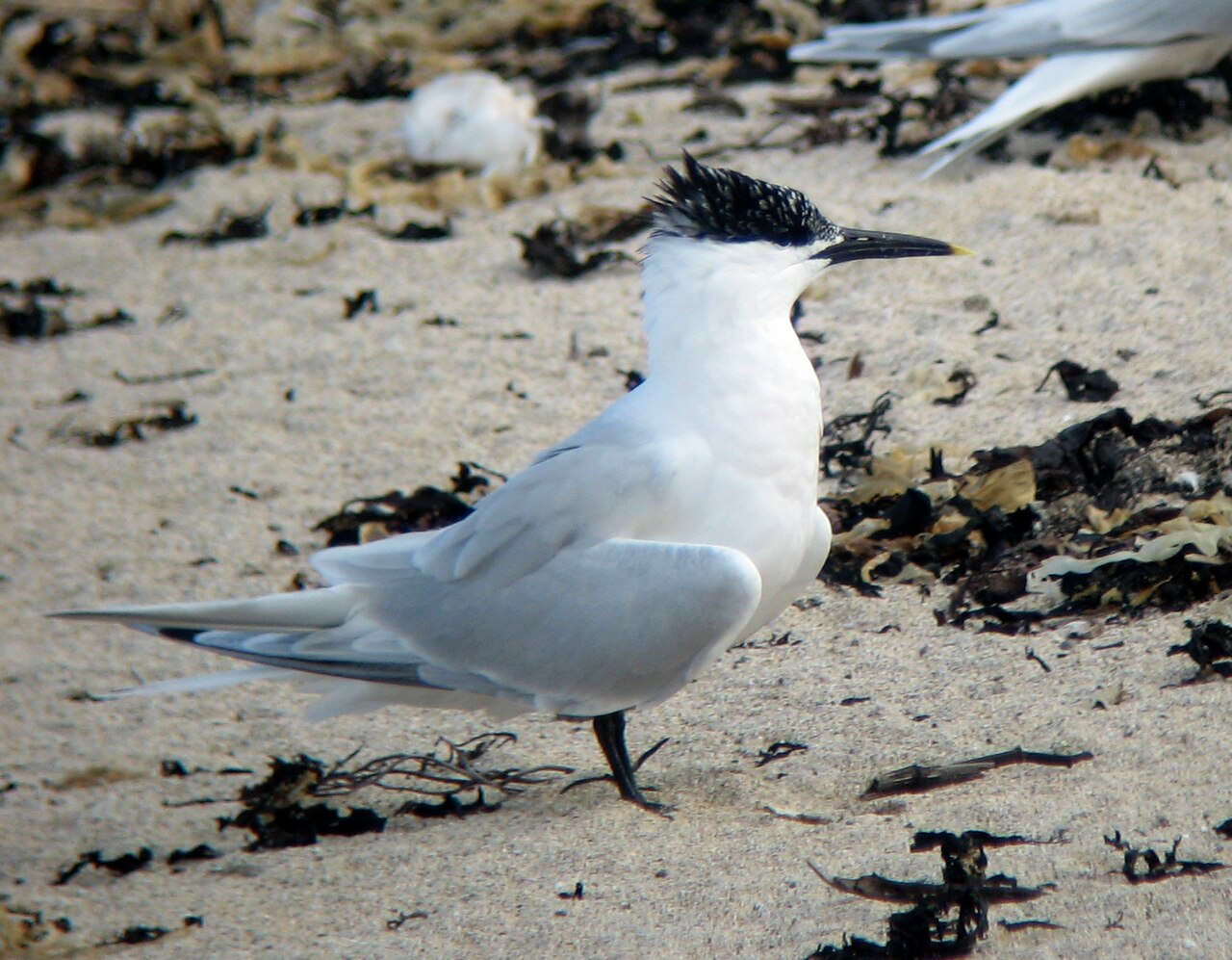
The Sandwich Tern is the black-billed crested tern of the sandbars: paper-pale, slender, with a long black bill of which only the extreme tip is yellow. On both sides of the Atlantic it breeds in dense colonies on bare sand islands; in North America from Virginia to Texas and on into the Gulf and the Caribbean.
Voice
The call is the species' trademark: a hard, grating kirrick or kerr-ink stressed on the second syllable, carrying for hundreds of metres. Over a colony dozens of these calls overlap into a shrill, unbroken din. Flying birds call almost continuously, at night as well, and chicks on the beach answer with a thinner, squeaking tsee-tsee. That one call names the bird before you see it: Royal and Elegant Terns sound lower and shorter.
Recording: Paul Kelly — CC BY-NC-SA 4.0 · Rosslare Harbour, Wexford, County Wexford, Ireland · xeno-canto
Identification
A medium-sized, slender tern with long narrow wings, a shallowly forked tail and black legs. The bill is long, thin and black with a sharply defined yellow tip that looks in the field like a drop of wax. In breeding plumage it wears a black cap drawn out behind into a ragged, upstanding crest; outside the breeding season the forehead turns white and only a black band across the hindcrown remains. Male and female are alike. Juveniles have a dark-scaled back, a dull crown and a shorter dark bill on which the yellow tip is often still missing.
Confusion species
Royal Tern (Thalasseus maximus) is markedly larger and has a heavy, straight, wholly orange bill with no yellow tip. Elegant Tern (T. elegans) of the Pacific has a longer, thinner, slightly drooping orange bill and a longer crest, and the two barely occur in the same area. Caspian Tern is larger again, with a massive blood-red bill and a dark underwing tip. On juveniles the yellow bill tip is unreliable; then go by size, by the black legs and above all by the call.
Compare terns: bill, legs, head and tail side by side
Habitat
Breeds on bare, low sand islands and shell banks along the coast, usually right among Royal Terns or Laughing Gulls whose vigilance it exploits. It forages in shallow water just off the beach, in inlets, estuaries and lagoons, and avoids the open ocean. It hardly ever goes inland, except when a hurricane puts it there. Outside the breeding season it rests on sandbars, groynes and piers, often in mixed flocks with other terns.
Where the bird is most often found, arranged by the USNVC — the vegetation classification of the United States and Canada — and CMECS for sea and coast.




Range and movements
On the American Atlantic coast it breeds from Virginia south to Florida and on along the Gulf of Mexico to Texas, with colonies in Yucatán and the Caribbean. In winter many birds stay in Florida, on the Gulf Coast and in the Antilles, while the bulk of the population shifts south to Central America and the north coast of South America. After breeding, young birds wander north along the coast to Maryland and New Jersey. The American birds form the subspecies acuflavidus, treated by some lists as a full species, but kept here within Sandwich Tern.
- Resident
- Breeding (summer)
- Winter
- Passage
- dark = core range, pale = thinly spread
Where and when to look
In summer look for it on a sandbar by an inlet, among the roosting Royal Terns: it is clearly smaller and its bill is black instead of orange. Work slowly along the line with a telescope and watch for the yellow tip — it flashes as soon as the bird turns its head. In an onshore surf it hunts just behind the breakers, and there you see the plunge-dive at close range.
Conservation
The species is listed as Least Concern (LC); the world population runs to a few hundred thousand birds; the United States holds some 94,000 breeders, with a stable to slightly increasing trend. Dense colonies make it vulnerable: one flood, one fox or one disturbance can wreck an entire island. Coastal erosion and sea-level rise are taking breeding islands away, but it settles readily on dredge-spoil islands. In northwest Europe avian influenza tore through the colonies in 2022; in North America the damage has so far been limited.
Scientific name
Thalasseus sandvicensis | (Latham, 1787)
John Latham described the species in 1787 as Sterna sandvicensis; because it was later moved to another genus, author and year stand in parentheses. The genus Thalasseus was introduced by Friedrich Boie in 1822 and comes from Greek thalassa, 'sea'. sandvicensis means 'of Sandwich': the described specimen came from Sandwich in Kent, England, the same town from which the Earls of Sandwich — and through them the sandwich — take their name. The North American birds are Thalasseus sandvicensis subsp. acuflavidus, 'with the sharp yellow tip'.