All species › Waders, gulls and terns › Skimmers, noddies, terns and gulls › Elegant Tern
Elegant Tern | Thalasseus elegans
Sierlijke stern | Charrán elegante
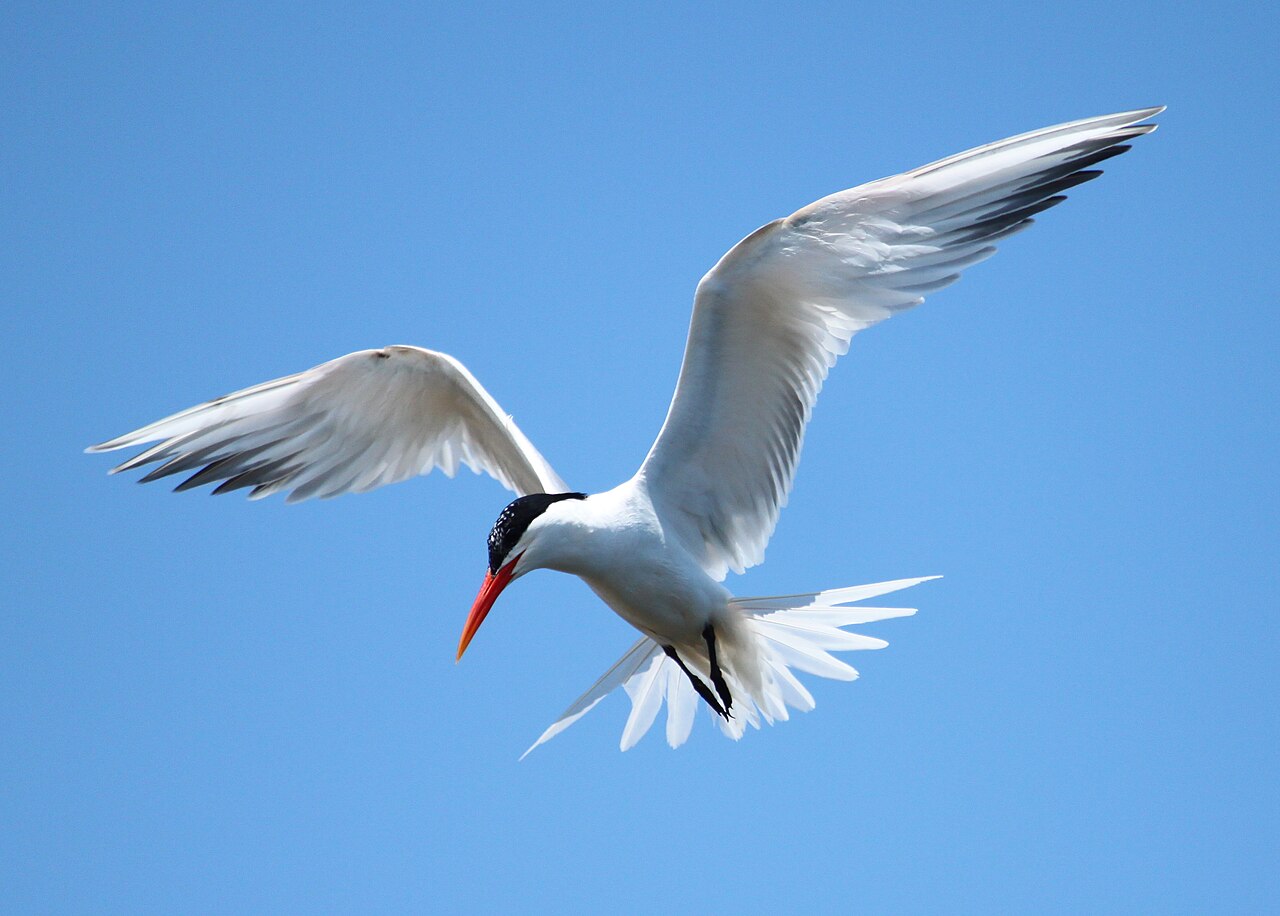
The Elegant Tern is the slenderest of the crested terns: a long, thin, slightly drooping orange bill, a streaming black crest and, in the breeding season, a breast washed with pink. Almost the entire world population breeds on a handful of islands in the Gulf of California and on a few southern Californian beaches.
Voice
A hard, grating karrik or kee-reek, higher and sharper than the Royal Tern's and with a distinct break in the middle. Over the colony on Isla Rasa the sound is a wall: tens of thousands of birds calling at once, carrying for kilometres across the water. At sea a flying bird is usually silent until it finds a shoal of anchovies, when the calling breaks out again. Chicks beg with a thin, rising cheep that the parent picks out among hundreds of others.
Recording: Paul Marvin — CC BY-NC-SA 4.0 · J Street Marina, Chula Vista, San Diego Co, California, United States · xeno-canto
Identification
A medium-sized tern with a long, thin bill that curves gently down towards the tip and is orange to orange-red. In breeding plumage the black cap runs out behind into a long, loose crest that streams back like a pennant in the wind; the underparts are white with a soft rose flush that shows only in good light. Outside the breeding season the forehead turns white, but the black still reaches around the eye, so the mask looks dark. The legs are black, the mantle pale grey, the outer primaries dark grey. Juveniles are greyer and finely scaled above, with a shorter yellow bill.
Confusion species
Royal Tern (Thalasseus maximus) is larger and heavier, with a thick straight bill of a deeper orange, and outside the breeding season shows a broad white forehead in which the black stops in front of the eye — on Elegant Tern the black reaches right around it. Sandwich Tern (T. sandvicensis) has a black bill with a yellow tip and breeds on the Atlantic side, so there is hardly any overlap. Caspian Tern is far bulkier, with a blood-red bill and dark primaries seen from below. Above all, measure the bill against the head: on Elegant Tern it is about as long as the head, on Royal Tern shorter and heavier.
Compare terns: bill, legs, head and tail side by side
Habitat
Breeds on flat, bare islands of gravel or shell, packed tightly together and often among Heermann's Gulls; on the mainland it uses dredge-spoil ground and closed-off salt pans. It forages in the coastal zone and a few kilometres offshore over shoals of anchovy and sardine, taking them by plunge-diving. It rests on sandy beaches, mudflats, rocks and harbour pilings. Fresh inland water it does not use.
Where the bird is most often found, arranged by the USNVC — the vegetation classification of the United States and Canada — and CMECS for sea and coast.




Range and movements
Breeds on Isla Rasa and Isla Montague in the Gulf of California and at a few sites in southern California, among them San Diego Bay and Bolsa Chica; in California only since 1959. After breeding, thousands of birds first move north along the Californian coast into Oregon and occasionally Washington before turning south in autumn. It winters along the Pacific coast from Central America to Peru and central Chile, far beyond the guide area. Since 1982 single birds have turned up in western Europe, where the species has bred in Spain and hybridised with Sandwich Tern.
- Resident
- Breeding (summer)
- Winter
- Passage
- dark = core range, pale = thinly spread
Where and when to look
In July and August look for it on the sandbars of the Californian river mouths, among the Royal Terns: watch for the thin, drooping bill and the long crest. In the morning the roosts usually lie on the bar on the seaward side; by midday they shift to the lagoons. If the beach stays empty, that often says more about the anchovy stocks than about the bird.
Conservation
Near Threatened (NT) on the Red List, not because numbers are low — some 90,000 breeding pairs — but because they sit in so few places that one bad year touches the whole species. Isla Rasa holds the greater part of the world population; rats and mice have been removed there successfully, but disturbance remains dangerous: in 2021 about 1,500 pairs at Bolsa Chica abandoned their nests after a drone crashed over the colony. Breeding success also tracks the anchovy: in warm El Niño years whole colonies fail.
Scientific name
Thalasseus elegans | (Gambel, 1849)
William Gambel described the species in 1849 as Sterna elegans; because it was later placed in another genus, author and year stand in parentheses. The genus Thalasseus was introduced by Friedrich Boie in 1822 and goes back to Greek thalassa, 'sea'. elegans is Latin for 'choice, elegant' — a verdict on the long bill and loose crest that the English, Dutch and Spanish names have all taken over. The described specimen came from Mazatlán in Sinaloa, on the Mexican west coast.